Is this your daily routine?
You lean on coffee to get through the day, Pour a glass of wine to wind down at night, Light up a cigarette when the stress hits, And nibble on something sweet before bed.
Well, congratulations — you’ve just recruited all four members of the Sleep-Destroying League. 😂
At Prime Lab, we call them CANS, short for Can’t Sleep.
CANS stands for: Caffeine, Alcohol, Nicotine, and Sugar.
They’re easy to access, and they do real damage.
In the global war on sleep quality, these four are world-class saboteurs. They attack the very molecular switches that govern NREM and REM sleep, creating a state of false rest.
That makes CANS the perfect entry point into the deeper conversation of sleep quality — a dimension defined not just by how long you sleep, but by your ratio of REM to NREM, and how fragmented your sleep is. And CANS messes with all of it — precisely.
Today, we’ll start with the first: Caffeine.
We’ll explore how it hijacks your deep sleep — specifically Slow-Wave Sleep (SWS) — and how to drink coffee smartly, without hurting your sleep.
Recap: Adenosine, Sleep Pressure, and Slow Waves
As discussed in earlier articles:
Our sleep is driven by two main engines:
- Circadian rhythm, controlled by melatonin and light, and
- Sleep pressure, regulated by adenosine.
Of these, sleep pressure is the key driver of NREM sleep, especially SWS.
Adenosine is the central molecule behind sleep pressure, and it builds up throughout the day as we stay awake.
To understand how caffeine hijacks this process, we need to meet the real protagonist of the night’s first half: Slow-Wave Sleep (SWS).
You might assume that deep sleep equals “rest,” where all brain activity just powers down. But that’s not quite how it works.
When we’re awake, billions of neurons are firing independently — chaotic, noisy, like a crowded schoolyard before morning assembly. EEG waves during this state look like this:

Source: Encyclopaedia Britannica — NREM sleep biology
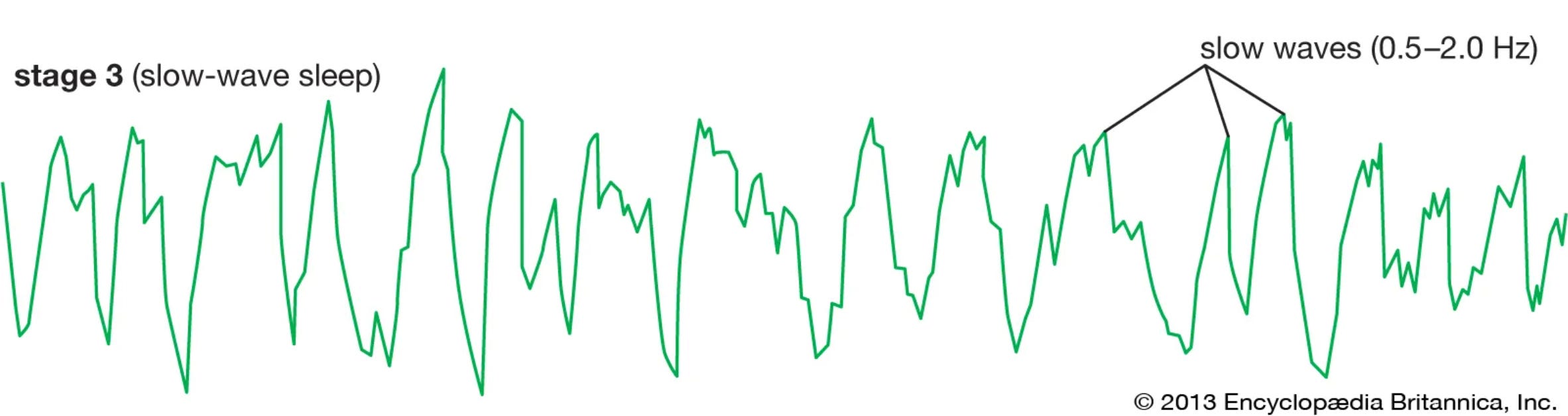
But in deep sleep, the neurons don’t “sleep.” Instead, they synchronize — firing together in slow, deep, rhythmic waves known as slow waves. It’s like the entire noisy schoolyard suddenly breaking into a calm, harmonious school anthem in perfect unison[1–6]:
Source: Encyclopaedia Britannica — NREM sleep biology
These slow waves signal synchronized firing. And they trigger some of the most critical repair work in the brain:
- Synaptic remodeling: transferring memory from the hippocampus to long-term storage in the cortex7;
- Waste clearance: glymphatic flushing of waste products like tau protein between neurons8;
- Hormonal reset: the peak release of growth hormone (GH), which coordinates tissue repair across the entire body9.
Caffeine: The Adenosine Hijacker
Here’s the key thing:
To enter synchronized slow-wave sleep, your adenosine levels must reach a threshold.
Once that threshold is crossed, adenosine binds with its receptors, increasing sleep pressure and pushing you toward deep sleep.
But if your adenosine level doesn’t hit the threshold — Either you won’t fall into deep sleep at all, Or if you do, the synchronization and intensity of the slow waves are weakened, compromising sleep quality.
The higher the adenosine concentration at sleep onset, the better the SWS quality tends to be10,11.
Now here’s where caffeine steps in.
Caffeine is a structural analog of adenosine. It looks similar enough to bind to adenosine receptors — but instead of triggering sleepiness, it blocks the signal entirely. It’s like taping over your smoke detector.
And since caffeine floods the bloodstream in higher concentrations than adenosine, it wins the competition for receptor sites, blocking the brain’s fatigue signals and preventing adenosine from crossing that critical threshold.
This binding is dynamic, not fixed. So even at night, when your body has built up plenty of adenosine, introducing caffeine can displace it — reclaiming receptor sites and suppressing sleep pressure, leaving you feeling “awake again” just when you’re supposed to be winding down12,13.
And the problem doesn’t go away quickly.
Caffeine’s half-life ranges from 2 to 10 hours, averaging 5 to 6 hours. Even a noon coffee can leave 20% or more of its caffeine still circulating in your bloodstream by bedtime14.
That’s how caffeine directly damages your deep sleep.
“But I don’t feel anything when I drink coffee…”
You might be thinking:
“I drink coffee and I sleep fine. It doesn’t really affect me.”
That’s exactly what makes this so sneaky.
Nearly every sleep scientist and neuropharmacologist agrees:
“Just because you don’t feel it, doesn’t mean your brain isn’t affected.”
Here’s why:
- Your subjective feeling is not your physiology. Just like people under sleep deprivation often report “feeling fine,” your brain may be silently compensating. You might’ve just adapted to a lower baseline without realizing it15,16.
- You’ve built a tolerance. Chronic caffeine consumption leads your brain to upregulate adenosine receptors to maintain sleep pressure. That means the same dose feels less effective over time — and your system starts relying on coffee just to function “normally”17,18. You’ve forgotten what it’s like to feel truly clear without caffeine.
- You might be a fast metabolizer. Genetically, people metabolize caffeine at different rates based on variations in the CYP1A2 gene. Here are the three genotypes[19–21]:
- AA (Fast): 2–4 hour half-life (~45% of people)
- AC (Medium): 4–6 hour half-life (~45%)
- CC (Slow): 6–10 hour half-life (~10–15%)
The half-life of a substance refers to the time it takes for the body to metabolize and eliminate 50% of it.
Studies show that individuals with the AA genotype, known as ultrarapid metabolizers, have an average caffeine half-life of approximately 2.5 hours. Compared to AA carriers, those with the C allele exhibit 30–40% lower CYP1A2 enzyme activity, resulting in a 2–3x slower clearance rate (AA > AC > CC).
The specific half-life values for each genotype presented in this article are scientific inferences made by Prime Lab, based on a synthesis of primary data and published research.
People with the AA genotype — nearly half the population — metabolize caffeine so quickly that they might not feel major effects. But that doesn’t mean there’s zero impact. Even moderate caffeine levels can still impair SWS quality by 25–35% — without any clear subjective sensation.
I, for example, am an AC type. In theory, coffee after noon should hurt my sleep. In practice, I don’t feel it. But studies show that just one afternoon coffee for someone like me can cut SWS by a third — a physiological effect I’ll never sense.
The brain protects us — often too well. Which is why we need logic, not just intuition, to determine what’s best for us.
How to Drink Coffee Wisely: Dosage + Timing
Scientific studies show that once caffeine concentration in blood reaches 1.5 µg/ml, it starts to measurably suppress slow-wave power, even if you still fall asleep normally22,23.
At this threshold, SWS is typically reduced by 15–25% — meaning your brain’s ability to restore, reset, and remap memories is that much less efficient.
At Prime Lab, we recommend keeping your caffeine level below 0.5 µg/ml at bedtime — just 1/3 of the suppression threshold.
Let’s do the math.
Assume you’re a fast metabolizer with a 3-hour half-life. You drink a Starbucks Grande Americano (473 ml, 3 shots espresso = 225 mg caffeine).
Blood caffeine spikes to ~6 µg/ml.
Now let’s track it through the half-lives:
- 1 half-life (3h): 3 µg/ml
- 2 half-lives (6h): 1.5 µg/ml
- 3 half-lives (9h): 0.75 µg/ml
- 4 half-lives (12h): 0.375 µg/ml
So to get below 0.5 µg/ml — the “safe zone” — you need at least 11–12 hours.
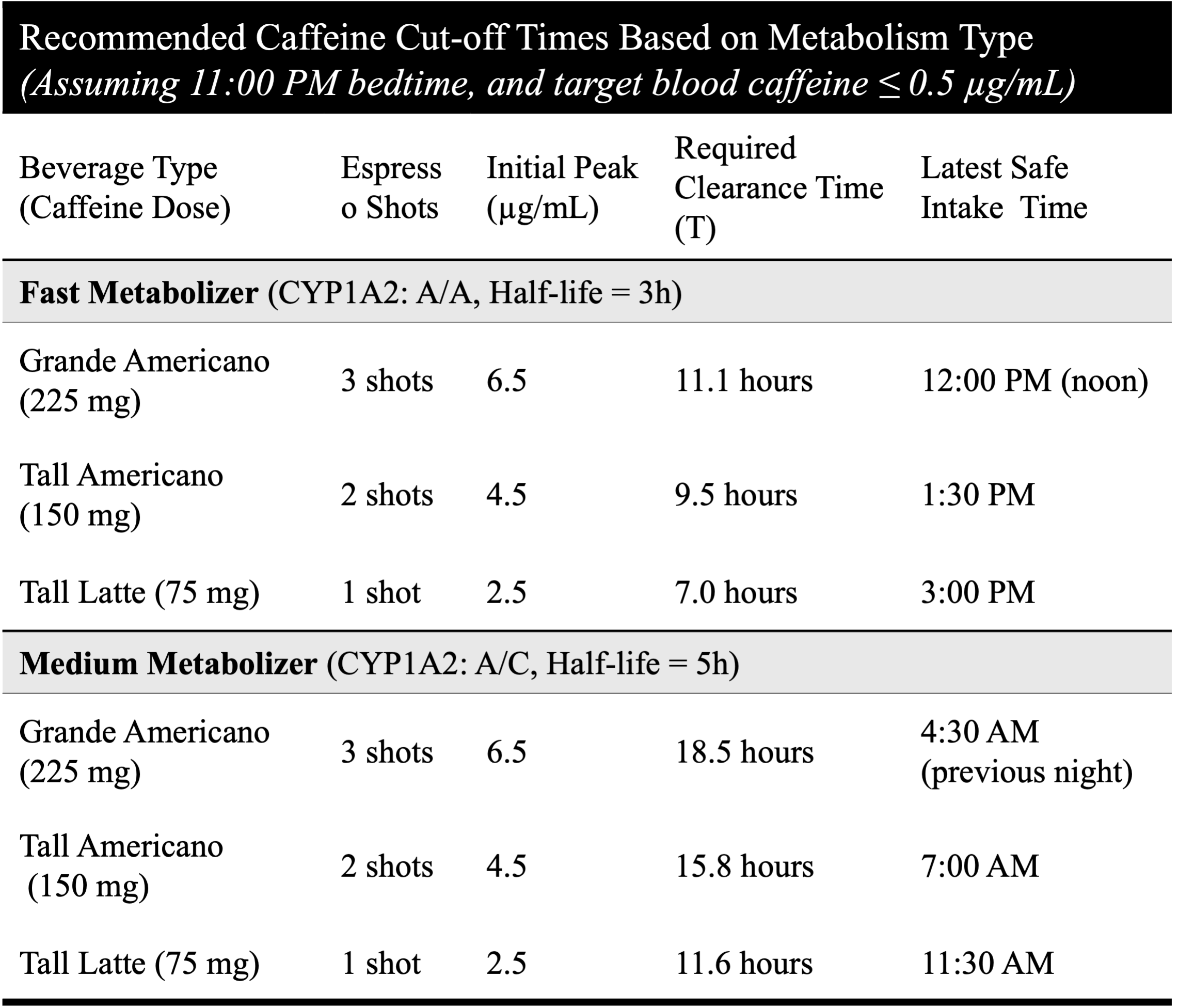
If you sleep at 11 p.m., that coffee needs to be finished before noon.
Now, if you’re a medium metabolizer, even a Tall Americano (2 shot espresso) should be your breakfast drink only — at least 16 hours before sleep.
And for slow metabolizers? Skip regular coffee altogether.
Here’s a cheat sheet from Prime Lab summarizing recommended dosages and latest timing for fast and medium metabolizers.
At Prime Lab, we have a love-hate relationship with coffee.
Yes, it’s rich in polyphenols with known long-term health benefits. But yes, it also hurts your sleep.
If you have to choose, it’s better to drink less — or better yet, switch to Decaf.
Decaf coffee retains only 2–5% of caffeine content, drastically reducing its impact on sleep. Even for medium metabolizers, one or two afternoon decaf cups are no problem. Slow metabolizers should still stick to mornings[24–26].
Final Takeaway
- It takes 3 to 4 half-lives to metabolize the caffeine from a Starbucks Grande Americano down to a level that won’t interfere with sleep.
- Even for fast metabolizers, that means about 11 hours. So if you're going to bed at 11 PM, you'd need to finish that cup by noon.
- Fast metabolizers can have a Grande Americano before noon; medium metabolizers may manage a Tall Latte before noon; slow metabolizers should avoid regular coffee altogether.
- Switching to decaf coffee, which contains 95–99% less caffeine, can significantly reduce caffeine’s impact on sleep.
- Your caffeine metabolism type can be determined through CYP1A2 gene testing: A/A indicates fast metabolism; A/C is intermediate; C/C is slow. Most people fall into the fast or intermediate categories.
So drink smart — and sleep deep.
Intervention recommendations are geared toward generally healthy individuals. If you have existing health conditions, always follow your doctor’s instructions.
References
[1]Walker, Matthew P. Why We Sleep: Unlocking the Power of Sleep and Dreams. Scribner, 2017.
[2]Torao-Angosto M, Manasanch A, Mattia M, Sanchez-Vives MV. Up and Down States During Slow Oscillations in Slow-Wave Sleep and Different Levels of Anesthesia. Front Syst Neurosci. 2021 Feb 9;15:609645.
[3]Ngo HV, Claussen JC, Born J, Mölle M. Induction of slow oscillations by rhythmic acoustic stimulation. J Sleep Res. 2013 Feb;22(1):22–31.
[4]Borbély AA (1 January 1998). “Processes underlying sleep regulation” (PDF). Hormone Research. 49 (3–4): 114–7. .
[5]Mazoyer B, Houdé O, Joliot M, Mellet E, Tzourio-Mazoyer N (September 2009). “Regional cerebral blood flow increases during wakeful rest following cognitive training”. Brain Research Bulletin. 80 (3): 133–8.
[6]Loomis AL, Harvey EN, Hobart GA (1937). “III Cerebral states during sleep, as studied by human brain potentials”. J. Exp. Psychol. 21 (2): 127–44.
[7]Rasch B, Born J. About sleep’s role in memory. Physiol Rev. 2013 Apr;93(2):681–766.
[8]Xie L, Kang H, Xu Q, Chen MJ, Liao Y, Thiyagarajan M, O’Donnell J, Christensen DJ, Nicholson C, Iliff JJ, Takano T, Deane R, Nedergaard M. Sleep drives metabolite clearance from the adult brain. Science. 2013 Oct 18;342(6156):373–7.
[9]Gronfier C, Luthringer R, Follenius M, Schaltenbrand N, Macher JP, Muzet A, Brandenberger G. A quantitative evaluation of the relationships between growth hormone secretion and delta wave electroencephalographic activity during normal sleep and after enrichment in delta waves. Sleep. 1996 Dec;19(10):817–24.
[10]Porkka-Heiskanen T, Strecker RE, Thakkar M, Bjorkum AA, Greene RW, McCarley RW. Adenosine: a mediator of the sleep-inducing effects of prolonged wakefulness. Science. 1997 May 23;276(5316):1265–8.
[11]Porkka-Heiskanen T, Alanko L, Kalinchuk A, Stenberg D. Adenosine and sleep. Sleep Med Rev. 2002 Aug;6(4):321–32.
[12]Snyder SH, Katims JJ, Annau Z, Bruns RF, Daly JW. Adenosine receptors and behavioral actions of methylxanthines. Proc Natl Acad Sci U S A. 1981 May;78(5):3260–4.
[13]Karcz-Kubicha, M., Antoniou, K., Terasmaa, A. et al. Involvement of Adenosine A1 and A2A Receptors in the Motor Effects of Caffeine after its Acute and Chronic Administration. Neuropsychopharmacol 28, 1281–1291 (2003).
[14]European Food Safety Authority (EFSA). “Scientific Opinion on the Safety of Caffeine.” EFSA Journal, vol. 13, no. 5, 2015, p. 4102.
[15]Van Dongen HP, Maislin G, Mullington JM, Dinges DF. The cumulative cost of additional wakefulness: dose-response effects on neurobehavioral functions and sleep physiology from chronic sleep restriction and total sleep deprivation. Sleep. 2003 Mar 15;26(2):117–26.
[16]Landolt HP, Dijk DJ, Gaus SE, Borbély AA. Caffeine reduces low-frequency delta activity in the human sleep EEG. Neuropsychopharmacology. 1995 May;12(3):229–38.
[17]Fredholm BB. Adenosine actions and adenosine receptors after 1 week treatment with caffeine. Acta Physiol Scand. 1982 Jun;115(2):283–6.
[18]Shi D, Daly JW. Chronic effects of xanthines on levels of central receptors in mice. Cell Mol Neurobiol. 1999 Dec;19(6):719–32.
[19]Low, J.JL., Tan, B.JW., Yi, LX. et al. Genetic susceptibility to caffeine intake and metabolism: a systematic review. J Transl Med 22, 961 (2024).
[20]Mahdavi S, Palatini P, El-Sohemy A. CYP1A2 Genetic Variation, Coffee Intake, and Kidney Dysfunction. JAMA Netw Open. 2023 Jan 3;6(1):e2247868.
[21]CYP1A2 CAFFEINE METABOLISM GENE ANALYSIS. biorixv, Analysis of the CYP1A2 caffeine metabolism gene in the student population at Lake Superior State University 4 Rebekka A Pittsley1, A, and Stephen H Kolomyjec, 2022
[22]Baur DM, Dornbierer DA, Landolt HP. Concentration-effect relationships of plasma caffeine on EEG delta power and cardiac autonomic activity during human sleep. J Sleep Res. 2024 Oct;33(5):e14140.
[23]Landolt HP, Dijk DJ, Gaus SE, Borbély AA. Caffeine reduces low-frequency delta activity in the human sleep EEG. Neuropsychopharmacology. 1995 May;12(3):229–38.
[24]Nawrot P, Jordan S, Eastwood J, Rotstein J, Hugenholtz A, Feeley M. Effects of caffeine on human health. Food Addit Contam. 2003 Jan;20(1):1–30.
[25]Poole, Rachel, et al. “Coffee Consumption and Health: Umbrella Review of Meta-Analyses of Multiple Health Outcomes.” BMJ, vol. 359, 2017, j5024.
[26]Temple JL, Bernard C, Lipshultz SE, Czachor JD, Westphal JA, Mestre MA. The Safety of Ingested Caffeine: A Comprehensive Review. Front Psychiatry. 2017 May 26;8:80.