87. The Vitamin D Dosing Debate: Finding the Sweet Spot Between the “Minimum Line” and the “Biohacker Line”

Painted by AI
You go in for a checkup, and the doctor glances at your report and says, “Your vitamin D is a little low, but it’s fine. Just get a bit more sun.”
If you were talking to a functional medicine practitioner, they might frown and say, “That level is too low. You should get it up to around 40–50.”
Then you scroll past some longevity biohacker online, and he’s taking 10,000 IU a day, keeping his blood level above 70, and saying he feels fantastic.
Same marker. Three completely different answers.
So who are you supposed to listen to?
Vitamin D may be one of the most controversial nutrients out there — because it is both a vitamin and a hormone-like molecule; because it matters not only for bone, but also for immunity, the cardiovascular system, and cognition. And on the core question — how much should you supplement? — the disagreements are real.
So today, let’s go deeper.
Clinical Medicine: The Conservative Logic of Safety
The clinical medicine recommendation looks roughly like this:
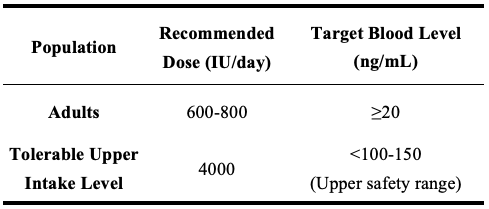
This standard comes from the 2011 report by the U.S. Institute of Medicine (IOM) 1,2. The logic is simple: as long as you can prevent deficiency diseases such as rickets and osteomalacia, that is enough. Research showed that in people whose blood vitamin D level is above 20 ng/mL, 97.5% have no problem maintaining skeletal health.
In other words, around 20 ng/mL — mission accomplished.
There is a reason clinical medicine is conservative. It deals with whole populations. It focuses on disease treatment. It cares about public-health cost-benefit at scale. Its job is to solve the “don’t get sick” problem for the overwhelming majority of people at the lowest reasonable cost.
And even with a threshold of 20 ng/mL, huge numbers of people still do not reach it. In Asia, 57.69% of people fall short of 20 ng/mL, as discussed in the previous piece.
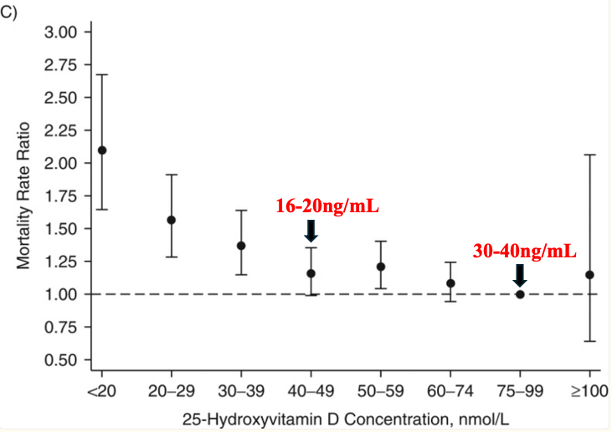
In 2017, after vitamin D data from the third U.S. National Health and Nutrition Examination Survey (NHANES III) were internationally standardized, the results showed that when 25(OH)D fell below 16–20 ng/mL, all-cause mortality rose significantly; between 20 and 40 ng/mL, the curve entered a plateau; and above 40 ng/mL, there were too few real-world samples and too much variance for the conclusions to be reliable (Upper figure) 12.
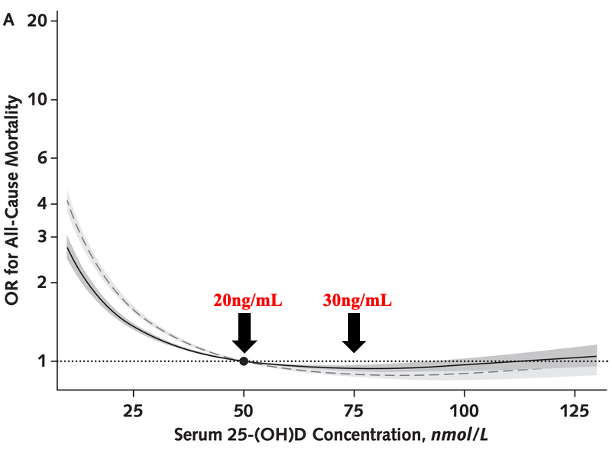
In 2022, a UK Biobank study of more than 300,000 people showed the same basic pattern: mortality risk mainly declined at the low end, then plateaued after 20–30 ng/mL, with no significant change beyond that (Bottom figure) 35.
Put those two studies together, and the signal is consistent: all-cause mortality is lowest around 20–40 ng/mL, but the real bulk of the benefit comes from climbing out of deficiency into sufficiency. Below 20 ng/mL, mortality risk can rise several-fold; once you are above 20 ng/mL, the marginal gain from pushing the number higher — if all-cause mortality is your yardstick — becomes quite small.
That explains the deep logic behind the clinical stance that “20 is enough”: high return on investment, high safety, and fully aligned with the principle of First, do no harm. Medicine has seen too many interventions that looked beneficial at first and later failed under large RCTs — hormone replacement therapy, antioxidant supplementation, low-fat diets. Until high-quality evidence shows that higher doses are truly better, the medical establishment is not going to move quickly.
But there is an important premise here: all-cause mortality is a blunt instrument. It is noisy, heavily confounded, and answers the question, “How do I avoid dying?” — not “How do I function better?” If your goals include optimizing immunity, lowering inflammation, or slowing aging, that is no longer a question clinical medicine is designed to answer.
At the same time, rigorous clinical research has also shown that the true toxic dose of vitamin D is actually quite high. Problems such as hypercalcemia and kidney injury usually appear only at blood concentrations above 150 ng/mL, and most cases involve extreme doses — more than 40,000 IU per day 11.
And because there is relatively little high-quality research on the range above 40 ng/mL, while clearly harmful blood levels are not seen until around 150 ng/mL, that leaves a broad “safety space” between 40 and 150 — and that is exactly where functional medicine and biohackers like to operate.
Functional Medicine: The Optimization Lens of Evolutionary Medicine
A functional medicine practitioner may look at the same data and arrive at a different conclusion.
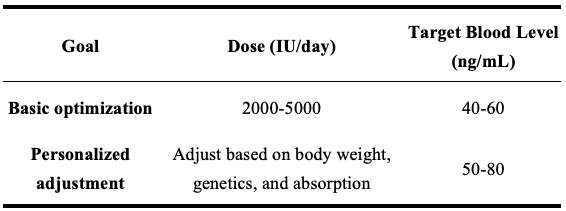
Their recommendation might look more like this (views vary from doctor to doctor):
Clinical medicine asks: What level prevents deficiency?
Functional medicine asks: At what level does the human organism function best?
Precisely because the studies above show that all-cause mortality does not rise meaningfully once 25(OH)D exceeds 40 ng/mL 12,35, the safety boundary appears relatively wide. That gives the functional medicine camp confidence: if higher levels do not show an obvious downside — at least for now — why not explore whether there may be additional benefits above the plateau?
One of their theoretical foundations is evolutionary medicine. Studies of traditionally living East African populations — such as the Maasai and the Hadza — show that their blood vitamin D levels are often in the 40–60 ng/mL range 4. They live with daily sun exposure, no sunscreen, no indoor office life. That, from an evolutionary perspective, is the “normal” state humans were designed for. By contrast, a modern average of 10–20 ng/mL may be the truly abnormal state.
Another foundation is vitamin D’s biological role. It is not merely a “vitamin.” It behaves more like a hormone, regulating the expression of many genes 5,6, with effects on immune regulation, cell differentiation, and inflammatory control. If you want those functions to operate at full capacity, 20 ng/mL may be far from sufficient. Mechanistically, that argument is not unreasonable.
On dosing, functional medicine often uses a rule of thumb: for every additional 100 IU, blood vitamin D rises by about 1 ng/mL; so 1000 IU raises it by around 10. Given that the upper safety boundary is somewhere around 100–150 ng/mL, the functional medicine position is that aiming for a blood level in the 40–80 range probably does not carry much downside for most people.
Functional medicine also emphasizes personalization. Vitamin D is fat-soluble and gets stored in adipose tissue. People with obesity (BMI >30) may need 2–3 times the dose of someone at normal weight to reach the same blood level 7,8. They reject one-size-fits-all dosing and prefer to adjust based on lab testing — which, to be fair, is a very good insight.
The table below shows the vitamin D blood ranges supported by different experts within the functional medicine world:
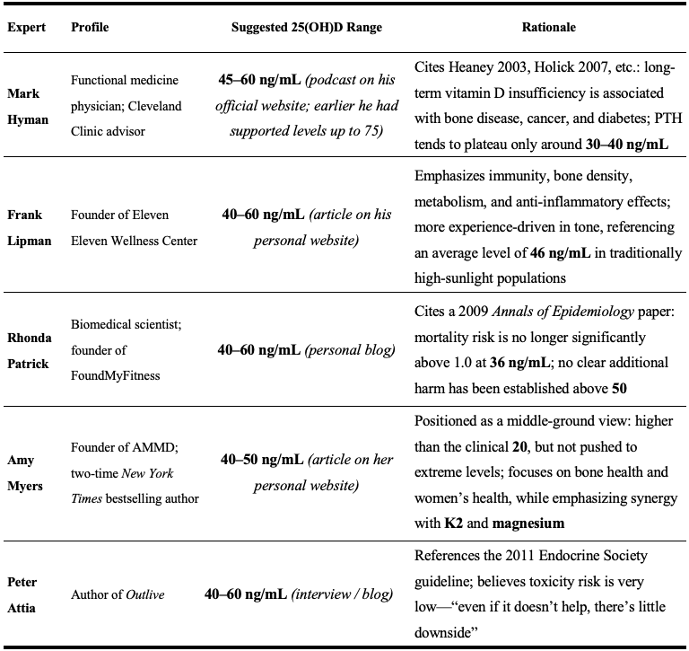
But the pushback is also clear: evolutionary optimal does not automatically equal modern optimal. The Maasai do not live like we do. Their diet, disease profile, and overall environment are entirely different. They may have had little cardiovascular disease — but their average lifespan was not especially long either, often dying before the age when modern people typically develop cardio-cerebrovascular disease. So direct comparison may be misleading.
And beyond that, much of functional medicine’s advice rests on observational research and clinical experience, not large randomized controlled trials.
The 2018 VITAL trial — more than 20,000 participants, followed for 5 years — found that supplementing 2000 IU of vitamin D daily had no significant effect on cardiovascular events or cancer incidence 10. It remains one of the largest vitamin D RCTs to date, and its findings were, if anything, disappointing for the functional medicine narrative.
So if I had to summarize functional medicine’s stance on vitamin D, I would put it like this:
Even if it turns out not to help much, it probably does not hurt — but exactly how much it helps is still uncertain.
That starts to drift into a slightly mystical zone.
Biohackers: Data-Driven, Edge-Seeking Experimentation
If functional medicine is the camp of gentle optimization, then biohackers are the camp of aggressive experimentation.
Dave Asprey, founder of Bulletproof Coffee, has said he has used doses as high as 5,000–10,000 IU, maintaining blood levels in the 70–90 ng/mL range. He treats vitamin D as part of a broader “hormone optimization” strategy, alongside testosterone, thyroid hormones, and cortisol 29,30.
Ben Greenfield, author of Boundless, has publicly said that he has long taken about 5000 IU of vitamin D daily, with quarterly 25(OH)D testing. He sets his personal target range at 40–80 ng/mL, and for people with autoimmune conditions has mentioned a range closer to 50–80 ng/mL [26–28].
Bryan Johnson, founder of Blueprint, raised his dose to 5000 IU/day in 2025, but after his blood vitamin D rose as high as 134 ng/mL — during a course of hyperbaric oxygen therapy — he reduced it back to 2000 IU/day [36–38].
Bryan Johnson is actually a good example here: to catch the potential risks of higher-dose supplementation early, biohackers tend to run bloodwork much more frequently — sometimes monthly. They do not just track vitamin D levels. They often monitor calcium, PTH, vitamin K2, magnesium, and more. If something starts to look off, they adjust immediately.
Bold hypotheses. Aggressive self-experimentation. High-frequency testing. Long-term N=1 trials. Get the possible upside earlier than everyone else — and carry the risk alone. That is the biohacker way.
It is not a fully scientific methodology in the classical sense, but it is hard not to respect the courage and the execution.
In the specific case of vitamin D, the biohacker hypothesis is basically this: if observational studies suggest that higher levels are associated with lower all-cause mortality, lower cardiovascular risk, and lower infection risk, why not try it?
But that remains just that — a hypothesis.
No one has high-quality evidence proving that higher is always better. And for ordinary people without a private medical team, without frequent blood testing, and without the time or discipline to constantly adjust, this path is simply not appropriate.
The Real Source of the Disagreement: Different Goals, Different Evidence Standards, Different Medical Resources
Put the three camps side by side:
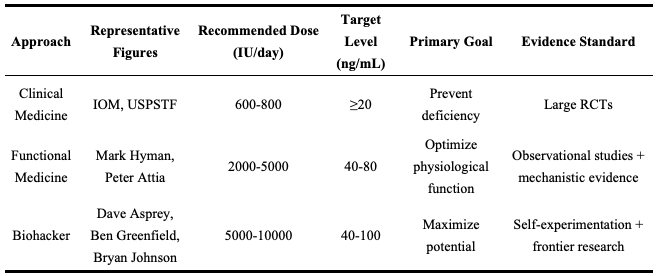
Clinical medicine’s conservatism makes sense—Public-health recommendations have to be extraordinarily safe, and cost matters. Its goal is to avoid disease, not necessarily to help you live at your absolute best.
Functional medicine’s logic of optimization also makes sense—Vitamin D’s potential benefits do seem to extend well beyond bone health. But the quality of the evidence is mixed, and many of its recommendations are experience-driven. Still, if the dose is safe, why not at least explore the possibility?
The biohackers’ spirit of exploration deserves respect — but it is less a scientific doctrine than a coherent personal choice.
So for Prime Lifers who actually want to optimize themselves, how should we choose?
Prime Lab’s Practical Recommendation: Gentle Optimization, Guided by Data
Our position is simple: optimize within the bounds of safety, and avoid extremes 18,19.
Safety comes first. Then we acknowledge that vitamin D likely offers broader health benefits than the clinical minimum captures.
Target blood level
Recommended range: 30–50 ng/mL
- Below 20 ng/mL: clear deficiency, needs correction
- 20–30 ng/mL: clinically “sufficient,” but may not be optimal
- 30–50 ng/mL: functional optimization zone, low risk, potentially high upside
- 60–80 ng/mL: controversial range, unclear benefit, requires close monitoring
- Above 100 ng/mL: approaching the risk zone, not recommended
Why choose 30–50? It is based on [31–34]:
- Observed “best optimization range” in observational studies (corresponding to the lowest all-cause mortality)
- Signals from evolutionary medicine about a more “natural” state
- Clinical experience from functional medicine
- Supportive safety data
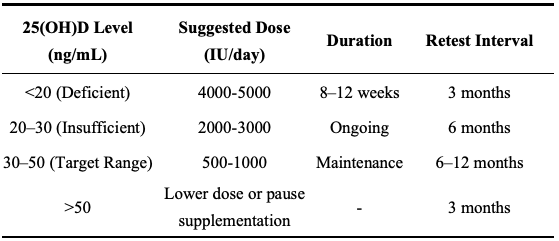
Supplementation dose
Individual factors that modify dose
- Body weight: people with obesity may need a higher dose
- Age: after age 70, skin synthesis capacity declines significantly 13, so supplementation needs may rise
- Season: in northern regions during winter, UVB is lower, so more supplementation may be needed
- Skin tone: people with darker skin typically synthesize vitamin D less efficiently because higher melanin reduces UVB penetration, so they need more sun exposure time 20,21
That said, we generally do not recommend relying on ultraviolet exposure to obtain vitamin D. So the more important thing is to establish your own baseline with a blood test, then supplement according to the table above.
Choosing a formulation
- Daily dosing provides more stable blood levels
- Choose a fat-soluble formulation, and take it with meals (vitamin D itself is fat-soluble, so absorption is better)
- Choose D3 (cholecalciferol) rather than D2, because it works better and lasts longer 14
Monitoring strategy
Basic monitoring:
- 25(OH)D: test every 3–6 months
Additional monitoring for high-dose users:
- Serum calcium: test alongside each check
- 24-hour urinary calcium (once a year): >250 mg/24h for women or >300 mg/24h for men suggests excessive calcium absorption and higher kidney stone risk
- Kidney function: hypercalcemia can damage the kidneys
- PTH (parathyroid hormone): a more sensitive functional marker
When vitamin D is insufficient, PTH rises compensatorily to maintain blood calcium. If your 25(OH)D has reached 40 ng/mL but your PTH is still elevated, that may indicate vitamin D resistance or another disorder of calcium metabolism 1.
Optional companion nutrients
Vitamin K2 helps activate matrix Gla protein (MGP), which helps prevent vascular calcification; it also activates osteocalcin, promoting calcium deposition into bone rather than blood vessels.
The Rotterdam Study found that higher K2 intake was associated with less coronary artery calcification. That is why K2 is often viewed as a worthwhile supportive factor 15,23,24.
Magnesium is an essential cofactor in vitamin D metabolism and also helps regulate PTH secretion. Research shows that magnesium participates in the activation and metabolism of vitamin D, and that magnesium insufficiency may impair the whole process 22. About 50% of the U.S. population does not get enough magnesium 17, which may be one hidden reason many people feel that they “supplemented but got no result.” We talked earlier about magnesium’s role in sleep, and it is worth connecting the dots.
That said, this kind of “synergy” makes sense mostly at the mechanistic level. We have not found full-text research clearly demonstrating the real-world size of the effect or the magnitude of the benefit. So these pairings are not essential.
Vitamin K2 and magnesium are both common supplements with generally good safety profiles. Whether to take them together is entirely a personal choice.
Intervention recommendations are geared toward generally healthy individuals. If you have existing health conditions, always follow your doctor’s instructions.
References
[1]Ross AC, Manson JE, Abrams SA, et al. The 2011 Report on Dietary Reference Intakes for Calcium and Vitamin D from the Institute of Medicine: What Clinicians Need to Know. J Clin Endocrinol Metab. 2011 Jan;96(1):53–58.
[2]Institute of Medicine (US) Committee to Review Dietary Reference Intakes for Vitamin D and Calcium. Dietary Reference Intakes for Calcium and Vitamin D. National Academies Press. 2011.
[3]US Preventive Services Task Force. Screening for Vitamin D Deficiency in Adults: US Preventive Services Task Force Recommendation Statement. JAMA. 2021 Apr;325(14):1436–1442.
[4]Luxwolda MF, Kuipers RS, Kema IP, et al. Traditionally living populations in East Africa have a mean serum 25-hydroxyvitamin D concentration of 115 nmol/L. Br J Nutr. 2012 Nov;108(9):1557–1561.
[5]Carlberg C, Seuter S. A genomic perspective on vitamin D signaling. Anticancer Res. 2009 Sep;29(9):3485–3493.
[6]Haussler MR, Whitfield GK, Kaneko I, et al. Molecular mechanisms of vitamin D action. Calcif Tissue Int. 2013 Feb;92(2):77–98.
[7]Ekwaru JP, Zwicker JD, Holick MF, et al. The Importance of Body Weight for the Dose Response Relationship of Oral Vitamin D Supplementation and Serum 25-Hydroxyvitamin D in Healthy Volunteers. PLoS One. 2014 Nov;9(11):e111265.
[8]Drincic AT, Armas LA, Van Diest EE, Heaney RP. Volumetric dilution, rather than sequestration best explains the low vitamin D status of obesity. Obesity (Silver Spring). 2012 Jul;20(7):1444–1448.
[9]Wang TJ, Zhang F, Richards JB, et al. Common genetic determinants of vitamin D insufficiency: a genome-wide association study. Lancet. 2010 Jul;376(9736):180–188.
[10]Manson JE, Cook NR, Lee IM, et al. Vitamin D Supplements and Prevention of Cancer and Cardiovascular Disease. N Engl J Med. 2019 Jan;380(1):33–44.
[11]Vieth R. Vitamin D toxicity, policy, and science. J Bone Miner Res. 2007 Dec;22(S2):V64-V68.
[12]Durazo-Arvizu RA, et al. The Reverse J-Shaped Association Between Serum Total 25-Hydroxyvitamin D Concentration and All-Cause Mortality: The Impact of Assay Standardization. Am J Epidemiol. 2017 Apr 15;185(8):720–726.
[13]MacLaughlin J, Holick MF. Aging decreases the capacity of human skin to produce vitamin D3. J Clin Invest. 1985 Oct;76(4):1536–1538.
[14]Tripkovic L, Lambert H, Hart K, et al. Comparison of vitamin D2 and vitamin D3 supplementation in raising serum 25-hydroxyvitamin D status: a systematic review and meta-analysis. Am J Clin Nutr. 2012 Jun;95(6):1357–1364.
[15]Geleijnse JM, Vermeer C, Grobbee DE, et al. Dietary intake of menaquinone is associated with a reduced risk of coronary heart disease: the Rotterdam Study. J Nutr. 2004 Nov;134(11):3100–3105.
[16]Deng X, Song Y, Manson JE, et al. Magnesium, vitamin D status and mortality: results from US National Health and Nutrition Examination Survey (NHANES) 2001 to 2006 and NHANES III. BMC Med. 2013 Aug;11:187.
[17]Rosanoff A, Weaver CM, Rude RK. Suboptimal magnesium status in the United States: are the health consequences underestimated? Nutr Rev. 2012 Mar;70(3):153–164.
[18] Demay MB, Pittas AG, Bikle DD, et al. Vitamin D for the Prevention of Disease: An Endocrine Society Clinical Practice Guideline. J Clin Endocrinol Metab. 2024 Aug;109(8):1907–1947.
[19] Durazo-Arvizu RA, Dawson-Hughes B, Kramer H, et al. The Reverse J-Shaped Association Between Serum Total 25-Hydroxyvitamin D and All-Cause Mortality: The Impact of Assay Standardization. Am J Epidemiol. 2017 Apr 15;185(8):720–726.
[20] Webb AR, Kazantzidis A, Kift RC, et al. Colour Counts: Sunlight and Skin Type as Drivers of Vitamin D Deficiency at UK Latitudes. Nutrients. 2018 Apr 7;10(4):457.
[21] Young AR, Morgan KA, Ho TW, et al. Melanin has a Small Inhibitory Effect on Cutaneous Vitamin D Synthesis: A Comparison of Extreme Phenotypes. J Invest Dermatol. 2020 Jul;140(7):1418–1426.e1.
[22] Dai Q, Zhu X, Manson JE, et al. Magnesium status and supplementation influence vitamin D status and metabolism: results from a randomized trial. Am J Clin Nutr. 2018 Dec 1;108(6):1249–1258.
[23] Li T, Wang Y, Tu WP. Vitamin K supplementation and vascular calcification: a systematic review and meta-analysis of randomized controlled trials. Front Nutr. 2023 May 12;10:1115069.
[24] Hasific S, Øvrehus KA, Lindholt JS, et al. Effects of Vitamin K2 and D Supplementation on Coronary Artery Disease in Men: A RCT. JACC Adv. 2023 Nov 24;2(9):100643.
[25] Sanders KM, Stuart AL, Williamson EJ, et al. Annual High-Dose Oral Vitamin D and Falls and Fractures in Older Women: A Randomized Controlled Trial. JAMA. 2010 May 12;303(18):1815–1822.
[26] Greenfield B. Start Here — Who Is Ben Greenfield? Ben Greenfield Life.
[27] Greenfield B. Episode #425 — Full Transcript. Ben Greenfield Life.
[28] Greenfield B. Episode #421 — Full Transcript. Ben Greenfield Life.
[29]Dave Asprey. These 3 Lab Tests Will Help You Live Longer — “You want them to be 60–70 ng/mL.”
[30]Dave Asprey. Brain Food: 5 Nutrients that Upgrade Your Mind — “Vitamin D dose: 5,000–10,000 IU daily.”
[31] Heath AK, Kim IY, Hodge AM, English DR, Muller DC. Vitamin D Status and Mortality: A Systematic Review of Observational Studies. Int J Environ Res Public Health. 2019 Jan 30;16(3):383.
[32] Schöttker B, Ball D, Gellert C, Brenner H. Serum 25-hydroxyvitamin D levels and overall mortality. A systematic review and meta-analysis of prospective cohort studies. Ageing Res Rev. 2013 Mar;12(2):708–18.
[33] Garland CF, Kim JJ, Mohr SB, Gorham ED, Grant WB, Giovannucci EL, et al. Meta-analysis of all-cause mortality according to serum 25-hydroxyvitamin D. Am J Public Health. 2014 Aug;104(8):e43-e50.
[34] Durazo-Arvizu RA, Dawson-Hughes B, Kramer H, Cao G, Merkel J, Coates P, et al. The Reverse J-Shaped Association Between Serum Total 25-Hydroxyvitamin D and All-Cause Mortality: The Impact of Assay Standardization. Am J Epidemiol. 2017 Apr 15;185(8):720–726.
[35]Sutherland JP, et al. Vitamin D Deficiency Increases Mortality Risk in the UK Biobank : A Nonlinear Mendelian Randomization Study. Ann Intern Med. 2022 Nov;175(11):1552–1559.
[36]Bryan Johnson. News / Blueprint — “I take 2,000 IU daily.”
[37]Bryan Johnson. Bryan Johnson’s Protocol — “vitamin D (2000 IU per day).”
[38]Bryan Johnson. X post — “My Vit D has been stable for years ~40 ng/mL and then spiked to 134 ng/mL…”