We’ve previously examined caffeine’s impact on sleep in depth. Yet coffee remains one of the most ubiquitous beverages in modern life, and for many, complete abstinence simply isn’t realistic. So the practical question becomes: how should we choose coffee — and how should we drink it — in daily life?
This article aims to offer a comprehensive, no-nonsense answer.
There’s another reason this matters. **Strip away caffeine’s sleep-disrupting effects, and coffee itself is a longevity-positive drink. **The same applies to green tea and many traditional Chinese teas. Coffee is rich in bioactive compounds — especially polyphenols such as chlorogenic acids — which exert anti-inflammatory effects, support metabolic regulation, and modulate the gut microbiome. Lighter roast profiles preserve more of these compounds (we’ll unpack polyphenol mechanisms separately).
If a beverage people genuinely enjoy also confers long-term health benefits, that’s close to ideal. This is precisely why we decided to take a deeper look at decaffeinated coffee — not as a compromise, but as a strategic option.
I. Experimental Design and Overview
Building on recent sleep research, Prime Lab reviewed mainstream industrial decaffeination technologies and conducted cross-comparisons of caffeine content in commonly available coffee products. Our goal was straightforward: develop a science-based caffeine timing strategy that minimizes sleep disruption.
Standardized protocol:
- Coffee:1:18 coffee-to-water ratio, brewed with 95°C water, yielding 473 mL as one standard serving. Tea (green, black, oolong, Pu-erh):5 g dry leaves brewed with 100°C water for 10 minutes, yielding 500 mL as one standard serving. Caffeine content was measured per standard serving.
- Calculations assumed a fast-metabolizer genotype with a 3-hour caffeine half-life. To avoid sleep disruption at 23:00,blood caffeine concentration should be ≤ 0.5 μg/mL.A 225 mg caffeine dose produces approximately 6 μg/mL blood concentration. Using these parameters, we derived recommended latest consumption times for one or two standard servings per day.
Summary of experimental results:
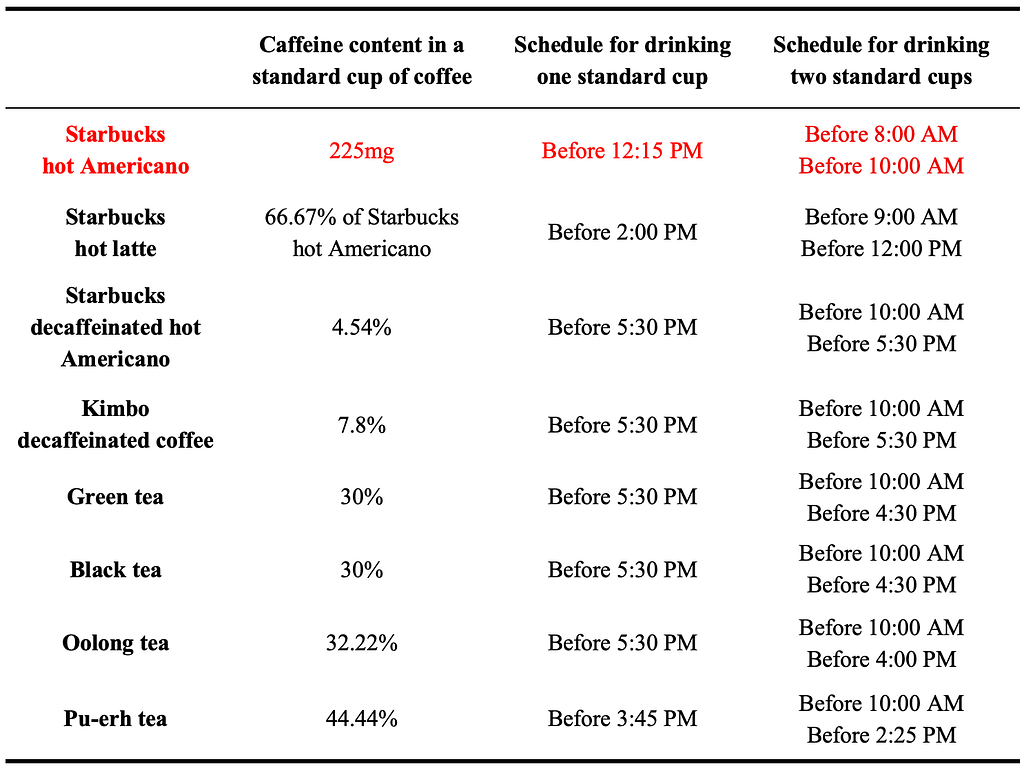
- The caffeine content of various drinks is measured relative tothe baseline of a regular hot Americano from Starbucks. For example, the absolute caffeine content of a Starbucks hot latte is 150 mg, which is 66.67% of a regular hot Americano.
- For the two decaffeinated coffees,due to their minimal effect on blood caffeine levels (less than 0.5 µg/mL), they theoretically won’t affect sleep if consumed at night. However, considering individual differences and typical consumption habits, it is recommended that the latest time to drink one cup isbefore 17:30 in the evening, ideally around dinner time. For green tea, black tea, and oolong tea, after calculations, it is concluded that the latest time to drink a standard cup is alsobefore 17:30 in the evening.
- The last column in the table indicates the suggested drinking times for each cup when consuming two standard cups of coffee/tea in a day. For example, the first cup of Starbucks hot Americano should be consumed at 8:00 AM, and the second cup should be consumed before 10:00 AM.
II. Decaffeination Methods
Three industrial methods dominate modern decaffeination: solvent-based processing, water processing, and supercritical CO₂ extraction.
Evaluating across three dimensions — caffeine removal efficiency, flavor preservation, and safety — Prime Lab’s position is clear: when options are available, water processing and supercritical CO₂ methods are preferable.
Removal efficiency: All three methods achieve 95%–99.9% caffeine removal. Some supercritical CO₂ systems exceed 99.9%.
Flavor retention: The key issue is whether water-soluble flavor compounds are stripped along with caffeine. Water-based systems recycle green coffee extract to preserve origin-specific flavor characteristics. Indirect solvent methods treat the extract rather than washing beans directly, reducing flavor loss. Supercritical CO₂ is theoretically more selective for caffeine, preserving aroma — though it requires higher equipment investment.
Safety considerations: In solvent methods, debate centers on methylene chloride (dichloromethane), classified by IARC as Group 2A (probable carcinogen). Regulatory limits in food applications are strict (U.S. regulations cap residues at 10 ppm in roasted and instant decaf coffee).** Under compliant manufacturing, high-dose exposure is unlikely**. Nevertheless, water and supercritical CO₂ processes avoid organic solvent residue concerns altogether.
III. What Methods Do Major Brands Use?
Starbucks:
- The official website discloses that the decaffeination method primarily used isthe solvent method (methylene chloride Direct Contact solvent method).
- The caffeine content is about 3% — 4% of a regular Espresso.
Kimbo:
- The UK brand Kimbo officially replied that its decaffeinated coffee usesthe supercritical CO₂ extraction method, which is a representative method for supercritical CO₂ decaffeinated coffee.
- The caffeine content isless than 0.1%of the brand’s regular coffee (yes, you read that correctly; the effect is that effective).
The appendix below provides a detailed introduction to the caffeine testing experiment and the related principles conducted by the Lab. Interested readers can continue to explore further.
Experiment Appendix and Principle Introduction:
I) Decaffeination Process Principles
Core principles between different processes: Decaffeination usually occurs during the green coffee bean stage. First, steam or hot water is used to expand the beans and open their pores, making it easier for caffeine to diffuse or dissolve out of the cell structure. Then, the main decaffeination process follows, with common methods outlined below:
A. Solvent Method 1 Core idea: First, steam the green coffee beans to open the pores, then use a solvent to selectively remove the caffeine.
- Direct (Direct Contact): The green beans are steamed first, then repeatedly washed or soaked with a solvent (commonly methylene chloride, MC, or ethyl acetate, EA) to extract the caffeine. Afterward, the beans are steamed or dried to remove the residual solvent. Methylene chloride is considered to have a strong selectivity for caffeine, minimizing the loss of flavor compounds.
- Indirect Solvent: First, the caffeine and flavor-soluble compounds are extracted into water from the beans. Then, the water is treated with a solvent to remove caffeine. The decaffeinated water is reintroduced to the beans, allowing the flavor compounds to return to the beans.
B. Water Process (Water + Activated Carbon Filtration, such as Swiss Water / Mountain Water Method) This method uses water diffusion and concentration gradients to move the caffeine from the beans to a mineral water solution. Activated carbon or other adsorbent media remove the caffeine from the water, and the green coffee extract (GCE) is recycled to maximize the retention of flavor-soluble compounds, similar to the indirect solvent method 2,3.
C. Supercritical CO₂ Method (Supercritical CO₂) Under high pressure and temperature, CO₂ reaches a supercritical state, becoming a solvent that selectively dissolves caffeine. After extraction, the caffeine is separated by depressurization or adsorption methods, and the CO₂ can be recycled. Research on pressure-swing supercritical CO₂ extraction reports nearly 100% decaffeination and reduced CO₂ usage under specific conditions 4.
II) Caffeine Detection Methods
1.China GB 5009.139–2014 5
Applicable range: Soft drinks, coffee/tea, and their solid and liquid products.
Core principle: The sample is degassed and water-extracted, then purified with magnesium oxide; milk samples use trichloroacetic acid to precipitate proteins. The C18 column is used for separation, and UV detection is performed at 272 nm, with external standard quantification.
2.International Standard ISO 20481:2008 6
This is also an HPLC method (typically reverse-phase C18 + UV detection) and is essentially similar to the China GB method.
III) PrimeLab Caffeine Content Evaluation Experiment
After understanding the decaffeination and detection methods used in the industry, Prime Lab conducted standardized caffeine testing on the coffee consumed by both consumers and the Lab, aiming to provide a scientific coffee consumption plan based on scientific facts.
1.Starbucks Decaffeinated Hot Americano
According to internal training manuals from Starbucks China, different stores use different methods for making decaffeinated coffee, depending on machine differences (press extraction or hand brew). However, the serving process is generally: brew concentrated liquid + dilute with water/ice.
The ratio of decaffeinated coffee concentrate powder to water is 1:5. For a Grande size cup, 3 portions of concentrate (135 mL) are mixed with 338 mL hot water to make a Grande size decaffeinated hot Americano.
By this ratio, the actual amount of coffee powder used in a Grande decaffeinated hot Americano is 27 g. A Grande decaffeinated hot Americano was purchased from the store, transferred into a clean bottled water container, and sent to a testing agency.
2.Prime Lab Coffee Consumption
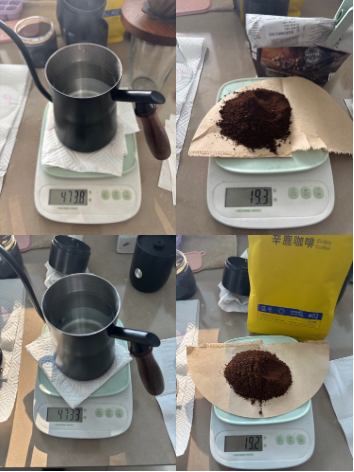
Prime Lab tested the Kimbo (decaffeinated, first two images) and a certain brand’s regular coffee beans (second two images). After cleaning all utensils with dishwashing liquid, the decaffeinated coffee beans were brewed by hand, followed by cleaning and brewing the standard coffee beans.
Both brews used a ratio of: Approximately 19 g coffee grounds + 473 g 95°C hot water by hand brewing. After naturally cooling to room temperature, the coffee was sealed in clean bottles and sent for third-party testing.
3.Test Results and Analysis
The caffeine content was tested by Intertek Tianxiang (one of the world’s largest consumer goods testing, inspection, and certification companies) in their Zhuhai laboratory using the national standard GB 5009.130–2014 for caffeine detection.
The results were as follows: Sample 1-D: Kimbo decaffeinated coffee Sample 2-N: Regular Lab coffee Sample 3-S: Starbucks decaffeinated hot Americano
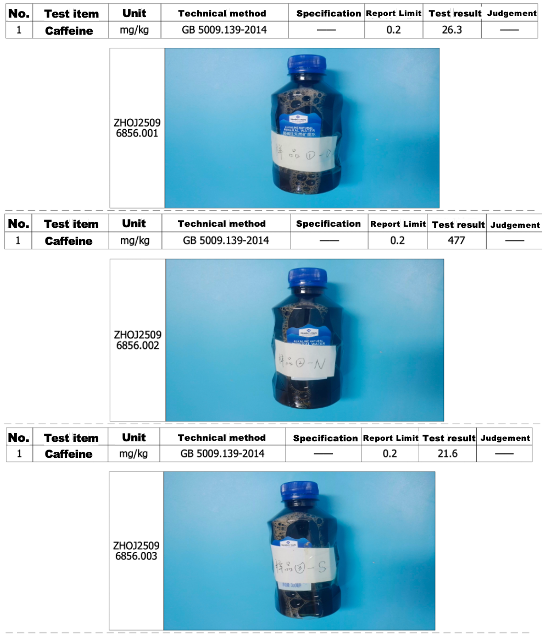
- Sample 1-D: Caffeine concentration was 26.3 mg/kg, equivalent to 12.46 mg of caffeine in 473 mL, with each gram of 1-D coffee corresponding to 0.65 mg of caffeine.
- Sample 2-N: Caffeine concentration was 477 mg/kg, equivalent to 225.76 mg of caffeine in 473 mL, with each gram of 2-N coffee corresponding to 11.76 mg of caffeine.
- Sample 3-S: Caffeine concentration was 21.6 mg/kg, equivalent to 10.22 mg of caffeine in 473 mL, with each gram of 3-S coffee corresponding to 0.38 mg of caffeine.
The caffeine content in Starbucks decaffeinated beans is about 58% of the Kimbo decaffeinated beans, while the Lab’s regular coffee beans have 18 times more caffeine than Kimbo decaffeinated beans and 22 times more than Starbucks decaffeinated beans.
Comparison with a 1:18 coffee-to-water ratio:
- Kimbo Decaffeinated: 473 mL water + 27 g beans, containing 17.55 mg of caffeine.
- Lab Regular Coffee: 473 mL water + 27 g beans, containing 317.52 mg of caffeine.
- Starbucks Decaffeinated: 473 mL water + 27 g beans, containing 10.22 mg of caffeine.
4.Caffeine content in Starbucks regular coffee
According to the information disclosed on Starbucks’ official website, a Grande standard hot Americano contains 225 mg of caffeine, while a Grande standard hot latte contains 150 mg of caffeine.


5.Caffeine content calculation for common teas
Referring to a study published in the top food science journal Foods, which provides caffeine content data for tea infusions of green tea, black tea, oolong tea, and pu-erh tea.
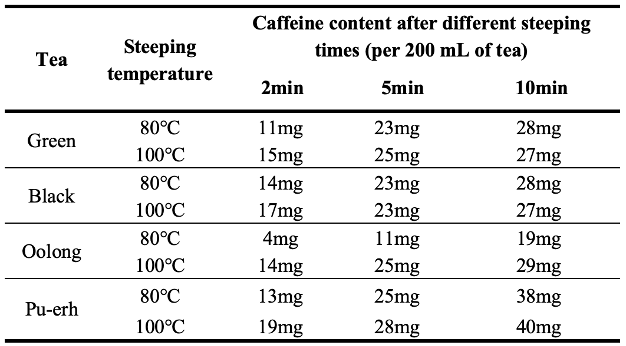
The caffeine content in the “brewed tea infusion” (measured in mg/200 mL) is provided below 7.
Each serving of tea infusion uses a fixed amount of tea leaves: 2 g of dry tea + 200 mL of water.
The study measured the caffeine content in green tea, oolong tea, black tea, and pu-erh tea under the conditions of 80°C/100°C, steeped for 2, 5, and 10 minutes (measured in mg/200 mL, using the HPLC ISO standard method). The tea was purchased in physical markets in Istanbul, Turkey, to compare the effects of fermentation processes on caffeine content in tea.
IV) How to “Scientifically and Timely” Consume Caffeine?
According to caffeine metabolism articles, individuals with a fast metabolism have a caffeine half-life of 3 hours. Blood caffeine concentration needs to be ≤0.5 µg/mL by 23:00 before sleeping. With 225 mg of caffeine, the blood caffeine level reaches 6 µg/mL. Based on this, the suitable drinking times for the three coffees are calculated as follows:
- One cup of Grande Kimbo decaffeinated: Blood caffeine concentration = 0.468 µg/mL (≤0.5).
- One cup of Grande Starbucks decaffeinated: Blood caffeine concentration = 0.273 µg/mL (≤0.5).
Thus, the two decaffeinated coffees can be consumed before or around dinner time (considering individual differences).
For regular coffee:
- Grande Lab regular hot Americano (317.52 mg) should be consumed by approximately 10:45 AM.
- Grande Starbucks regular hot Americano (225 mg) should be consumed by 12:15 PM.
- Grande Starbucks regular hot latte (150 mg) should be consumed by 2:00 PM.
For tea, with a standard 5 g tea leaves + 100°C water to brew 500 mL tea, caffeine content is below 100 mg, and drinking it before 5 PM will not affect sleep (except for pu-erh tea, which contains about 100 mg, and should be consumed by 3:45 PM).
Intervention recommendations are geared toward generally healthy individuals. If you have existing health conditions, always follow your doctor’s instructions.
References
[1]Ramalakshmi K, Raghavan B. Caffeine in coffee: its removal. Why and how? Crit Rev Food Sci Nutr. 1999 Sep;39(5):441–456.
[2]Vasquez K. How is coffee decaffeinated, and is it safe to drink? Chemical & Engineering News. 2024 Aug 29;102(27).
[3]SWISS WATER®. Our Coffee Decaffeination Process
[4]Hiraga Y, Yoshida C, Aoki K, Watanabe M. Efficient decaffeination of green coffee beans using pressure swing supercritical CO2 extraction. Innov Food Sci Emerg Technol. 2025 Aug;104:104154.
[5]National Standard of the People’s Republic of China. GB 5009.139–2014: National Food Safety Standard — Determination of Caffeine in Beverages
[6]International Organization for Standardization. ISO 20481:2008 Coffee and coffee products — Determination of the caffeine content — Routine method using HPLC.
[7]Ayakdaş G, et al. Determination of L-Theanine and Caffeine Contents in Tea Infusions Prepared under Varying Fermentation Degrees, Brewing Conditions, and Serving Methods. Foods. 2025.
[8]National Coffee Association. Decaf coffee. About Coffee. Accessed 2026 Feb 9.
[9]Food and Drug Administration. Methylene chloride. Electronic Code of Federal Regulations, 21 CFR 173.255. Accessed 2026 Feb 9.
[11]International Agency for Research on Cancer. IARC Monographs Volume 110: evaluation of five chemicals. IARC News. 2014 Jul 11.