In my last article, I explored the impact of sleep deprivation and duration. Today, I want to examine another crucial dimension of high-quality sleep: circadian alignment.
And no — this isn’t just about “going to bed on time” or being more disciplined. Because science has issued a stark warning about what happens when our internal rhythms are chronically out of sync.
I. A Wake-Up Call from the IARC: Night Shift Work Is a Probable Carcinogen
In 2007, the International Agency for Research on Cancer (IARC), part of the World Health Organization, made a landmark classification: shift work that disrupts circadian rhythms was officially listed as a Group 2A carcinogen — “probably carcinogenic to humans” 1,2.
Group 1 includes well-known dangers like tobacco, alcohol, and processed meat;
Group 2A includes red meat, and now, night shift work.
This means the evidence of harm in humans is limited, but animal studies show sufficient evidence — enough to raise serious concern.
Jobs that involve chronic night shifts — like nurses, drivers, factory workers — fall into this category.
Large epidemiological studies have linked circadian disruption to higher risks of hormone-related cancers such as breast and prostate cancer, as well as colorectal cancer. The famed Nurses’ Health Study, for example, found that long-term shift work (over 15 years) significantly raised the risk of both colorectal and breast cancers 3,4,25.
Why This Matters, Even If You Don’t Work in Shifts
The IARC was studying nurses and factory workers. But their warning isn’t really about occupation — it’s about the cost of long-term circadian misalignment at a molecular level. And that cost is blind to profession.
If you’re a finance professional trading the US stock market and regularly sleep from 3am to 10:30am — even if you’re sleeping 7 hours — you’re chronically out of sync.
If you stay up late watching Netflix, gaming, or drinking till 2–3am, then wake up at 7am for work — you’re hitting yourself with a double blow: sleep deprivation + rhythm disruption.
So this isn’t just theoretical. Even if you’re not on a night shift schedule, your lifestyle may be putting you at the same risk.
II. How Disruption Becomes Disease: The Biology of a Broken Rhythm
Our bodies are made up of trillions of cells, and they all dance to the beat of a circadian conductor — the suprachiasmatic nucleus (SCN) in the hypothalamus.
Light is the maestro’s baton. It synchronizes the SCN, which in turn signals “peripheral clocks” in other organs like the liver, pancreas, and muscles. Research suggests 10–20% of all human gene expression follows a rhythmic, 24-hour oscillation 5,6.
When this conductor goes off-beat — due to night shifts, erratic schedules, or light exposure at the wrong time — it throws the whole orchestra into disarray. The amplitude and precision of cellular rhythms decline, leading to system-wide dysfunction 7.
This desynchronization quickly impacts four key defense mechanisms:
- Immune Surveillance
- Melatonin Secretion
- DNA Repair
- Metabolic Homeostasis
When these systems are off, cancer cells can exploit the chaos.
1️⃣ Immune Imbalance: NK Cells Out of Sync
Natural killer (NK) cells — our body’s first responders against precancerous cells — follow a strict circadian patrol schedule 8,9.
When your internal clock is disrupted, the activity of NK cells becomes misaligned. The night shift when they should be most active? Their performance is suppressed. This gives potential cancer cells a longer “surveillance-free” window to grow and spread.
In a famous study at UCLA, researchers let healthy adults sleep only 4 hours for one night. The next morning, their NK cell activity had dropped by 30% compared to a normal night’s sleep 8,9.
2️⃣ Melatonin Suppression and Impaired DNA Repair
Melatonin isn’t just a sleep aid — it’s also one of the body’s most powerful antioxidants, with proven anti-cancer effects.
Exposure to artificial light at night — from screens or overhead lighting — significantly inhibits melatonin production [10–12], weakening this night-time defense system.
Meanwhile, animal studies show that circadian rhythms regulate DNA repair enzymes. If you’re out of sync, cells may enter replication when repair activity is low — a dangerous setup for mutations and tumor development 13.
3️⃣ A Pro-Inflammatory, Pro-Cancer Metabolic Environment
Insulin sensitivity peaks in the morning and declines throughout the day. Eating late at night — when your metabolism is at its weakest — promotes insulin resistance and high blood sugar.
Cancer cells thrive in this environment.
In addition, long-term circadian misalignment increases systemic inflammation, one of the key enablers of chronic diseases, including cancer.
Disruption doesn’t just raise cancer risk — it affects everything. Hormones like melatonin, growth hormone, cortisol, and testosterone all rely on circadian rhythm. So do metabolic sensitivity, mitochondrial function, cognitive clarity, and emotional regulation 14,15.
III. Aligning Your Rhythm: A Practical Guide
Our time, consciously or not, is usually divided between five daily priorities: sleep, eating, exercise, work/study, and leisure. For most people, the subconscious importance ranking looks like this:
Wakefulness > Sleep
More specifically, for a typical sedentary office worker, it may look like this:
Work/Study > Leisure > Eating + Sleep > Exercise
The result? Work eats into leisure. Then leisure — in retaliation — starts to consume sleep and meal time. And when eating and sleep are already squeezed, movement simply disappears.
Now contrast that with the Prime Life hierarchy:
Sleep > Eating + Exercise > Work + Leisure
Imagine your life as a home facing the sea, soaked in spring sunshine. The foundation — the steel and concrete — is formed by sleep, food, and movement. Only once those are secure can you design the soft furnishings of work and play. That’s how you build a life that’s livable, durable, and full of grace.
This is also why we talked about nutrition and exercise before we even got to sleep. Because only when sleep becomes the foundation can the full daily architecture of Prime Life come to life.
Today, let’s focus on how to coordinate all your major Zeitgebers — the environmental cues that keep your circadian rhythm aligned 16,17.
1️⃣ Define Your Ideal Sleep Rhythm
- Based on your chronotype (night owl or early bird) and your wake-up obligations, choose a sleep time you can realistically maintain.
- In principle, go to bed no later than 11:30 PM.
- Target 8 hours of sleep, which usually means 8.5 hours in bed to account for wake time.
- Avoid drastic shifts. If you usually fall asleep at 2am, don’t try to jump to a 9:30pm bedtime overnight — that kind of change is unsustainable.
2️⃣ Use Light Wisely (The Most Powerful Zeitgeber)
Light is the strongest synchronizer of the master clock (SCN) because it directly shifts the circadian phase forward or backward 18.
- Morning: Get sunlight within 15–30 minutes of waking up. Even on a cloudy day, natural outdoor light is far more intense than indoor lighting. This is the most effective and cheapest way to tell your brain: “A new day has begun.”
- Evening: Actively avoid bright light. In the 1–2 hours before bedtime, stop using high-brightness screens and white lighting. Any exposure to blue light will suppress melatonin and delay sleep onset. Use warm light or red light instead.
3️⃣ Meal Timing (A Crucial Peripheral Zeitgeber)
Meal timing helps synchronize the clocks in your liver, pancreas, and glucose metabolism systems 19.
- Eat during daytime hours, when insulin sensitivity is naturally higher.
- Finish dinner early. Avoid all caloric intake within 3–4 hours of bedtime.
Late-night eating keeps your digestive and metabolic systems active, which interferes with natural sleep onset [20–22].
This is why time-restricted eating patterns like 16:8 or early Time-Restricted Eating (eTRE) are so effective. They allow a long fasting period before sleep, which stabilizes blood sugar, improves insulin sensitivity, and lets your liver and pancreas rest.
Example from Prime Lab:
- Breakfast: 9:30 AM
- Lunch: 12:30 PM
- Dinner: 5:30 PM
This keeps all eating within an 8-hour window, finishing 5+ hours before sleep.
eTRE means finishing all calorie intake early, within 8–10 hours of your day, to align with your body’s peak metabolic efficiency 22. In fact, 16:8 is a mild version of eTRE. A more extreme version would be “no eating after noon.”
4️⃣ Exercise Timing (Another Important Zeitgeber)
We’ve explored this in depth in our movement chapter. But in the context of circadian synergy:
- Morning workouts are optimal. They pair naturally with morning sunlight exposure.
- Fasted morning workouts shorten your eating window by 1–1.5 hours.
- Over time, morning exercise advances your circadian phase by 45–60 minutes, making early sleep and wake-up easier 23.
- Avoid late workouts: High-intensity activity within 3–4 hours of sleep delays melatonin and disrupts sleep quality. Evening exercise timing is tricky, so we generally don’t recommend nighttime workouts.
5️⃣ Skin Temperature (A Subtle but Powerful Cue)
Temperature plays a role in circadian timing too. In the morning, cortisol, light, movement, and food all raise body temperature 19.
To prepare for sleep:
- Avoid eating or exercising 3–4 hours before bed
- Take a bath 2–3 hours before sleep — even a warm one. Evaporation lowers skin temperature.
- Keep your bedroom cool at night to help signal sleep.
A Practical, Sustainable Rhythm
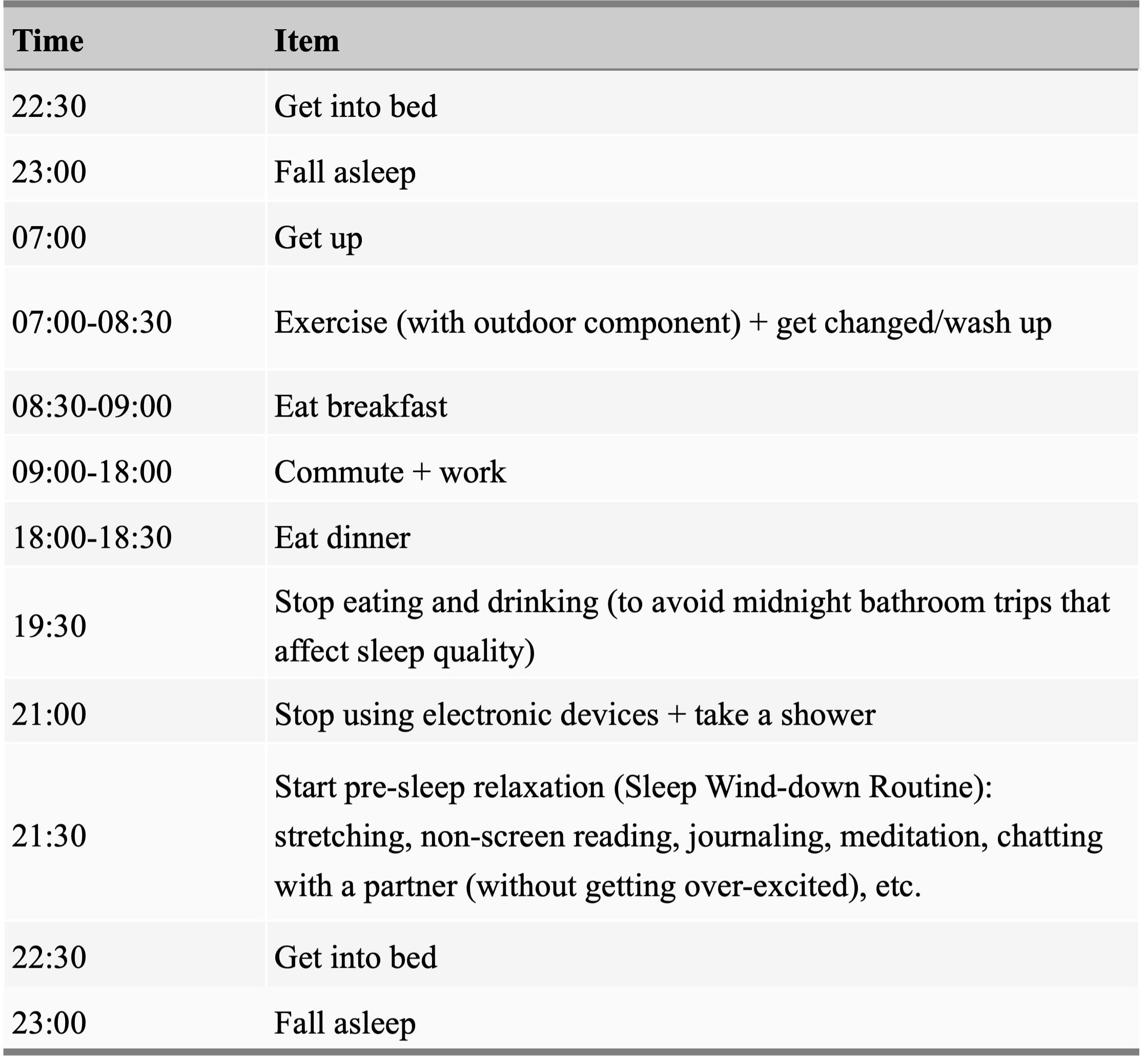
All things considered, here’s a realistic, non-extreme, sleep-centered daily framework for circadian alignment:
One More Thing…
At Prime Lab, we always aim to give clear, actionable recommendations.
Coming up with the “optimal plan” isn’t hard — with logic and literature, you can reverse-engineer it. The hard part is the messy, human part:
- Everyone’s life is different. Even a non-extreme answer still needs personalization.
- And knowing something doesn’t mean you can do it. We all know that feeling.
That’s why Prime Life is not just a scientific framework — it’s a spiritual practice of living well.
We begin with the science. But the real journey is bridging the gap between knowing and becoming.
Let’s walk it — together.
Intervention recommendations are geared toward generally healthy individuals. If you have existing health conditions, always follow your doctor’s instructions.
References
[1]International Agency for Research on Cancer. Painting, Firefighting, and Shiftwork. IARC Monographs on the Evaluation of Carcinogenic Risks to Humans, vol. 98, IARC, 2010.
[2]International Agency for Research on Cancer. Night Shift Work. IARC Monographs, vol. 124, IARC, 2020.
[3]Moon, Jinyoung, et al. “Night shift work and female breast cancer: a two-stage dose–response meta-analysis for the correct risk definition.” BMC Public Health 24.1 (2024): 2065. doi:10.1186/s12889–024–19518–2.
[4]Rivera-Izquierdo, Mario, et al. “Shift Work and Prostate Cancer: An Updated Systematic Review and Meta-Analysis.” International Journal of Environmental Research and Public Health 17.4 (2020): 1345. doi:10.3390/ijerph17041345.
[5]Mohawk, Jennifer A., et al. “Cell Autonomy and Synchrony of Suprachiasmatic Nucleus Circadian Oscillators.” Seminars in Cell & Developmental Biology, vol. 22, no. 3, 2011, pp. 281–87.
[6]Zhang, Ron, et al. “A Circadian Gene Expression Atlas in Mammals: Implications for Biology and Medicine.” Proceedings of the National Academy of Sciences, vol. 111, no. 45, 2014, pp. 16219–24.
[7]Luo, Bo, et al. “The Contribution of Circadian Clock to the Biological Processes.” Frontiers in Molecular Biosciences, vol. 11, 2024, article 1387576.
[8]Irwin, Michael R. “Why Sleep Is Important for Health: A Psychoneuroimmunology Perspective.” Annual Review of Psychology, vol. 66, 2015, pp. 143–172.
[9]Irwin, Michael, et al. “Partial Sleep Deprivation Reduces Natural Killer Cell Activity in Humans.” Psychosomatic Medicine, vol. 56, no. 6, Nov.–Dec. 1994, pp. 493–498.
[10]Tan, Dun-Xian, et al. “Chemical and Physical Properties and Potential Mechanisms: Melatonin as a Broad Spectrum Antioxidant and Free Radical Scavenger.” Current Topics in Medicinal Chemistry, vol. 2, no. 2, 2002, pp. 181–97.
[11]Reiter, Russel J., et al. “Melatonin as an Antioxidant: Under Promises but Over Delivers.” Journal of Pineal Research, vol. 61, no. 3, 2016, pp. 253–78.
[12]Talib, Waleed H., et al. “Melatonin in Cancer Treatment: Current Knowledge and Future Opportunities.” Molecules, vol. 26, no. 9, 2021, article 2506.
[13]Gaddameedhi, Shobhan, et al. “The Circadian Clock Controls Sunburn Apoptosis and Erythema in Mouse Skin.” Proceedings of the National Academy of Sciences, vol. 108, no. 46, 2011, pp. 18790–95.
[14]Spiegel, Karine, Rachel Leproult, and Eve Van Cauter. “Impact of Sleep Debt on Metabolic and Endocrine Function.” The Lancet, vol. 354, no. 9188, 23 Oct. 1999, pp. 1435–1439.
[15]Meier-Ewert, Hans K., et al. “Effect of Sleep Loss on C-Reactive Protein, an Inflammatory Marker of Cardiovascular Risk.” Journal of the American College of Cardiology, vol. 43, no. 4, 2004, pp. 678–683.
[16]Jagannath, Ajay, et al. “The Genetics of Circadian Rhythms, Sleep and Health.” Human Molecular Genetics, vol. 26, no. R2, 2017, pp. R128–38.
[17]Bollinger, Tobias, and Christoph Scheier. “Circadian Rhythms: From Genes to Physiology and Disease.” Swiss Medical Weekly, vol. 144, 2014, w13984.
[18]Blume, Christine, et al. “Effects of Light on Human Circadian Rhythms, Sleep and Mood.” Somnologie, vol. 23, 2019, pp. 147–56.
[19]Chellappa, Sarah L., et al. “Daytime Eating Prevents Internal Circadian Misalignment and Glucose Intolerance in Night Work.” Science Advances, vol. 7, no. 49, 2021, eabg9910.
[20]Chellappa SL, Qian J, Vujovic N, Morris CJ, Nedeltcheva A, Nguyen H, Rahman N, Heng SW, Kelly L, Kerlin-Monteiro K, Srivastav S, Wang W, Aeschbach D, Czeisler CA, Shea SA, Adler GK, Garaulet M, Scheer FAJL. Daytime eating prevents internal circadian misalignment and glucose intolerance in night work. Sci Adv. 2021 Dec 3;7(49):eabg9910.
[21]Sutton EF, Beyl R, Early KS, Cefalu WT, Ravussin E, Peterson CM. Early Time-Restricted Feeding Improves Insulin Sensitivity, Blood Pressure, and Oxidative Stress Even without Weight Loss in Men with Prediabetes. Cell Metab. 2018 Jun 5;27(6):1212–1221.e3.
[22]Sutton, Elizabeth F., et al. “Early Time-Restricted Feeding Improves Insulin Sensitivity, Blood Pressure, and Oxidative Stress Even without Weight Loss in Men with Prediabetes.” Cell Metabolism, vol. 27, no. 6, 2018, pp. 1212–21.e3.
[23]Thomas, J. Matthew, et al. “Circadian Rhythm Phase Shifts Caused by Timed Exercise Vary with Chronotype.” JCI Insight, vol. 5, no. 3, 2020, e134270.
[24]Refinetti, Roberto. “Circadian Rhythmicity of Body Temperature and Metabolism.” Temperature, vol. 7, no. 4, 2020, pp. 321–41.
[25]Schernhammer, Eva S., et al. “Rotating Night Shifts and Risk of Breast Cancer in Women Participating in the Nurses’ Health Study.” Journal of the National Cancer Institute, vol. 93, no. 20, 2001, pp. 1563–68.