Over the past few pieces, we talked about the two major ways light affects the body through the skin: ultraviolet light and red light / near-infrared light. Today, we close the loop by finishing the pathway of light through the eyes. In the sleep module, we already went deep into the relationship between blue light and melatonin. Today, I want to fill in the gaps and explain the whole story of light and the eyes in one place.
There Is a “Non-Visual System” Hidden in the Eye
On your retina, there is a special group of cells called ipRGCs — intrinsically photosensitive retinal ganglion cells. They are not responsible for helping you “see” objects. Their job is to detect the intensity and color of ambient light, then send those signals to the brain’s biological clock center — the suprachiasmatic nucleus (SCN). From there, the SCN regulates the pineal gland and hypothalamus, influencing melatonin secretion, cortisol rhythm, body-temperature fluctuations, alertness, and mood 2,26,27.
These ipRGCs contain a light-sensitive pigment called melanopsin, which is most sensitive to blue light around 480 nm 3. Animal studies have already identified at least six subtypes, each projecting to different brain regions and performing different functions 4,28,29. In other words, the effect of light entering through the eyes is not a single channel. It is a set of parallel circuits running at the same time.
The core principle is very clear: during the day, you need sufficiently strong natural light; at night, you need sufficiently low short-wavelength light. This is a foundational environmental factor for maintaining circadian rhythm, metabolic health, and cognitive performance 30,31.
Any Light Can Damage the Eyes at Excessive Doses
Before we break things down by wavelength, we need to establish a basic idea: there is no such thing as a color of light that is “naturally safe” under all conditions.
Light damages the eyes through three main mechanisms: photochemical damage (short-wavelength, high-energy light breaking molecular bonds) 6, thermal damage (high-power light sources literally heating tissue), and oxidative stress with chronic inflammation 32,33. These mechanisms can stack on top of one another.
The retina also appears to be more vulnerable at night. Animal studies show that when the biological clock is in its “night phase,” the same intensity of light may cause more severe retinal damage 7. That gives us a second reason to avoid strong light at night — beyond melatonin suppression.
So what counts as “too much”? Here are a few reference anchors 31[34–26]:
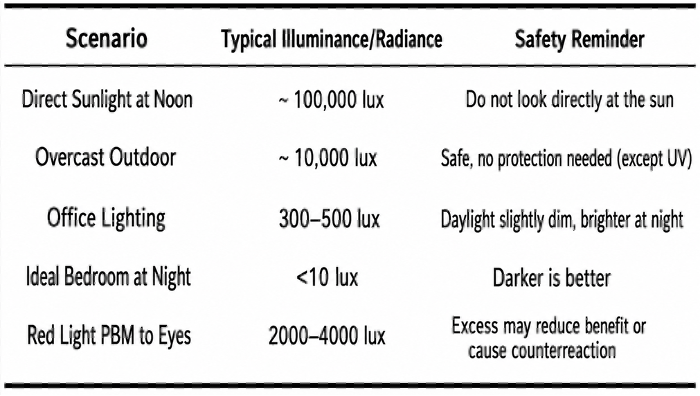
5 mW/cm² converted to lux = 5 mW/cm² × 10 × 0.061 × 683 ≈ 2083 lux. Here, 10 is the conversion factor from mW/cm² to the standard unit W/m², 0.061 is the relative sensitivity coefficient of red light compared with yellow-green light, and 683 is the maximum luminous efficacy value for yellow-green light.
So 5–10 mW/cm² of red light is roughly equivalent to 2000–4000 lux.
The core judgment standard is actually very simple: if looking at a light source feels clearly uncomfortable or glaring, then it is too strong for your current visual comfort. That does not necessarily mean it is unsafe, but it is still worth lowering the power.
Ultraviolet Light: Almost Only Harmful to the Eyes
Ultraviolet light (<400 nm) has almost no known physiological benefit through the eye pathway — only damage risk. Its main targets are the cornea, conjunctiva, and lens, and long-term cumulative exposure is clearly associated with increased risk of cortical cataracts 8.
But there is an important age difference. In adults, the lens itself acts as a natural UV filter: only 1%–2% of UVA reaches the retina 37,38.
For children under 10, however, the lens is not yet fully developed, and roughly 75% of UVA can penetrate through to the retina 10,39. Another high-risk group is older adults after cataract surgery with transparent intraocular lens implants — the natural filter has been removed 40.
So wear sunglasses when you go outside. This is “sunscreen” for the eyes. When choosing sunglasses, look for the UV400 label — not how dark the lenses are 11. Dark lenses without UV protection can be even more dangerous: the pupils dilate in the darker environment, allowing more ultraviolet light to enter directly. UV eye protection for children is severely underestimated.
Blue Light: Friend in the Morning, Enemy at Night
We already covered the relationship between blue light (~446–500 nm) and circadian rhythm in the sleep article, so I will not repeat all the mechanistic details here.
The conclusion is clear: blue light or natural light in the morning can help advance your circadian phase, increase daytime alertness, and improve the rhythmic amplitude of nighttime melatonin secretion 12. Excessive blue-light exposure at night, however, suppresses melatonin, delays sleep onset, and reduces sleep quality 13.
The same wavelength can have completely opposite effects depending on timing. This is one of the classic examples in photobiology where timing determines whether something is beneficial or harmful.
Warm Light and Nighttime Lighting: Darkness Matters More Than Redness
At the same perceived brightness, warm, low-color-temperature light sources — yellow, orange, and red light, with color temperature ≤2700K — disrupt nighttime circadian rhythm less than cool white light 14,31,41.
But we need to clarify a common misconception: saying “red light has no effect on sleep at all” is not quite accurate. High-brightness red light, long exposure, or use right before bed can still affect sleep through brightness itself and behavioral activation — for example, scrolling on your phone under red light.
At night, the most important thing is keeping the overall light level low. Low color temperature comes second. Having both is best, but if you can only choose one, choose dim 25.
Red Light PBM for the Eyes: Promising, But the Dose Must Be Extremely Low
Retinal cells are rich in mitochondria, so the mitochondrial activation effect of red light (~620–900 nm) may also apply to the retina 15. This is the potential healing mechanism behind red light photobiomodulation (PBM) for the eyes. Early studies suggest it may improve age-related decline in retinal function 16.
But there is an absolute red line here: the amount of red light the eyes can tolerate is not even in the same order of magnitude as what skin or muscle can tolerate. Never use a red-light panel designed for skin exposure to shine directly into your eyes.
If you want to understand the parameter ranges commonly used in research, the following can serve as a reference:
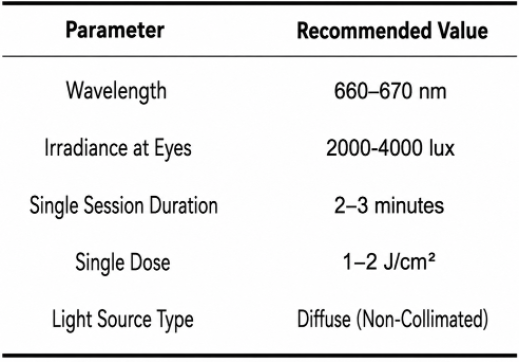
If that intensity still feels glaring, reduce the power further, or shine the red light onto a white wall and let reflected diffuse light enter the eyes. Retinal tissue is extremely delicate. It is better to underdose than overdose. This field is still in the frontier-exploration stage and is far from having a mature consensus.
Natural Light as a Full-Spectrum Intervention
There is a classic experiment: participants went camping in the wilderness for one week, relying entirely on natural light with no artificial lighting. The result was that the onset of melatonin secretion shifted earlier by about 2 hours on average, and the difference between “early birds” and “night owls” narrowed substantially 17.
This suggests that even under genetic influence, the modern artificial-light environment can significantly delay circadian phase and amplify the tendency to sleep late.
Natural light has different key values for different groups.
Older adults face a special challenge. At age 80, the lens transmits only about one-third as much 480 nm blue light as it does at age 10. Combined with age-related pupil constriction 18, the effective circadian signal reaching the retina may be only about 20%–30% of that in young people 42. Older adults therefore need significantly higher environmental illuminance to achieve the same circadian-synchronizing effect. Bright daytime light exposure (1,000–2,500+ lux) has been shown to improve sleep consolidation and reduce nighttime agitation in patients with dementia 19,43.
For children, the strongest environmental evidence for myopia prevention comes from outdoor time. A randomized controlled trial in Guangzhou showed that adding about 40 minutes of outdoor activity per day reduced the 3-year incidence of myopia from 39.5% to 30.4% — a relative risk reduction of about 23% 20. One proposed mechanism is that natural light promotes retinal dopamine release, and dopamine signaling inhibits excessive elongation of the eyeball 44.
Hormonal Regulation Through Light
Through the eye-retina pathway, light also influences at least four key hormones or neurotransmitters, thereby regulating the whole body-mind system:
Melatonin — the clearest pathway. It is the marker of nighttime “biological darkness.” Short-wavelength light suppresses it most strongly, making it central to the entire light-circadian-sleep chain 13.
Cortisol — morning light strengthens the cortisol awakening response, helping you start the day alert and supporting daytime vigilance and circadian alignment 22.
Dopamine — light exposure promotes retinal dopamine release, which is related both to myopia prevention and to overall alertness and motivation 44.
Serotonin — brain serotonin turnover is positively correlated with the amount of sunlight on that day, independent of seasonal factors 23. This offers a biochemical explanation for why sunny days lift mood, and partly explains why light therapy can help seasonal depression.
One More Thing
Get at least 30 minutes of natural light exposure during the day. This one habit covers circadian synchronization, mood, and myopia prevention all at once.
For nighttime lighting, the first priority is dim, and the second is warm. Aim for the bedroom to be below 10 lux, and start lowering overall light levels 1–2 hours before bed.
Ultraviolet light brings harm to the eyes without meaningful benefit. Wear UV400 sunglasses outdoors, and do not forget to protect children’s eyes.
Red light PBM for the eyes is a frontier direction, but the dose must be extremely low — far lower than skin-oriented devices — and should only be delivered through diffuse light. Stop if it feels glaring.
Your “night owl constitution” may not be entirely innate. One week of pure natural light can shift melatonin earlier by 2 hours. Instead of obsessing over which supplement to take, first fix the free infrastructure of your light environment.
Intervention recommendations are geared toward generally healthy individuals. If you have existing health conditions, always follow your doctor’s instructions.
References
[1] Burns AC, Windred DP, Rutter MK, Olivier P, Vetter C, Saxena R, Lane JM, Phillips AJK, Cain SW. Day and night light exposure are associated with psychiatric disorders: an objective light study in >85,000 people. Nat Ment Health. 2023;1:853–862.
[2] Hattar S, Liao HW, Takao M, Berson DM, Yau KW. Melanopsin-containing retinal ganglion cells: architecture, projections, and intrinsic photosensitivity. Science. 2002 Feb;295(5557):1065–70.
[3] Bailes HJ, Lucas RJ. Human melanopsin forms a pigment maximally sensitive to blue light (λmax approximately 479 nm) supporting activation of Gq/11 and Gi/o signalling cascades. Proc Biol Sci. 2013 Jan;280(1759):20122987.
[4] Chen SK, Badea TC, Hattar S. Photoentrainment and pupillary light reflex are mediated by distinct populations of ipRGCs. Nature. 2011 Aug;476(7358):92–5.
[5] Siraji MA, Spitschan M, Kalavally V, Haque S. Light exposure behaviors predict mood, memory and sleep quality. Sci Rep. 2023 Aug 1;13(1):12425.
[6] Ham WT, Mueller HA, Sliney DH. Retinal sensitivity to damage from short wavelength light. Nature. 1976 Apr;260(5547):153–5.
[7] Vaughan DK, Nemke JL, Fliesler SJ, Darrow RM, Organisciak DT. Evidence for a circadian rhythm of susceptibility to retinal light damage. Photochem Photobiol. 2002 May;75(5):547–553.
[8] Taylor HR, West SK, Rosenthal FS, Muñoz B, Newland HS, Abbey H, Emmett EA. Effect of ultraviolet radiation on cataract formation. N Engl J Med. 1988 Dec;319(22):1429–33.
[9] Boettner EA, Wolter JR. Transmission of the ocular media. Invest Ophthalmol. 1962 Nov;1:776–83.
[10] Barker FM, Brainard GC. The direct spectral transmittance of the excised human lens as a function of age. Washington (DC): U.S. Food and Drug Administration; 1991. FDA 785345 0090 RA.
[11] Rosenthal FS, Bakalian AE, Lou CQ, Taylor HR. The effect of sunglasses on ocular exposure to ultraviolet radiation. Am J Public Health. 1988 Jan;78(1):72–4.
[12] Khalsa SB, Jewett ME, Cajochen C, Czeisler CA. A phase response curve to single bright light pulses in human subjects. J Physiol. 2003 Jun;549(Pt 3):945–52.
[13] Chang AM, Aeschbach D, Duffy JF, Czeisler CA. Evening use of light-emitting eReaders negatively affects sleep, circadian timing, and next-morning alertness. Proc Natl Acad Sci U S A. 2015 Jan;112(4):1232–7.
[14] Cajochen C, Frey S, Anders D, Späti J, Bues M, Pross A, Mager R, Wirz-Justice A, Stefani O. Evening exposure to a light-emitting diodes (LED)-backlit computer screen affects circadian physiology and cognitive performance. J Appl Physiol (1985). 2011 May;110(5):1432–8.
[15] Kokkinopoulos I, Colman A, Hogg C, Heckenlively J, Jeffery G. Age-related retinal inflammation is reduced by 670 nm light via increased mitochondrial membrane potential. Neurobiol Aging. 2013 Feb;34(2):602–9.
[16] Shinhmar H, Grewal M, Sivaprasad S, Hogg C, Chong V, Neveu M, Jeffery G. Optically Improved Mitochondrial Function Redeems Aged Human Visual Decline. J Gerontol A Biol Sci Med Sci. 2020 Sep 16;75(9):e49-e52.
[17] Wright KP Jr, McHill AW, Birks BR, Griffin BR, Rusterholz T, Chinoy ED. Entrainment of the human circadian clock to the natural light-dark cycle. Curr Biol. 2013 Aug;23(16):1554–8.
[18] Turner PL, Mainster MA. Circadian photoreception: ageing and the eye’s important role in systemic health. Br J Ophthalmol. 2008 Nov;92(11):1439–44.
[19] Riemersma-van der Lek RF, Swaab DF, Twisk J, Hol EM, Hoogendijk WJ, Van Someren EJ. Effect of bright light and melatonin on cognitive and noncognitive function in elderly residents of group care facilities: a randomized controlled trial. JAMA. 2008 Jun;299(22):2642–55.
[20] He M, Xiang F, Zeng Y, Mai J, Chen Q, Zhang J, et al. Effect of time spent outdoors at school on the development of myopia among children in China: a randomized clinical trial. JAMA. 2015 Sep;314(11):1142–8.
[21] Zhou X, Pardue MT, Iuvone PM, Qu J. Dopamine signaling and myopia development: what are the key challenges. Prog Retin Eye Res. 2017 Nov;61:60–71.
[22] Scheer FA, Buijs RM. Light affects morning salivary cortisol in humans. J Clin Endocrinol Metab. 1999 Sep;84(9):3395–8.
[23] Lambert GW, Reid C, Kaye DM, Jennings GL, Esler MD. Effect of sunlight and season on serotonin turnover in the brain. Lancet. 2002 Dec;360(9348):1840–2.
[24] Figueiro MG, Wood B, Plitnick B, Rea MS. The impact of light from computer monitors on melatonin levels in college students. Neuro Endocrinol Lett. 2011;32(2):158–63.
[25] Gooley JJ, Chamberlain K, Smith KA, Khalsa SB, Rajaratnam SM, Van Reen E, Zeitzer JM, Czeisler CA, Lockley SW. Exposure to room light before bedtime suppresses melatonin onset and shortens melatonin duration in humans. J Clin Endocrinol Metab. 2011 Mar;96(3):E463–72.
[26]Schmidt TM, Chen SK, Hattar S. Intrinsically photosensitive retinal ganglion cells: Many subtypes, diverse functions. Trends Neurosci. 2011 Nov;34(11):572–580.
[27]Mure LS. Intrinsically photosensitive retinal ganglion cells of the human retina. Front Neurol. 2021;12:636330.
[28]Aranda ML, Schmidt TM. Diversity of intrinsically photosensitive retinal ganglion cells: circuits and functions. Cell Mol Life Sci. 2021;78:889–907.
[29]Mure LS. Intrinsically photosensitive retinal ganglion cells of the human retina. Front Neurol. 2021;12:636330.
[30]Burns AC, Saxena R, Vetter C, Phillips AJK, Lane JM, Cain SW. Time spent in outdoor light is associated with mood, sleep, and circadian rhythm-related outcomes: A cross-sectional and longitudinal study in over 400,000 UK Biobank participants. J Affect Disord. 2021 Dec 1;295:347–352.
[31]Brown TM, Brainard GC, Cajochen C, et al. Recommendations for daytime, evening, and nighttime indoor light exposure to best support physiology, sleep, and wakefulness in healthy adults. PLoS Biol. 2022 Mar 17;20(3):e3001571.
[32]Glickman RD. Phototoxicity to the retina: mechanisms of damage. Int J Toxicol. 2002 Nov-Dec;21(6):473–490.
[33]van Norren D, Vos JJ. Light damage to the retina: an historical approach. Eye (Lond). 2016 Feb;30(2):169–172.
[34]Siqueira RC, Belíssimo LM, Pinho TS, Dourado LFN, Alves AP, de Paiva MRB, Ajero U, Cunha ADS. Short-Term Results of Photobiomodulation Using Light-Emitting Diode Light of 670 nm in Eyes with Age-Related Macular Degeneration. Photobiomodul Photomed Laser Surg. 2021 Sep;39(9):581–586. 、
[35]Burton B, Parodi MB, Jürgens I, Zanlonghi X, Hornan D, Roider J, Lorenz K, Munk MR, Croissant CL, Tedford SE, Walker M, Ruckert R, Tedford CE. LIGHTSITE II Randomized Multicenter Trial: Evaluation of Multiwavelength Photobiomodulation in Non-exudative Age-Related Macular Degeneration. Ophthalmol Ther. 2023 Apr;12(2):953–968.、
[36]Boyer D, Hu A, Warrow D, Xavier S, Gonzalez V, Lad E, Rosen RB, Do D, Schneiderman T, Ho A, Munk MR, Jaffe G, Tedford SE, Croissant CL, Walker M, Rückert R, Tedford CE. LIGHTSITE III: 13-Month Efficacy and Safety Evaluation of Multiwavelength Photobiomodulation in Nonexudative (Dry) Age-Related Macular Degeneration Using the Lumithera Valeda Light Delivery System. Retina. 2024 Mar 1;44(3):487–497.
[37]Chawda D, Shinde P. Effects of Solar Radiation on the Eyes. Cureus. 2022 Oct 29;14(10):e30857.
[38]Cheng YS, Linetsky M, Gu X, Ayyash N, Gardella A, Salomon RG. Light-induced generation and toxicity of docosahexaenoate-derived oxidation products in retinal pigmented epithelial cells. Exp Eye Res. 2019 Apr;181:325–345.
[39]van Kuijk FJ. Effects of ultraviolet light on the eye: role of protective glasses. Environ Health Perspect. 1991;96:177–184
[40]Li ZL, Tso MO, Jampol LM, Miller SA, Waxler M. Retinal injury induced by near-ultraviolet radiation in aphakic and pseudophakic monkey eyes. A preliminary report. Retina. 1990;10(4):301–14.
[41]Santhi N, Thorne HC, Van der Veen DR, et al. The spectral composition of evening light and individual differences in the suppression of melatonin and delay of sleep in humans. J Pineal Res. 2012 Jul;53(1):47–59.
[42]Kessel L, Lundeman JH, Herbst K, Andersen TV, Larsen M. Age-related changes in the transmission properties of the human lens and their relevance to circadian entrainment. J Cataract Refract Surg. 2010 Feb;36(2):308–12.
[43]Riemersma-van der Lek RF, Swaab DF, Twisk J, Hol EM, Hoogendijk WJ, Van Someren EJ. Effect of bright light and melatonin on cognitive and noncognitive function in elderly residents of group care facilities: a randomized controlled trial. JAMA. 2008 Jun 11;299(22):2642–55.
[44]Landis EG, Park HN, Chrenek M, et al. Ambient Light Regulates Retinal Dopamine Signaling and Myopia Susceptibility. Invest Ophthalmol Vis Sci. 2021;62(1):28.