前几期我们聊了光通过皮肤影响身心的两条主要路径:紫外线和红光/近红外。今天收个尾,把光通过眼睛这条通路讲完。在睡眠板块,我们已经深入聊过蓝光和褪黑素的关系,今天查漏补缺,把光和眼睛的所有事情一次说明白。
眼睛里藏着一套"非视觉系统"
你的视网膜上有一群特殊的细胞叫 ipRGC(内在光敏视网膜神经节细胞)。它们不负责让你"看见"东西,而是专门感知环境光的强度和颜色,然后把信号传给大脑的生物钟中枢(视交叉上核,SCN),再由 SCN 去调控松果体、下丘脑,进而影响褪黑素分泌、皮质醇节律、体温波动、警觉性和情绪 [2][26][27]。
这些 ipRGC 含有一种叫黑视蛋白的感光色素,对约 480 nm 的蓝光最敏感 [3]。动物实验目前已明确发现至少 6 个亚型,分别投射到不同脑区,执行不同功能 [4][28][29]。换句话说,光通过眼睛对你的影响,不是单一通道,而是一组平行回路同时在运作。
核心原则很清晰:白天要有足够强的自然光,夜间要有足够低的短波光。这是维持昼夜节律、代谢健康和认知表现的基础环境因子[30][31]。
任何光,剂量过高都伤眼
在分波段讲之前,先建立一个总认知:不存在"某种颜色的光天然安全"这回事。
光对眼睛的损伤有三类机制:光化学损伤(短波高能光打断分子键)[6]、热损伤(高功率光源烤熟组织)、氧化应激与慢性炎症[32][33]。三者可以叠加。
而视网膜在夜间更脆弱。动物研究显示,生物钟处于"夜间相位"时,同等强度的光照可能造成更严重的视网膜损伤[7]。这为"夜间避免强光"增加了超越褪黑素抑制的第二重理由。
那多少算"过量"?给几个参考锚点[31][34-26]:
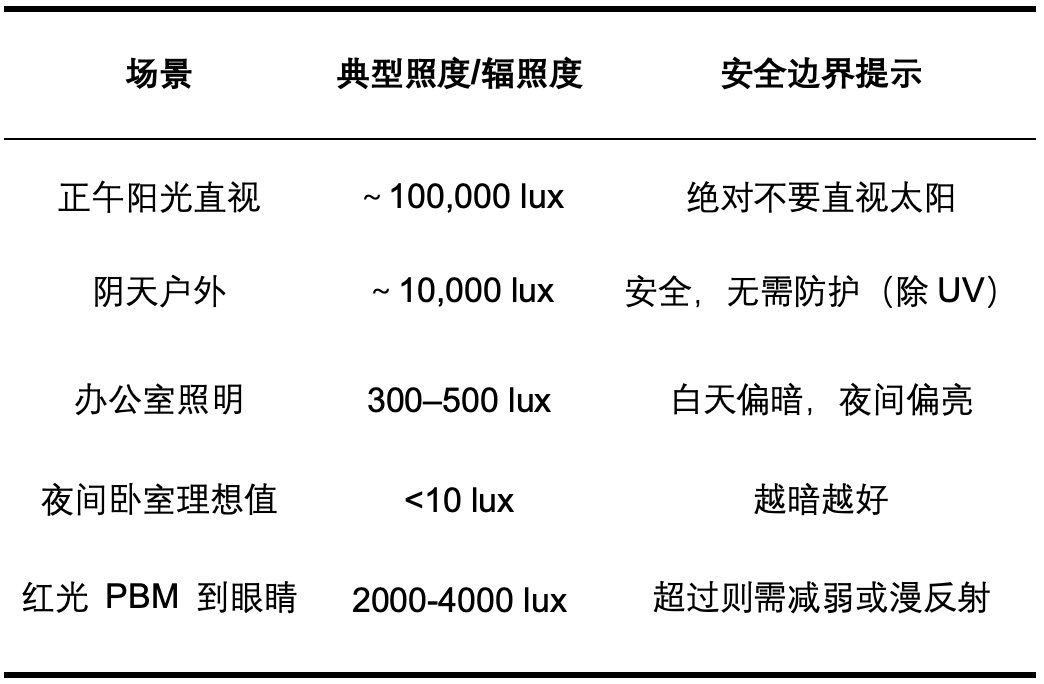
核心判断标准其实很朴素:如果你看一个光源觉得明显不舒服、刺眼,说明它对当前视觉舒适性来说偏强;虽然不一定就不安全,但仍值得调低功率。
紫外线:对眼睛基本只有伤害
紫外线(<400 nm)通过眼睛这条路,几乎没有已知的生理益处,只有损伤风险。它的攻击靶点是角膜、结膜和晶状体,长期累积暴露与皮质性白内障的风险增加关系明确 [8]。
但有个关键的年龄差异:成年人的晶状体本身就是天然 UV 滤镜,仅 1%–2% 的 UVA 能到达视网膜[37][38]。
然而 10 岁以下儿童的晶状体尚未发育完全,约 75% 的 UVA 可以穿透到达视网膜[10][39]。另一个高风险群体是白内障术后植入透明人工晶体的老人——那层天然滤镜被摘掉了[40]。
所以,出门戴上太阳眼镜吧,这是对眼睛的"防晒"。选太阳镜一定要看 UV400 标识,而不是看镜片颜色深浅 [11]。深色镜片如果没有 UV 防护,反而更危险——瞳孔在暗环境中扩大,让更多紫外线长驱直入。儿童的 UV 眼部防护被严重低估。
蓝光:早上是朋友,晚上是敌人
蓝光(~446–500 nm)和昼夜节律的关系,在睡眠那期已经系统讲过,这里不再重复机制细节。
结论很明确:早晨接受蓝光或自然光,能帮你提前昼夜节律相位、增强白天警觉性、改善夜间褪黑素的分泌节律振幅 [12]。而晚上过多蓝光暴露,则抑制褪黑素,推迟入睡,降低睡眠质量 [13]。
同一个波段,时间不同,效果截然相反。这是光生物学里最经典的“时间决定好坏”的案例。
暖光与夜间照明:暗比红更重要
同等视觉亮度下,暖色低色温光源(黄光、橙光、红光,色温 ≤2700K)比冷白光对夜间节律的干扰更小 [14][31][41]。
但要澄清一个常见误解:“红光完全不影响睡眠”并不严谨。高亮度的红光、长时间暴露、紧贴入睡前使用,仍然可能通过亮度本身和行为激活(比如你在红光下刷手机)影响睡眠。
夜间最重要的是整体光照水平低,其次才是低色温。两者兼具最好,但如果只能选一个,选暗[25]。
红光 PBM 照眼睛:有潜力,但剂量必须极低
视网膜细胞富含线粒体,红光(~620–900 nm)对线粒体的激活作用同样适用于视网膜 [15]。这是红光光生物调节(PBM)对眼睛的潜在疗愈机制——初步研究显示它可能改善年龄相关的视网膜功能下降 [16]。
但这里有个绝对红线:眼睛能承受的红光剂量和皮肤/肌肉完全不是一个量级。 绝对不能用照射皮肤的红光面板去直射眼睛。
如果你想了解研究中常见的参数范围,以下可参考:
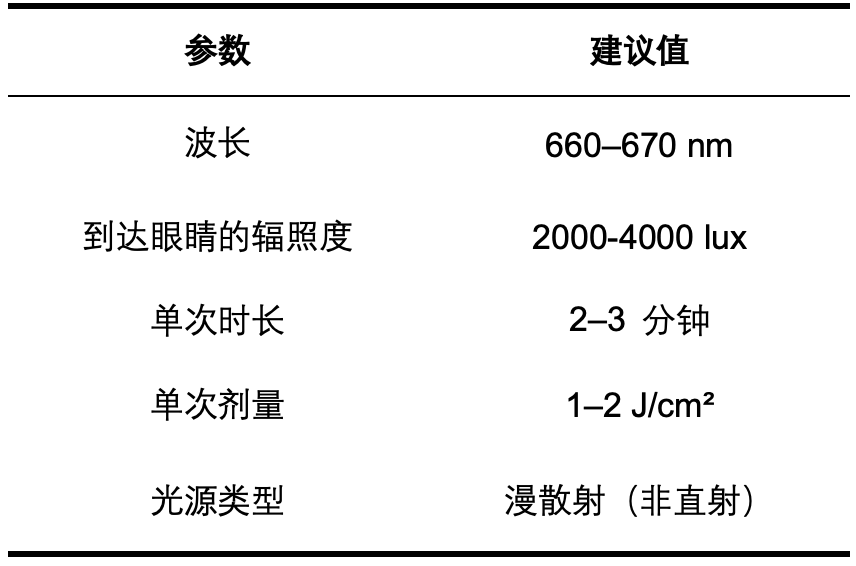
如果这个强度仍然觉得刺眼,继续调低功率,或者把红光打到白墙上,用反射散射光进入眼睛。视网膜组织极其脆弱,宁可剂量不足也不要过量。这个领域还处于前沿探索阶段,远未形成成熟共识。
自然光的全谱光干预
有一个经典实验:让受试者在野外露营一周,完全依靠自然光(无人工照明)。结果褪黑素分泌起始时间平均提前约 2 小时,而且"早鸟"和"夜猫子"之间的差异大幅缩小 [17]。
这说明即便在基因遗传的影响下,现代人工光环境会显著推迟时相,放大晚睡倾向。
自然光对不同人群有不同的关键价值:
老年人面临特殊挑战。 80 岁时晶状体对 480 nm 蓝光的透过率仅为 10 岁时的 1/3左右,加上老年性瞳孔缩小[18],到达视网膜的有效节律信号可能只有年轻人的20%-30% 左右[42],老年人需要显著更高的环境照度才能获得等效的节律同步效果。白天高照度光照(1,000–2,500+ lux)已被证实可改善痴呆患者的睡眠整合度、减少夜间躁动 [19][43]。
儿童近视防控的最强环境证据来自户外。 广州一项 RCT 显示,每天增加约 40 分钟户外活动,3 年后近视发生率从 39.5% 降至 30.4%——相对风险降低约 23% [20]。机制之一是自然光促进视网膜多巴胺释放,而多巴胺信号抑制眼轴过度增长[44]。
光的激素调节
光通过眼睛-视网膜通路,还会影响至少四种关键激素/神经递质,进而调节我们的全部身心:
褪黑素——最明确的链路。夜间"生物黑暗"的标志物,短波光抑制最强,是光-节律-睡眠整条链的核心环节 [13]。
皮质醇——晨光强化皮质醇觉醒反应,帮助你早上清醒地启动,支持白天的警觉和时相同步 [22]。
多巴胺——光照促进视网膜多巴胺释放,既与近视防控相关,也影响整体警觉性和动机[44]。
血清素——脑血清素转换率与当天日照时长正相关(独立于季节因素)[23]。这为"晴天心情好"提供了生化解释,也部分说明为什么光疗对季节性抑郁有效。

白天至少 30 分钟以上的自然光暴露。这一个习惯同时覆盖节律同步、情绪、近视防控多个维度。
夜间照明的第一优先级是"暗",第二才是"暖"。卧室目标 10 lux 以下,睡前 1–2 小时开始降低整体光照水平。
紫外线对眼睛只有伤害没有益处。户外戴 UV400 太阳镜,尤其别忘了给孩子戴。
红光 PBM 照眼睛是前沿方向,但剂量必须极低(远低于照皮肤的设备),且只能用漫散射光源。觉得刺眼就停。
你的"晚睡体质"可能不是天生的——一周纯自然光就能把褪黑素提前 2 小时。与其纠结该吃什么补剂,不如先把光环境这个免费的基础设施搞对。

Disclaimer :该文不代表医学建议,为个人学习、研究、实践和分享,仅供参考。如需获取医学指导,请直接咨询医生或专业医疗从业者。关于主动干预的分享,主要针对健康人群;有基础病的朋友,请优先遵循医嘱。
参考文献
[1] Burns AC, Windred DP, Rutter MK, Olivier P, Vetter C, Saxena R, Lane JM, Phillips AJK, Cain SW. Day and night light exposure are associated with psychiatric disorders: an objective light study in >85,000 people. Nat Ment Health. 2023;1:853-862.
[2] Hattar S, Liao HW, Takao M, Berson DM, Yau KW. Melanopsin-containing retinal ganglion cells: architecture, projections, and intrinsic photosensitivity. Science. 2002 Feb;295(5557):1065-70.
[3] Bailes HJ, Lucas RJ. Human melanopsin forms a pigment maximally sensitive to blue light (λmax approximately 479 nm) supporting activation of Gq/11 and Gi/o signalling cascades. Proc Biol Sci. 2013 Jan;280(1759):20122987.
[4] Chen SK, Badea TC, Hattar S. Photoentrainment and pupillary light reflex are mediated by distinct populations of ipRGCs. Nature. 2011 Aug;476(7358):92-5.
[5] Siraji MA, Spitschan M, Kalavally V, Haque S. Light exposure behaviors predict mood, memory and sleep quality. Sci Rep. 2023 Aug 1;13(1):12425.
[6] Ham WT, Mueller HA, Sliney DH. Retinal sensitivity to damage from short wavelength light. Nature. 1976 Apr;260(5547):153-5.
[7] Vaughan DK, Nemke JL, Fliesler SJ, Darrow RM, Organisciak DT. Evidence for a circadian rhythm of susceptibility to retinal light damage. Photochem Photobiol. 2002 May;75(5):547-553.
[8] Taylor HR, West SK, Rosenthal FS, Muñoz B, Newland HS, Abbey H, Emmett EA. Effect of ultraviolet radiation on cataract formation. N Engl J Med. 1988 Dec;319(22):1429-33.
[9] Boettner EA, Wolter JR. Transmission of the ocular media. Invest Ophthalmol. 1962 Nov;1:776-83.
[10] Barker FM, Brainard GC. The direct spectral transmittance of the excised human lens as a function of age. Washington (DC): U.S. Food and Drug Administration; 1991. FDA 785345 0090 RA.
[11] Rosenthal FS, Bakalian AE, Lou CQ, Taylor HR. The effect of sunglasses on ocular exposure to ultraviolet radiation. Am J Public Health. 1988 Jan;78(1):72-4.
[12] Khalsa SB, Jewett ME, Cajochen C, Czeisler CA. A phase response curve to single bright light pulses in human subjects. J Physiol. 2003 Jun;549(Pt 3):945-52.
[13] Chang AM, Aeschbach D, Duffy JF, Czeisler CA. Evening use of light-emitting eReaders negatively affects sleep, circadian timing, and next-morning alertness. Proc Natl Acad Sci U S A. 2015 Jan;112(4):1232-7.
[14] Cajochen C, Frey S, Anders D, Späti J, Bues M, Pross A, Mager R, Wirz-Justice A, Stefani O. Evening exposure to a light-emitting diodes (LED)-backlit computer screen affects circadian physiology and cognitive performance. J Appl Physiol (1985). 2011 May;110(5):1432-8.
[15] Kokkinopoulos I, Colman A, Hogg C, Heckenlively J, Jeffery G. Age-related retinal inflammation is reduced by 670 nm light via increased mitochondrial membrane potential. Neurobiol Aging. 2013 Feb;34(2):602-9.
[16] Shinhmar H, Grewal M, Sivaprasad S, Hogg C, Chong V, Neveu M, Jeffery G. Optically Improved Mitochondrial Function Redeems Aged Human Visual Decline. J Gerontol A Biol Sci Med Sci. 2020 Sep 16;75(9):e49-e52.
[17] Wright KP Jr, McHill AW, Birks BR, Griffin BR, Rusterholz T, Chinoy ED. Entrainment of the human circadian clock to the natural light-dark cycle. Curr Biol. 2013 Aug;23(16):1554-8.
[18] Turner PL, Mainster MA. Circadian photoreception: ageing and the eye's important role in systemic health. Br J Ophthalmol. 2008 Nov;92(11):1439-44.
[19] Riemersma-van der Lek RF, Swaab DF, Twisk J, Hol EM, Hoogendijk WJ, Van Someren EJ. Effect of bright light and melatonin on cognitive and noncognitive function in elderly residents of group care facilities: a randomized controlled trial. JAMA. 2008 Jun;299(22):2642-55.
[20] He M, Xiang F, Zeng Y, Mai J, Chen Q, Zhang J, et al. Effect of time spent outdoors at school on the development of myopia among children in China: a randomized clinical trial. JAMA. 2015 Sep;314(11):1142-8.
[21] Zhou X, Pardue MT, Iuvone PM, Qu J. Dopamine signaling and myopia development: what are the key challenges. Prog Retin Eye Res. 2017 Nov;61:60-71.
[22] Scheer FA, Buijs RM. Light affects morning salivary cortisol in humans. J Clin Endocrinol Metab. 1999 Sep;84(9):3395-8.
[23] Lambert GW, Reid C, Kaye DM, Jennings GL, Esler MD. Effect of sunlight and season on serotonin turnover in the brain. Lancet. 2002 Dec;360(9348):1840-2.
[24] Figueiro MG, Wood B, Plitnick B, Rea MS. The impact of light from computer monitors on melatonin levels in college students. Neuro Endocrinol Lett. 2011;32(2):158-63.
[25] Gooley JJ, Chamberlain K, Smith KA, Khalsa SB, Rajaratnam SM, Van Reen E, Zeitzer JM, Czeisler CA, Lockley SW. Exposure to room light before bedtime suppresses melatonin onset and shortens melatonin duration in humans. J Clin Endocrinol Metab. 2011 Mar;96(3):E463-72.
[26]Schmidt TM, Chen SK, Hattar S. Intrinsically photosensitive retinal ganglion cells: Many subtypes, diverse functions. Trends Neurosci. 2011 Nov;34(11):572-580.
[27]Mure LS. Intrinsically photosensitive retinal ganglion cells of the human retina. Front Neurol. 2021;12:636330.
[28]Aranda ML, Schmidt TM. Diversity of intrinsically photosensitive retinal ganglion cells: circuits and functions. Cell Mol Life Sci. 2021;78:889-907.
[29]Mure LS. Intrinsically photosensitive retinal ganglion cells of the human retina. Front Neurol. 2021;12:636330.
[30]Burns AC, Saxena R, Vetter C, Phillips AJK, Lane JM, Cain SW. Time spent in outdoor light is associated with mood, sleep, and circadian rhythm-related outcomes: A cross-sectional and longitudinal study in over 400,000 UK Biobank participants. J Affect Disord. 2021 Dec 1;295:347-352.
[31]Brown TM, Brainard GC, Cajochen C, et al. Recommendations for daytime, evening, and nighttime indoor light exposure to best support physiology, sleep, and wakefulness in healthy adults. PLoS Biol. 2022 Mar 17;20(3):e3001571.
[32]Glickman RD. Phototoxicity to the retina: mechanisms of damage. Int J Toxicol. 2002 Nov-Dec;21(6):473-490.
[33]van Norren D, Vos JJ. Light damage to the retina: an historical approach. Eye (Lond). 2016 Feb;30(2):169-172.
[34]Siqueira RC, Belíssimo LM, Pinho TS, Dourado LFN, Alves AP, de Paiva MRB, Ajero U, Cunha ADS. Short-Term Results of Photobiomodulation Using Light-Emitting Diode Light of 670 nm in Eyes with Age-Related Macular Degeneration. Photobiomodul Photomed Laser Surg. 2021 Sep;39(9):581-586. 、
[35]Burton B, Parodi MB, Jürgens I, Zanlonghi X, Hornan D, Roider J, Lorenz K, Munk MR, Croissant CL, Tedford SE, Walker M, Ruckert R, Tedford CE. LIGHTSITE II Randomized Multicenter Trial: Evaluation of Multiwavelength Photobiomodulation in Non-exudative Age-Related Macular Degeneration. Ophthalmol Ther. 2023 Apr;12(2):953-968.、
[36]Boyer D, Hu A, Warrow D, Xavier S, Gonzalez V, Lad E, Rosen RB, Do D, Schneiderman T, Ho A, Munk MR, Jaffe G, Tedford SE, Croissant CL, Walker M, Rückert R, Tedford CE. LIGHTSITE III: 13-Month Efficacy and Safety Evaluation of Multiwavelength Photobiomodulation in Nonexudative (Dry) Age-Related Macular Degeneration Using the Lumithera Valeda Light Delivery System. Retina. 2024 Mar 1;44(3):487-497.
[37]Chawda D, Shinde P. Effects of Solar Radiation on the Eyes. Cureus. 2022 Oct 29;14(10):e30857.
[38]Cheng YS, Linetsky M, Gu X, Ayyash N, Gardella A, Salomon RG. Light-induced generation and toxicity of docosahexaenoate-derived oxidation products in retinal pigmented epithelial cells. Exp Eye Res. 2019 Apr;181:325-345.
[39]van Kuijk FJ. Effects of ultraviolet light on the eye: role of protective glasses. Environ Health Perspect. 1991;96:177-184
[40]Li ZL, Tso MO, Jampol LM, Miller SA, Waxler M. Retinal injury induced by near-ultraviolet radiation in aphakic and pseudophakic monkey eyes. A preliminary report. Retina. 1990;10(4):301-14.
[41]Santhi N, Thorne HC, Van der Veen DR, et al. The spectral composition of evening light and individual differences in the suppression of melatonin and delay of sleep in humans. J Pineal Res. 2012 Jul;53(1):47-59.
[42]Kessel L, Lundeman JH, Herbst K, Andersen TV, Larsen M. Age-related changes in the transmission properties of the human lens and their relevance to circadian entrainment. J Cataract Refract Surg. 2010 Feb;36(2):308-12.
[43]Riemersma-van der Lek RF, Swaab DF, Twisk J, Hol EM, Hoogendijk WJ, Van Someren EJ. Effect of bright light and melatonin on cognitive and noncognitive function in elderly residents of group care facilities: a randomized controlled trial. JAMA. 2008 Jun 11;299(22):2642-55.
[44]Landis EG, Park HN, Chrenek M, et al. Ambient Light Regulates Retinal Dopamine Signaling and Myopia Susceptibility. Invest Ophthalmol Vis Sci. 2021;62(1):28.