In the previous article, we unpacked the major updates in the Dietary Guidelines for Americans, 2025–2030 (DGA). In this piece, we reopen Prime Lab’s own nutritional framework — Prime Diet 1.0, first released in August 2025 — and examine it side by side with the new guidelines.
At a directional level, the two are aligned. Both emphasize diversity, high nutrient density, minimizing ultra-processed foods, prioritizing protein, increasing vegetable intake, and limiting added sugars and calorie-dense diets.
But they diverge in orientation.
- The DGA is designed for broad applicability. Prime Diet is built around individualization, precision, and measurable control.
- The DGA functions as a baseline public health policy meant to prevent most people from “eating disastrously.” Prime Diet, however, is written for proactive health optimizers — Prime Lifers — and deliberately integrates a longevity lens.
What follows is a structured comparison across major macronutrient categories, along with the design logic behind Prime Diet’s key choices.
A necessary note: Prime Lab is not a medical institution, and we do not provide individualized clinical treatment.This article analyzes only the general population recommendations in the DGA. Dietary guidance for pregnancy, lactation, elderly care, or specific diseases involves greater complexity and variability and will not be covered here.
I. Total Energy, Macronutrients, and Structural Design

Prime Diet 1.0 does not prescribe a fixed macronutrient ratio. Instead, it offers an algorithm.
First, determine ideal total energy intake based on age, body weight, and activity level. Then calculate protein requirements. The remaining caloric budget is dynamically distributed between fat (40–45%) and carbohydrates (35–40%). Finally, a visual plate strategy — vegetables occupying half the plate, with the remaining half divided equally among protein, fat, and carbohydrates — ensures appropriate fiber and micronutrient allocation.
The DGA, in contrast, leans toward standardized proportional frameworks that are easier to scale across populations.
Prime Diet treats macronutrients less as static percentages and more as adjustable levers within a metabolic system.
II. Protein: DGA’s Breakthrough vs. Prime Diet’s Fine-Tuned Control
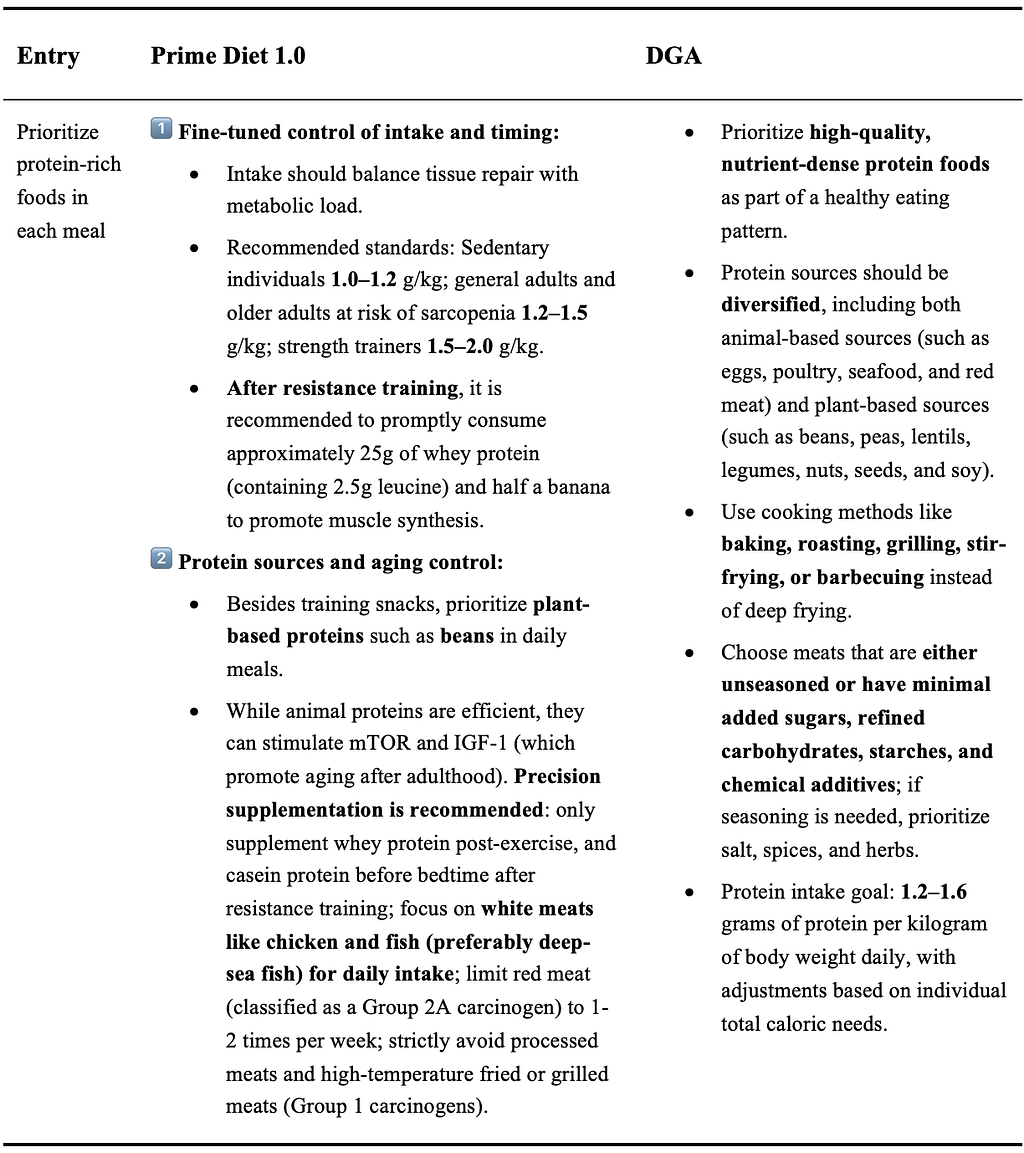
On protein, the DGA made a historic move — raising daily recommendations from the decades-old 0.8 g/kg to 1.2–1.6 g/kg. On this fundamental issue, it now largely aligns with Prime Diet 1.0.
**The Prime Diet further makes more detailed and scientifically aligned arrangements regarding protein intake, timing of intake, and sources of intake. **Protein is a double-edged sword. It supports growth and muscle synthesis, yet excessive or misaligned intake may accelerate aging pathways. The goal is to “use good steel where the blade is sharpest” — maximizing anabolic benefits while minimizing potential metabolic costs.
From the perspective of Prime Life, protein is more like a dynamic balance of “dosage × age × training status”: for middle-aged and young adults, the focus is more on the source structure and appropriate amounts; for older adults, the emphasis is on sufficient intake to combat sarcopenia.
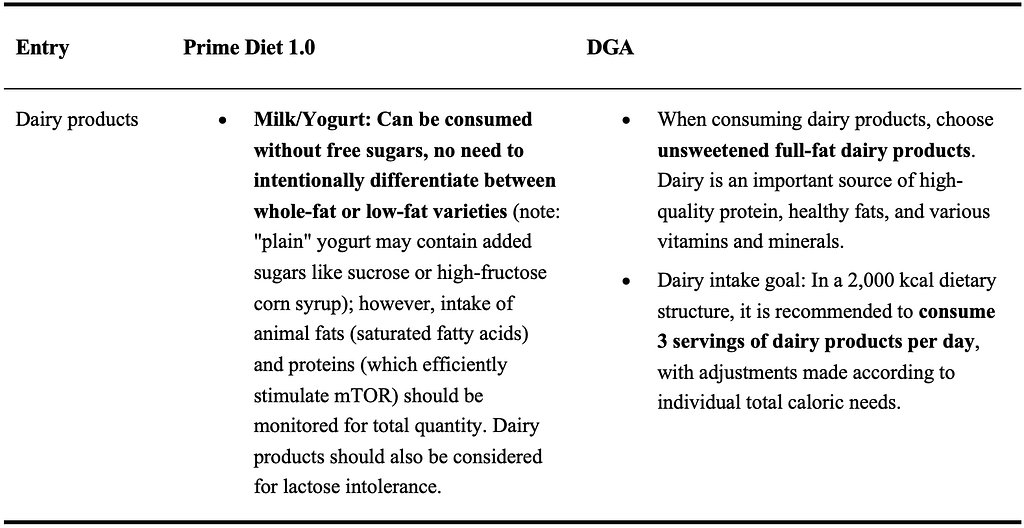
On full-fat milk, both DGA and Prime Diet share similar views: saturated fat and whole milk are no longer demonized — but total intake must remain controlled.
The DGA has made **a delayed correction **to the previous guidelines, which led to the widespread of “low-fat, high-sugar” processed foods due to an excessive fear of fats. The new guidelines acknowledge that rather than consuming “pseudo-healthy” foods that have had their fats industrially removed and replaced with added sugars to improve taste, it is better to consume dairy products in their natural form.
III. Fat: From Demonization to Reassessment

The new DGA softens its stance on saturated fat but maintains a cap at 10% of total calories. In practice, this ceiling is easily breached — three cups of full-fat milk alone consume more than 60% of that daily allowance.
Prime Diet views fat differently. Fat is metabolically gentle compared to carbohydrates (which can induce glycemic volatility) and protein (which requires nitrogen waste handling and, in excess, may stimulate aging pathways). In practice, healthy fats can reasonably occupy an equal — or even greater — caloric share compared to carbohydrates.
Prime Diet considers saturated fats to be neutral, not equating them with harm to the body, and holds an open attitude toward full-fat milk.
However, Prime Diet clearly points out that fats can indeed be categorized as good or bad (for example, the monounsaturated fats found in olive oil and the Omega-3 found in fish oil are relatively better). We should increase the intake of good fats to replace the proportion of other fats: for instance, while saturated fats are neutral, their intake should be controlled; Omega-6 is valuable but can easily be consumed in excess in modern diets; and for trans fats, the recommendation is to consume none.
IV. Carbohydrates: Eat the Right Ones
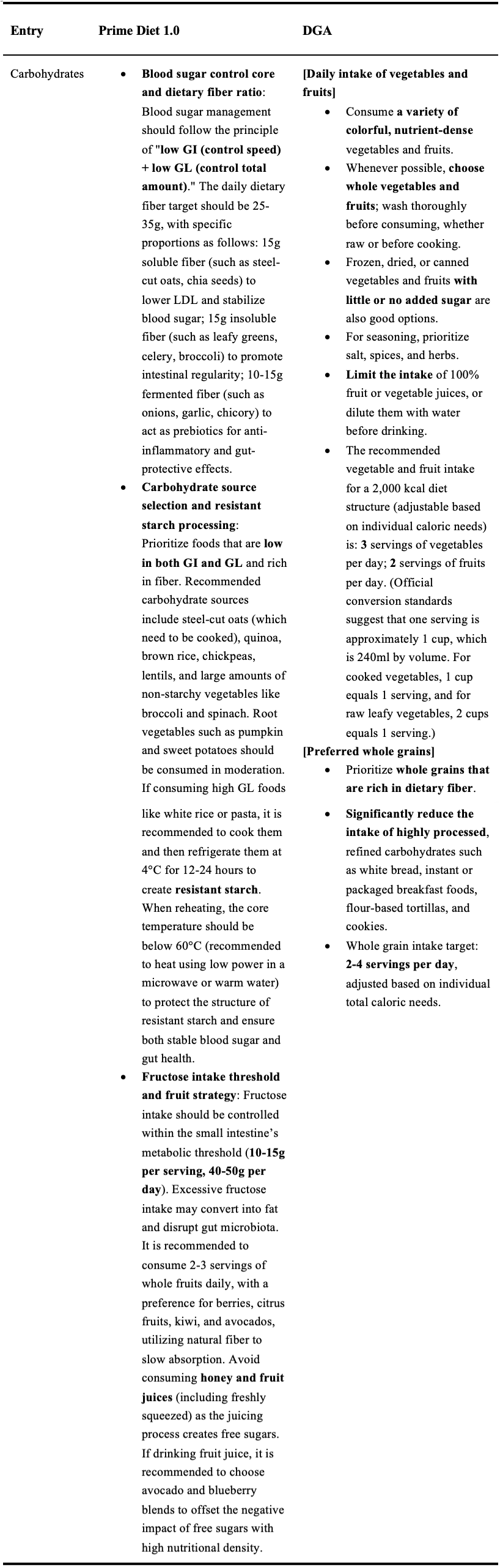
Broadly speaking, DGA and Prime Diet align on carbohydrates, but differ in technical precision due to their target audiences.
- Structural integrity and grain selection:The DGA recommends whole wheat bread and oats. Prime Diet pushes further — toward steel-cut oats and intact whole grains — preserving physical structure to lower glycemic index (GI).
- Blood glucose regulation and metabolic optimization:The DGA emphasizes increasing whole grain proportion. Prime Diet requires control of both GI and glycemic load (GL), and introduces a practical strategy: cooling cooked starches to generate resistant starch, thereby reducing insulin spikes.
- Vegetable positioning and fiber strategy:The DGA treats vegetables as foundational components. Prime Diet makes them the volumetric anchor — half the plate by physical volume — allowing satiety to regulate total caloric intake organically.
- Fruit intake and fructose thresholds:The DGA recommends two servings daily and is relatively lenient on diluted juice. Prime Diet strictly avoids free fructose (such as honey and fruit juice). Fruit intake follows small-intestinal metabolic thresholds: 10–15g fructose per meal (approximately 1 to 1.5 apples). Priority is given to nutrient-dense whole fruits like berries to minimize hepatic fat conversion.
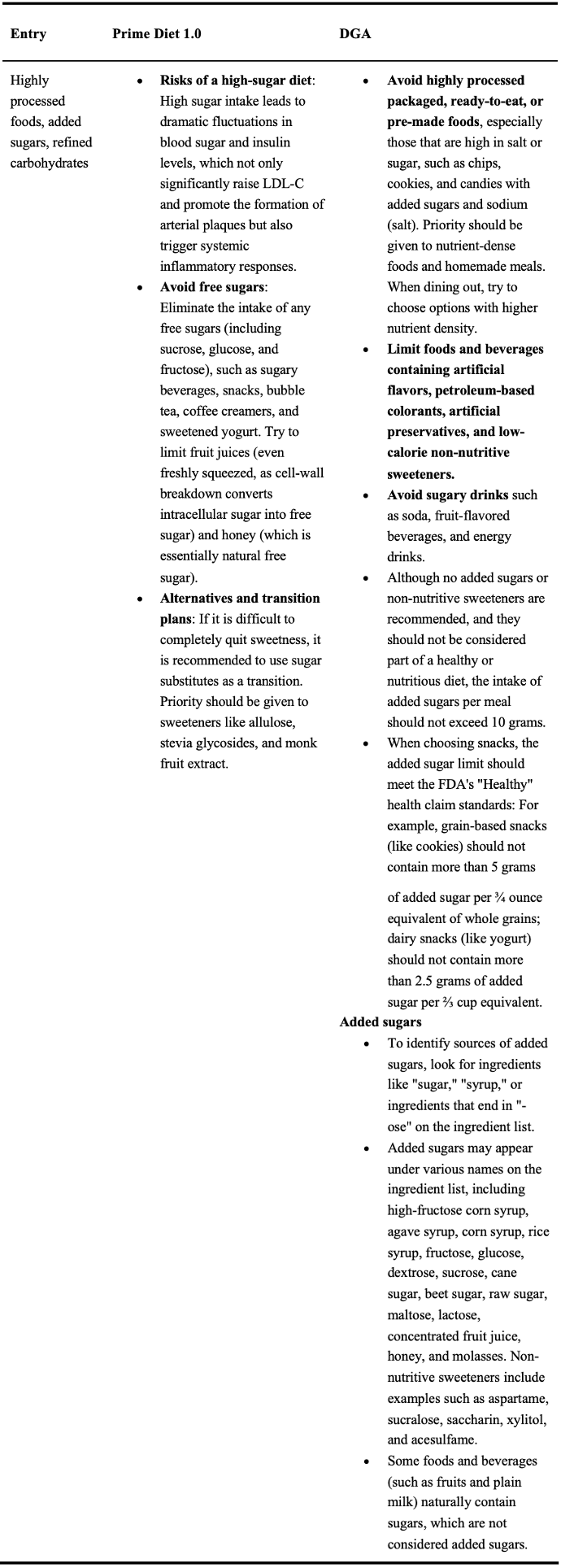
On non-nutritive sweeteners, the difference is subtle.Both frameworks avoid endorsing aspartame and similar artificial sweeteners. The DGA leans toward broad restriction. Prime Diet adopts a substitution strategy: if sweeteners meaningfully reduce intake of free sugars (such as sucrose or high-fructose corn syrup), they may hold transitional value.
Quality still matters. For individuals struggling to detach from sweetness, allulose, stevia glycosides, and monk fruit extract can serve as pragmatic bridge tools under current evidence.
Prime Diet’s stance is simple: replace “short-term confirmed harmful” sugars with “short-term relatively safe, long-term under observation” alternatives. Gradual redirection is often more sustainable than abrupt prohibition. Sometimes, a second-best strategy is what actually enables long-term adherence.
V. Other Considerations

Prime Diet 1.0 remains in ongoing development in certain areas. Qualitatively, our current positions largely align with DGA 2025, though quantitative differences may emerge.
Take alcohol as an example. The new DGA removed its previous numeric guidance (“no more than two drinks per day for men, one for women”), replacing it with a vague recommendation to “reduce intake.”
Prime Diet’s position is more direct: the less alcohol, the better — ideally zero.
We recognize the social complexity and emotional context surrounding drinking. But from a purely physiological standpoint, the scientific evidence linking** alcohol to health risk is unequivocal.**
We may elaborate further in a future article — or incorporate updates into Prime Diet 2.0.
Intervention recommendations are geared toward generally healthy individuals. If you have existing health conditions, always follow your doctor’s instructions.
References
[1]Fardet A. New hypotheses for the health-protective mechanisms of whole-grain cereals: what is beyond fibre? Nutr Res Rev. 2010 Jun;23(1):65–134.
[2]Liu AG, Most MM, Brashear MM, Johnson WD, Cefalu WT, Greenway FL. Reducing the glycemic index or carbohydrate content of mixed meals reduces postprandial glycemia and insulinemia over the entire day but does not affect satiety. Diabetes Care. 2012 Aug;35(8):1633–1637.
[3]Wilmanski T, Diener C, Rappaport N, Patwardhan S, Wiedrick J, Lapidus J, et al. Gut microbiome pattern reflects healthy ageing and predicts survival in humans. Nat Metab. 2021 Feb;3(2):274–286.
[4]Jang C, Wada S, Yang S, Gosis B, Zeng X, Zhang Z, et al. The small intestine shields the liver from fructose-induced steatosis. Nat Metab. 2020 Jul;2(7):586–593.
[5]Reynolds AN, Akerman AP, Mann J. Dietary fibre and whole grains in diabetes management: Systematic review and meta-analyses. PLoS Med. 2020 Mar 6;17(3):e1003053.
[6]U.S. Department of Agriculture & U.S. Department of Health and Human Services. (2025). Dietary Guidelines for Americans, 2025–2030 (10th ed.).