On January 7, 2026, the USDA and HHS jointly released the 2025–2030 Dietary Guidelines for Americans (DGA), a once-every-5-years publication that heavily influences federal policies, clinical nutrition advice, and public eating habits. This is the 10th edition since 1980.
And this edition has sparked unprecedented controversy[1–3].
- TheAmerican Heart Association (AHA)publicly raised concerns about sodium intake, red meat, and saturated fat in dairy.
- Deanne Brandstetter, President of theAcademy of Nutrition and Dietetics (AND), noted that “some of the recommendations in the DGAs are not aligned with the current body of evidence and will create challenges for implementation”.
- TheCenter for Science in the Public Interest (CSPI)even released its own “uncompromised version” of the guidelines, directly challenging the USDA head-on.
What exactly went wrong in this edition of the DGA?
Let’s take a deep dive, from the perspective of Prime Lab’s nutrition research and real-world practice.
What’s Changed in the New Guidelines?
The latest edition has been drastically slimmed down — from 164 pages in 2020 to just 10 pages (only 6 for the general population). Admittedly, this makes it more actionable. But the tradeoff is less nuance, leaving plenty of room for misinterpretation.
Let’s break down the most debated changes:
1️⃣ Protein: A Breakthrough in Quantity — But a Double-Edged Sword
The recommended daily intake for protein has been increased from 0.8 g/kg to 1.2–1.6 g/kg, especially for older adults. This is a meaningful leap forward.
For midlife and beyond, increased protein helps preserve muscle mass, stabilize blood sugar, and increase satiety, all of which help counteract metabolic aging.
At Prime Lab, we’ve long treated “adequate protein” as a foundational pillar of nutrition. But this is a double-edged sword: protein is only beneficial when used wisely.
Yes, it activates mTOR, a key signal for muscle growth and repair. But chronically elevated mTOR (especially from excess animal protein) may also accelerate aging and inflammation, particularly when paired with a sedentary lifestyle and caloric surplus.
So protein must be timed and tailored — especially around exercise windows, when mTOR activation is productive and beneficial.
Our recommendations:
- Adults in general:1.2–1.5 g/kg
- Sedentary individuals:1.0–1.2 g/kg
- Resistance training:1.5–2.0 g/kg
- Healthy older adults:1.0–1.2 g/kg;Older adults with sarcopenia:1.2–1.5 g/kg;Severe malnutrition risk: up to2.0 g/kg
2️⃣ Underestimating the Risks of Red Meat
The new guidelines take a lenient stance on red meat, likely aiming to balance nutrient needs (e.g., iron, B12) for groups like the elderly, pregnant women, and athletes.
But red meat carries well-established risks:
- Classified as a Group 2A carcinogenby the IARC, with strong links to colorectal cancer4.
- High inpalmitic acidand other fatty acids that, especially in high-energy, low-fiber diets, can fuelchronic inflammation and metabolic dysfunction.
- Containsheme iron, which is highly bioavailable but hasno active excretion path. Over time, this can lead toiron overload— triggering oxidative stress, accelerating aging, and elevating chronic disease risk (especially in non-menstruating women and men who don’t donate blood).
We reviewed the studies cited by the DGA: many are short-term, lab-controlled trials that fail to account for long-term chronic disease or cancer risk[5–8].
At Prime Lab, we don’t demonize red meat — but we do recommend moderation. 1–2 small servings per week is a safer range.
3️⃣ Dairy and Fat: A Math Problem Without a Solution
The DGA now embraces “full-fat dairy without added sugar”, stepping away from its old fat-phobic bias.
That’s a good correction. But here’s the paradox:
The guidelines recommend 3 cups of full-fat milk per day. According to FDA standards, that equals about 13.5g of saturated fat.
At the same time, they cap saturated fat intake at 10% of total calories, or roughly 22g/day on a 2,000 kcal diet.
So just the milk alone consumes 60%+ of the daily saturated fat allowance. Eat a little red meat or use a spoon of butter, and you’re already over the limit.
At Prime Lab, we agree with setting a saturated fat cap — ideally closer to 5–6% for longevity, though 10% is reasonable for the general public.
But when the cap is fixed, you have to spend it wisely — on nutrient-dense, high-quality fat sources like eggs (1.5–2g saturated fat each) or full-fat milk, not red meat and butter.
This is why Prime Diet 1.0** emphasizes poultry and plant protein over red meat**.
Reading the New Inverted Pyramid: More Confusion Than Clarity
Over the years, the US has tried several visual formats:
- 1992: the infamous “low-fat, high-carb”classic food pyramid
- 2005: the abstract, unusableMyPyramid
- 2011: the overly simplifiedMyPlate
Now, we have an Inverted Food Pyramid — a bold visual pivot, but a confusing one.
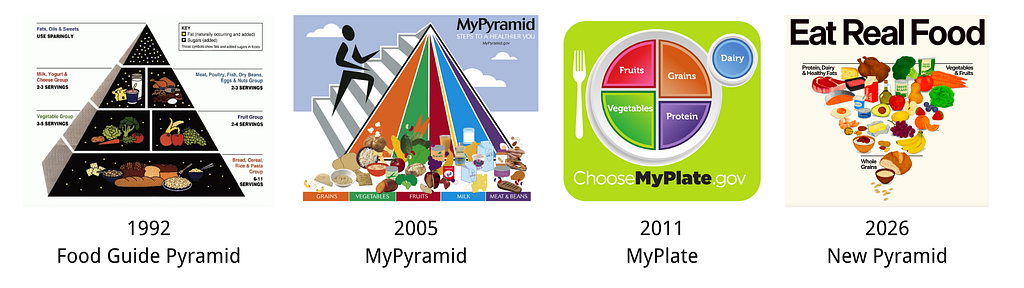
Let’s break it down:
⬅️ Left Side: Unlimited Protein and Fat?
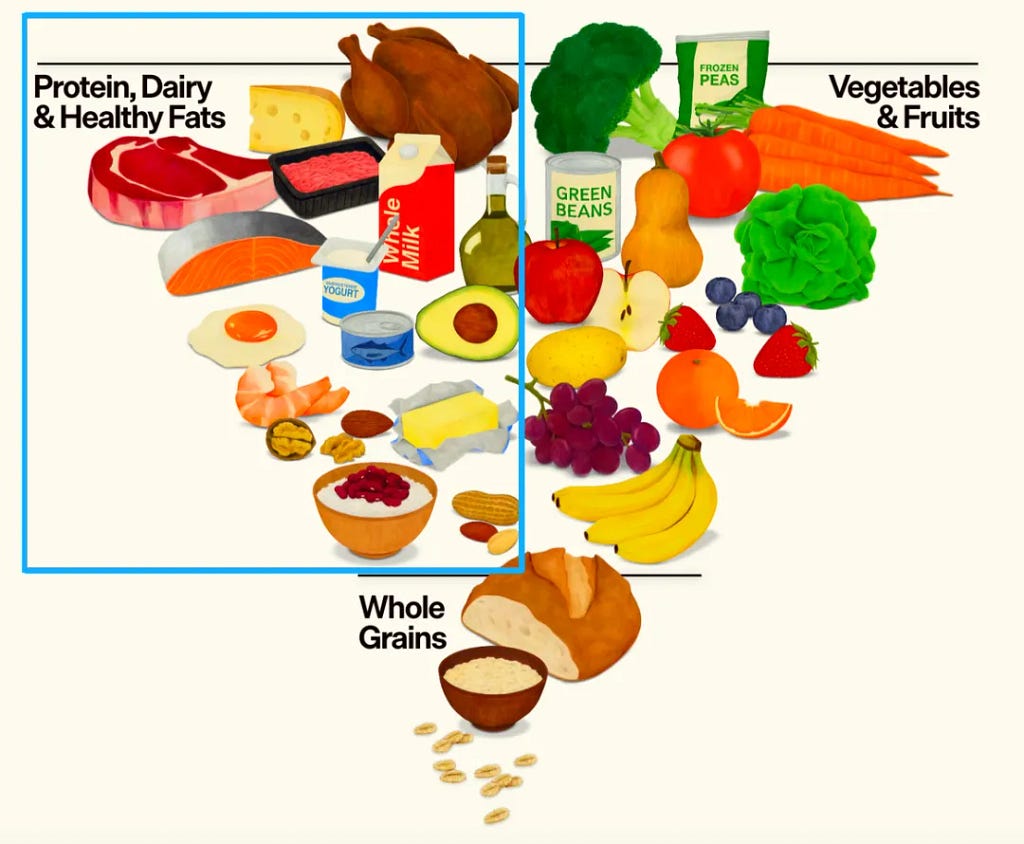
- Despite the10% saturated fat limitin the text, the visual chartgroups full-fat dairy, butter, and red meat togetheron the same tier — withno warnings or upper limits. It visually suggests: “These are all great, eat freely.” But follow this chart blindly, and you’ll overshoot saturated fat fast.
- Plant proteins, meanwhile, arerelegated to a corner— visually minimized, contrary to the guideline’s text which calls fordiverse protein sources.
From a Prime Life perspective, plant protein has distinct advantages:
- Lower mTOR activation, which meansless cellular overdrive, more longevity gains.
- Comes bundled withfiber and micronutrients.
But plant protein also haslower amino acid density and bioavailability, so older adults with low activity may struggle to maintain muscle if relying solely on plants. In these cases, total intake andleucine sufficiencymust be closely monitored.
➡️ Right Side: Fruit Over Vegetables?
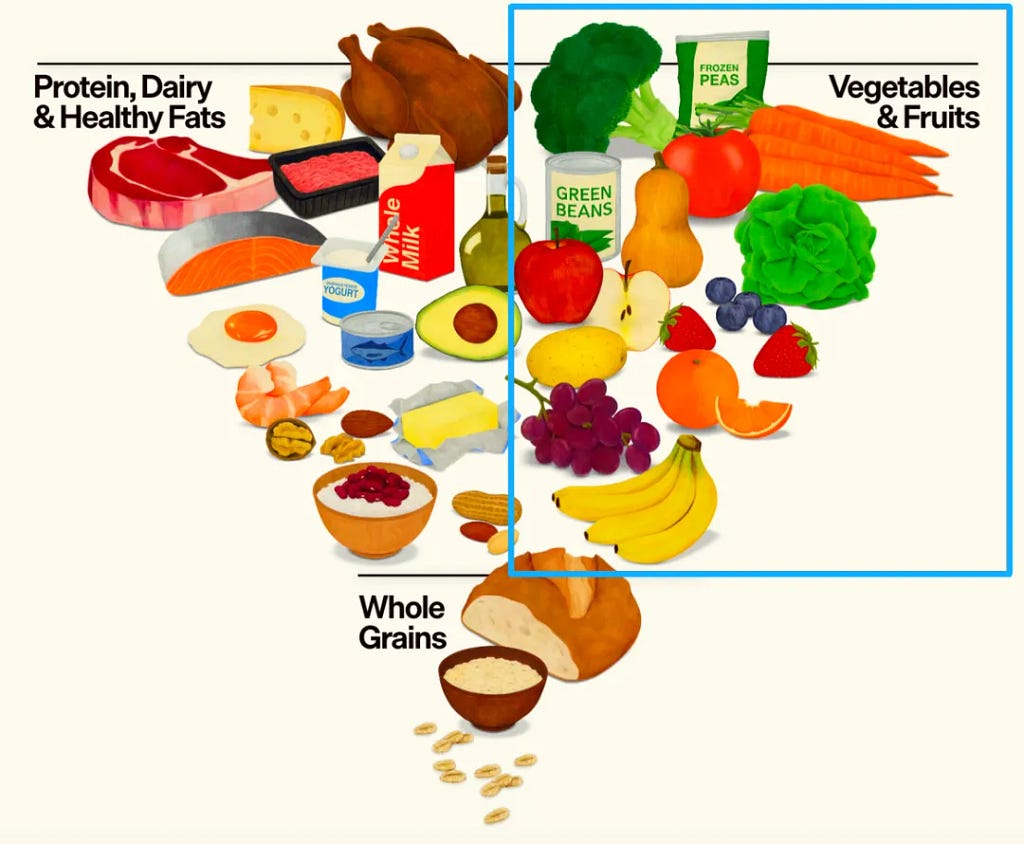
- The guideline recommends3 servings of vegetables and 2 of fruit daily. Yet the chart gives fruitlarger visual space and more vivid color, unintentionally casting it as the hero.
- Potatoes — technically starches — aregrouped with apples and oranges, misleadingly suggesting they’re equal. This can lead todouble-carb meals(e.g., rice + stir-fried potatoes), spiking blood glucose.
- There’s evencanned green beansin the chart. Processed, high-sodium foods like these shouldn’t be modeled visually. At Prime Lab, we always advocate forfresh, whole foods.
Our take on fruits and vegetables:
- Let vegetables take uphalf your plate.
- Fructose ≤ 15g per meal(about 1–1.5 apples), or40–50g per day, is a manageable load.
- If fruitreplaces added sugars, it can even helpstabilize blood glucose[12–15].
- Butvegetables should still outweigh fruitin overall quantity.
⬇️ Bottom: The Underloved Carbs
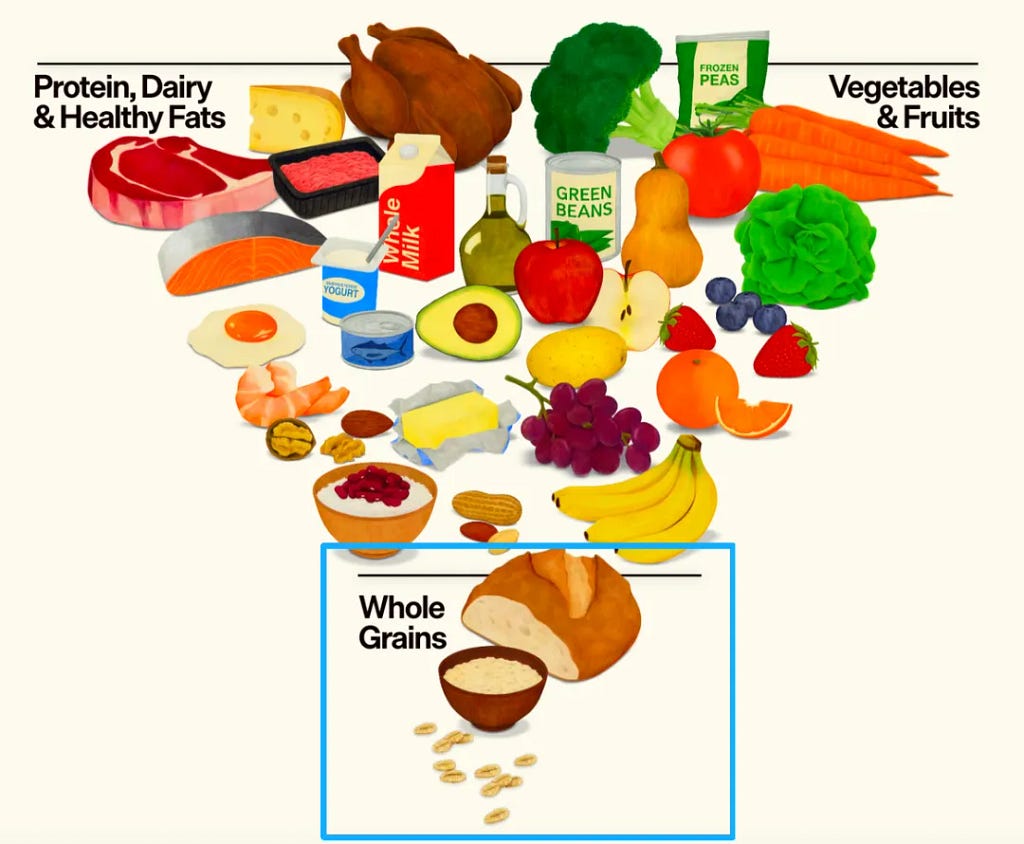
Whole grains are squeezed into a tiny sliver at the bottom, looking like an afterthought.
This creates a false sense of “low-carb is ideal”, especially when compared to the 1992 original pyramid.
Yet the actual guideline calls for 2–4 servings of carbs/day (roughly 1–2 bowls of cooked rice). That’s more than the chart implies.
Prime Lab’s view:
- Carbs are thebrain’s primary, most efficient fuel.
- Don’t fear them — but chooselow-GI sources.
- A good ratio:half the plate = vegetables, the rest divided equally amongprotein, fat, and carbs.
- Adjust carb portion slightly downward based on your metabolic profile to balanceenergy needs and blood sugar control.
How Should We View the Guidelines?
At its core, the DGA is policy, not science. It’s designed to address America’s public health crisis — rampant obesity and stubborn chronic disease — through defensive, population-level strategy.
Understanding that, you’ll see why it sometimes “overcorrects.”
This version is also steeped in MAHA (“Make America Healthy Again”) political flavor. The stance against ultra-processed foods, skepticism toward industrial seed oils, and renewed support for “natural” animal proteins all reflect the ideological fingerprints of figures like RFK Jr.
Put simply: this is a mass-level rescue protocol, not a precision health guide for individuals.
From a Prime Life perspective, there’s no one-size-fits-all menu.
A truly useful guideline emerges from your own metabolic data, hormone profile, and lifestyle. Rather than blindly following government templates, we’d rather you start by knowing yourself.
In fact, Prime Lab has previously developed Prime Diet 1.0 — a personalized, evidence-based framework. In our next article, we’ll revisit that in light of the DGA’s controversies, and go deeper into the nutritional logic behind our system.
Stay tuned.
Intervention recommendations are geared toward generally healthy individuals. If you have existing health conditions, always follow your doctor’s instructions.
References
[1]https://newsroom.heart.org/news/releases-20260107-6915862
[3]https://www.cspi.org/statement/new-dietary-guidelines-undercut-science-and-sow-confusion
[4]International Agency for Research on Cancer. IARC’s Mission: Cancer Research for Cancer Prevention. IARC, 2025. Accessed 29 July 2025
[5]Sanders LM, Palacios OM, Wilcox ML, Maki KC: Beef Consumption and Cardiovascular Disease Risk Factors: A Systematic Review and Metaanalysis of Randomized Controlled Trials. Curr Dev Nutr 2024, 8:104500.
[6]Sanders LM, Wilcox ML, Maki KC: Red meat consumption and risk factors for type 2 diabetes: a systematic review and meta-analysis of randomized controlled trials. Eur J Clin Nutr 2023, 77:156–165.
[7]O’Connor LE, Kim JE, Campbell WW: Total red meat intake of ≥0.5 servings/d does not negatively influence cardiovascular disease risk factors: a systemically searched meta-analysis of randomized controlled trials. Am J Clin Nutr 2017, 105:57–69.
[8]Akheruzzaman M, Hefner M, Baller D, Clark S, Feizy Z, Thomas DM, Dhurandhar NV: Effect of unprocessed red meat on obesity and related factors: A systematic review and meta-analysis. Obesity (Silver Spring) 2025, 33:1627–1636.
[10]https://www.ecfr.gov/current/title-21/chapter-I/subchapter-B/part-131/subpart-B/section-131.110
[11]https://fdc.nal.usda.gov/food-details/746782/nutrients
[12]Jang, Cholsoon, et al. “The Small Intestine Converts Dietary Fructose into Glucose and Organic Acids.” Cell Metabolism, vol. 27, no. 2, 2018, pp. 351–361.e3.
[13]Jang, Cholsoon, et al. “The Small Intestine Shields the Liver from Fructose-Induced Steatosis.” Cell Metabolism, vol. 32, no. 5, 2020, pp. 801–812.e6.
[14]Wu, Yanru, et al. “Glycerate from Intestinal Fructose Metabolism Induces Islet Cell Damage and Glucose Intolerance.” Cell Metabolism, vol. 34, no. 7, 2022, pp. 1042–1053.e6.
[15]Ramírez, Carlos B., et al. “Circulating Glycerate Predicts Resilience to Fructose-Induced Metabolic Disorder in Humans.” Cell Metabolism, 2025.
[16]U.S. Department of Agriculture & U.S. Department of Health and Human Services. (2025). Dietary Guidelines for Americans, 2025–2030 (10th ed.).
[17]U.S. Department of Agriculture & U.S. Department of Health and Human Services. (2020). Dietary Guidelines for Americans, 2020–2025 (9th ed.).