Looking back on all the sleep modules we’ve explored so far, one thing becomes clear:
Whether it’s light, temperature, diet, exercise, CANS (Caffeine, Alcohol, Nicotine, Sugar), circadian rhythm, or regularity — these seemingly different themes are all trying to do the same thing.
They are physical signals, sent through the body, repeatedly delivering a single message to the nervous system: Is it safe? Is it predictable? Can we finally let down our guard?
- Light resets the SCN (Suprachiasmatic Nucleus), signaling the handoff between cortisol and melatonin.
- Temperature regulates peripheral vasodilation and core body heat, gently activating the parasympathetic nervous system.
- Blood sugar levels determine whether your body will rebound with stress hormones in the middle of the night.
- CANS disrupt the balance of neurotransmitters and can keep your brain on high alert.
- And regularity? Regularity equals predictability. Predictability equals safety.
All signs point to one truth: Sleep is never an isolated event. It’s the nervous system’s integrated response to how you live your entire life.
So when it comes to falling asleep, there are always two doors:
- One is physical — creating a physiological and biochemical environment where the parasympathetic system can take over with ease.
- The other is psychological — training your attention and interpretive frameworks, gradually reshaping the brain’s threat-detection system and lowering your stress threshold so parasympathetic activation can happen at night, more reliably and more often.
This brings us to one of Prime Lab’s core principles in mental health and emotional regulation: mind and body are one.
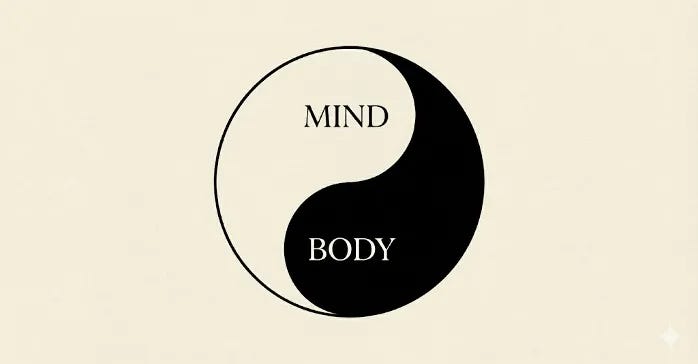
Painted by AI
Prime Life flows in two directions:
We move from the body to the mind. And we also use the mind to influence the body.
Only when these two paths converge, do we find a truly sustainable peak state — @Prime.
Most of what we’ve covered so far in the sleep series has been focused on the first path: from body to mind. Now it’s time to start exploring the second one, through future modules on emotions and mental states.
But in this entry, we’ll stay focused on one example — how both of these paths come together in a Winding-Down Routine to help sleep happen naturally.
From Body to Mind
This part is simple. You follow the checklist we’ve gradually built up in previous articles — removing anything that might keep your sympathetic system online and gently clearing the way for parasympathetic mode to take over.
Specifically:
- Try to fall asleep before midnight, and keep your sleep-wake rhythm stable.
- Finish your last cup of coffee by noon, or switch to low-caf alternatives.
- Avoid alcohol after dinner (or better yet, skip it altogether).
- Avoid smoking.
- Don’t eat high-glycemic or sugary foods in the 3–4 hours before bed; avoid late-night snacking.
- Get natural outdoor light within 30 minutes of waking up; avoid blue light 1–2 hours before bed; use warm lights with a color temperature below 2700K (ideally 1000–2000K).
- Stay off electronic devices for at least an hour before sleep, especially phones in bed.
- Sleep in complete darkness.
- Take a hot bath or foot soak 60–90 minutes before bed.
- Keep your room cool and well-ventilated, use breathable bedding.
If falling asleep is a struggle for you, this checklist is a good place to start — inspect your environment and behaviors to see if any of them are sending the wrong signals.
Once your micro-environment is tuned to welcome parasympathetic activation, sleep often arrives without force.
From Mind to Body
In the previous entry, we explored four mental paradigms that promote parasympathetic states. These mental modes need a “carrier” — something that feels familiar and safe to you — so that you can revisit them repeatedly in low-stress situations, and let their patterns slowly imprint onto your body [1–7].
But let’s be clear: mastering these mental paradigms takes time. You likely won’t feel a dramatic shift on night one. Why? Because the thing we’re rewiring isn’t our logical brain — it’s the underlying threat-detection system: the limbic system, the brainstem, the hypothalamus. That takes repetition and safety.
So again, here are the four paradigms:
- No planning
- No problem-solving
- No responsibility
- No judgement
The thoughts that disrupt sleep usually show up disguised in different names: risk assessment, contingency planning, cost-benefit analysis, self-reflection, prepping for tomorrow. The list never ends.
Fortunately, there are many Winding-Down Routines that can serve as “carriers” for these paradigms: reading, journaling, talking, sketching, listening to music or podcasts, bathing, breathing, meditating, stretching… the key is to find one that feels effortless and familiar to you.
But a few key distinctions are worth emphasizing:
1. If it still feels like “practice,” don’t do it before bed
Anything that requires effort, goals, improvement, or progress — that’s sympathetic mode. Practicing, optimizing, tracking, even evaluating whether your practice is working — this entire loop belongs to the “doing” brain.
So ironically, trying to “practice” something that’s meant to activate your parasympathetic system may have the opposite effect, especially if you haven’t mastered it yet2,7.
In other words:
Practice → Optimization → Evaluation → Self-Monitoring → Sympathetic Activation
Take meditation. Is it a good wind-down tool? Yes, but only if you’re already deeply familiar with it. If you’re “practicing” meditation before bed — trying to become a better meditator — you’re actually doing the opposite. You’re working. That’s a sympathetic state 8,9.
Winding-down routines should be effort-free, non-evaluative, and responsibility-free in the moment.
That doesn’t mean you should stop practicing these mental paradigms. Far from it — they’re powerful tools, and their benefits go far beyond sleep. Just don’t practice them right before bed. Do them earlier — after dinner, or before a nap — when sleep isn’t your goal.
2. Be cautious with language-based winding-down tools
Using language to “train” parasympathetic modes is a high-level skill. The benefits are huge, but so are the risks.
Yes, natural, judgment-free storytelling (narrative drift) can be parasympathetic. But language, when unconscious, easily slides into meaning → judgment → responsibility → action → sympathetic activation [4–6].
Let’s say you try journaling before bed. Great idea — unless you start reflecting on the day, evaluating wins and losses, planning tomorrow, or feeling emotions as you write. Even if you try to “close” the writing process (like ripping the page to signal “the day is over”), it still requires a high level of internal awareness to prevent sympathetic activation 10,11.
A 2019 study gave participants 14 minutes of relaxing music or spoken text before a 90-minute nap, on two separate days. The results? Even at the same volume and duration, music led to significantly shorter N1 (lightest sleep stage) and longer deep sleep (N3), plus better subjective sleep scores. Language-based stimuli made it harder to reach restorative sleep.
The same logic applies to “winding-down conversations.” They sound nice in theory — but they demand high cognitive alignment and emotional safety between partners. In most real-world relationships, this kind of non-judgmental, non-instrumental storytelling is rare — and hard to sustain.
You could read a book that’s plotless, emotionless, and judgment-free. But let’s be honest: mustering the energy to read that kind of book at bedtime is a struggle in itself. And struggle is a sympathetic state.
By contrast, non-verbal activities — like sketching, listening to instrumental music, bathing, breathing, stretching — tend to be safer and easier for most people. They offer a gentler space to practice “no planning, no solving, no responsibility, no judgement.”
3. The key isn’t what you do — it’s what you don’t do
The goal isn’t to do parasympathetic thinking. It’s to arrive at a state of not doing — a state with no effort, no goals, no self-assessment.
But if that’s hard to access, then doing something that passively occupies your bandwidth can help.
Back to language. Let’s say you listen to a podcast or audiobook before bed. If the content is dry or complicated, it may actually help by overloading your cognitive bandwidth and gently “crashing” your system. In that passive context, it feels effortless.
But if your goal is to squeeze in one last learning session before sleep — well, now you’re back in sympathetic mode. The harder the content, the harder sleep becomes 12.
Even non-verbal activities can turn sympathetic if you attach too much intention to them — trying to do them “right,” “effectively,” or “better.”
For example:
- Meditation, as I mentioned earlier.
- Deep exhalations activate the parasympathetic system, but trying hard to breathe deeply can create tension13,14.
- Body scans are helpful — if they’re vague. Precision scans can become goal-oriented and effortful 7,9.
- Stretching helps, but only if it lets your muscles release, not work harder1,2.
- Drawing can be great — until you start judging your work. “Does this look good?” Boom. Sympathetic mode reactivated 12.
This is the subtle part. It’s hard to explain fully in words. You’ll need to experience it for yourself.
4. No matter the method, consistency matters most
To your nervous system, routine = predictability = safety.
And safety is what parasympathetic mode craves.
So whatever your routine looks like, build it with consistency. Start the same actions, at the same time, in the same order. Say the same words, even. Predictability is the point. Novelty is not 2.
You don’t need anything fancy.
A warm bath and foot soak at 9:30 PM. Then face wash, brushing teeth, tidying the bed. Lights out at 10:30 PM.
Effortless. Repeated. Familiar.
That’s all your system needs to wind down.
One More Thing…
Even after writing all this, I’ll admit — this mental framework isn’t always easy to apply. I still stumble.
But I try to return to these four principles again and again, until they become routine. Until they send a quiet signal to my system: it’s time to let go.
At night, I write down four lines.
They’ve become a small ritual. A nightly reminder. A gentle reprogramming of my internal narrative.
At Night, We Enter A State Of — —
No Planning, No Problem-Solving, No Responsibility, No Judgment.
Intervention recommendations are geared toward generally healthy individuals. If you have existing health conditions, always follow your doctor’s instructions.
References
[1]Edinger JD, Arnedt JT, Bertisch SM, Carney CE, Harrington JJ, Lichstein KL, et al. Behavioral and psychological treatments for chronic insomnia disorder in adults: an American Academy of Sleep Medicine clinical practice guideline. J Clin Sleep Med. 2021 Feb;17(2):255–262.
[2]Espie CA, Broomfield NM, MacMahon KMA, Macphee LM, Taylor LM. The attention-intention-effort pathway in the development of psychophysiologic insomnia: a theoretical review. Sleep Med Rev. 2006 Aug;10(4):215–245.
[3]Riemann D, Spiegelhalder K, Feige B, Voderholzer U, Berger M, Perlis M, et al. The hyperarousal model of insomnia: a review of the concept and its evidence. Sleep Med Rev. 2010 Feb;14(1):19–31.
[4]American Academy of Sleep Medicine. International classification of sleep disorders — third edition text revision (ICSD-3-TR): supplemental material. Darien (IL): American Academy of Sleep Medicine; 2023.
[5]de Zambotti M, Trinder J, Silvani A, Colrain IM, Baker FC. Dynamic coupling between the central and autonomic nervous systems during sleep: A review. Neurosci Biobehav Rev. 2018 Jul;90:84–103.
[6]Harvey AG. A cognitive model of insomnia. Behav Res Ther. 2002 Aug;40(8):869–893.
[7]Broomfield NM, Espie CA. Towards a valid, reliable measure of sleep effort. J Sleep Res. 2005 Dec;14(4):401–407.
[8]Gong H, Ni CX, Liu YZ, Zhang Y, Su WJ, Lian YJ, et al. Mindfulness meditation for insomnia: a meta-analysis of randomized controlled trials. J Psychosom Res. 2016 Oct;89:1–6.
[9]Ong JC, Manber R, Segal Z, Xia Y, Shapiro S, Wyatt JK. A randomized controlled trial of mindfulness meditation for chronic insomnia. Sleep. 2014 Sep;37(9):1553–1563.
[10]Cordi MJ, Ackermann S, Rasch B. Effects of relaxing music on healthy sleep. Sci Rep. 2019 Jun 24;9(1):9079.
[11]Carney CE, Harris AL, Moss TG, Edinger JD. Distinguishing rumination from worry in clinical insomnia. Behav Res Ther. 2010 Jun;48(6):540–546.
[12]Harvey AG, Payne S. The management of unwanted pre-sleep thoughts in insomnia: distraction with imagery versus general distraction. Behav Res Ther. 2002 Mar;40(3):267–277.
[13]Laborde S, Mosley E, Thayer JF. Effects of voluntary slow breathing on heart rate and heart rate variability: a systematic review and a meta-analysis. Neurosci Biobehav Rev. 2022 Jul;138:104711.
[14]Magnon V, Dutheil F, Vallet GT. Benefits from one session of deep and slow breathing on vagal tone and anxiety in young and older adults. Sci Rep. 2021 Sep;11:19267.