In The Matrix, Morpheus offers Neo two options: one promises comfort without truth, the other — truth without comfort.
As I continued to study and reflect, I’ve come to realize something profound: living in this era is an extraordinary stroke of luck.
We may be the first generation in human history with access to a true “super option” — one that could rewrite not only how long we live, but how much of that time we actually own.
Let me walk you through the three goals of what I call a Prime Life (initially proposed from previous essay), and why they represent the foundation of that choice.
The Three Goals of Prime Life
- Own every single day: Be present, grounded, free, and at peace. With clarity of mind and strength of body, I want to fully feel, respond to, create, and experience life — moment by moment.
- Live 20 more healthy, happy years: Extend life from the expected 80 years to 100 — not through luck, but through conscious choices and consistent action.
- Health Span / Life Span ≥ 95%: Compress the period of disease and disability into the final 2–5% of life, instead of the current 15–20%.
Why set such ambitious goals?
Because long-term consistency needs fuel. A reason that’s both grounded and galvanizing. Something we believe is possible — and also worth it.
I hesitated before writing this down. These goals are bold. Not everyone will achieve them. Genetics, environment, and accidents are real. Even if we do everything “right,” nothing is guaranteed.
But I wrote them anyway. Because I believe that clarity of purpose is the root of resilience.
Just like a great company needs a great vision, a meaningful life deserves a horizon that pulls us forward. If we can’t even convince ourselves, how can we expect to go to bed on time, eat the right food, or choose discomfort over convenience — again and again?
To be clear: Prime Life is not about certainty. It’s about increasing our odds. The world runs on probabilities. So does life. And no matter where we start, this framework helps us tip the odds in our favor.
The Stoics said it best, thousands of years ago:
The only thing we truly own is our actions. Be calm about what you can’t control. Do everything you can about what you can. And learn to know the difference.
1. Are These Goals Scientifically Grounded?
Let’s look at the numbers.
In developed countries, the average life expectancy is ~80 years, but healthy life expectancy’s just 80% of that. Which means most people spend the last 10+ years of their life in pain, dependency, or both.
My goal is different: → Extend life by 20 years, reaching 100 → Compress disability into the last 2–5 years → Achieve Health Span / Life Span ≥ 95%
It sounds audacious — but data tells us it’s within reach, especially for those willing to act.
▍Extending life by 20 years
- A 2022 review in Nature Aging found that multi-pronged lifestyle interventions — diet, sleep, exercise, chronic disease management — can extend life by 10–15 years
- Buck Institute longevity modeling suggests a +20 year extension is theoretically possible with sustained midlife interventions
- Real-world “Blue Zone” populations — who don’t rely on modern drugs — already live to 95–100 naturally
▍Compressing frailty into <5% of life
- Multiple Lancet and Nature Aging studies agree: shrinking the end-of-life disease window is a key frontier
- Research on Super-Agers shows that 2–3 years of final decline is not only possible — it’s happening
- Science is actively delaying biological decline through earlier detection and smarter maintenance
And that first goal — “Owning every single day” — is not a distant ambition. It’s a daily experience. Presence, agency, and peace aren’t just virtues. They’re also medicine. Studies show that mindfulness, purpose, and connection boost immunity, reduce inflammation, and strengthen cardiovascular function.
Living well now is how we earn more time later.
2. Why Is “20 Extra Years” a Super Option Only We Hold?
These Prime Life goals matter not only because they’re good in themselves — but because they position us to catch the wave of something unprecedented.
We live at a strange intersection of science, society, and possibility.
▍Tipping Point 1: Technology is beginning to fight aging itself
For most of human history, aging was an untouchable truth. But in recent years, that line has started to blur.
A once fringe concept — Longevity Escape Velocity (LEV) — is now entering mainstream scientific discourse. It describes the moment when technological life extension outpaces the natural aging process.
Ray Kurzweil once put it this way:
For every year you stay alive, you may gain two months of life.
That’s not science fiction. It’s a real projection. With rapid advances in AI-driven diagnostics, cellular reprogramming, senolytic drugs, and regenerative medicine, the velocity is accelerating. And our relationship to time is changing.
Maybe someday, history books will say:
On this day, the first 150-year-old was born. On this day, the first 1000-year-old began their journey.
And maybe that day has already passed. Maybe that person is already walking among us. Maybe that person… is us.
We won’t know until much later. But the choices we make today — what we eat, how we sleep, what we prioritize — might just be the reason we’re still here to witness that moment.
That’s the first super option.
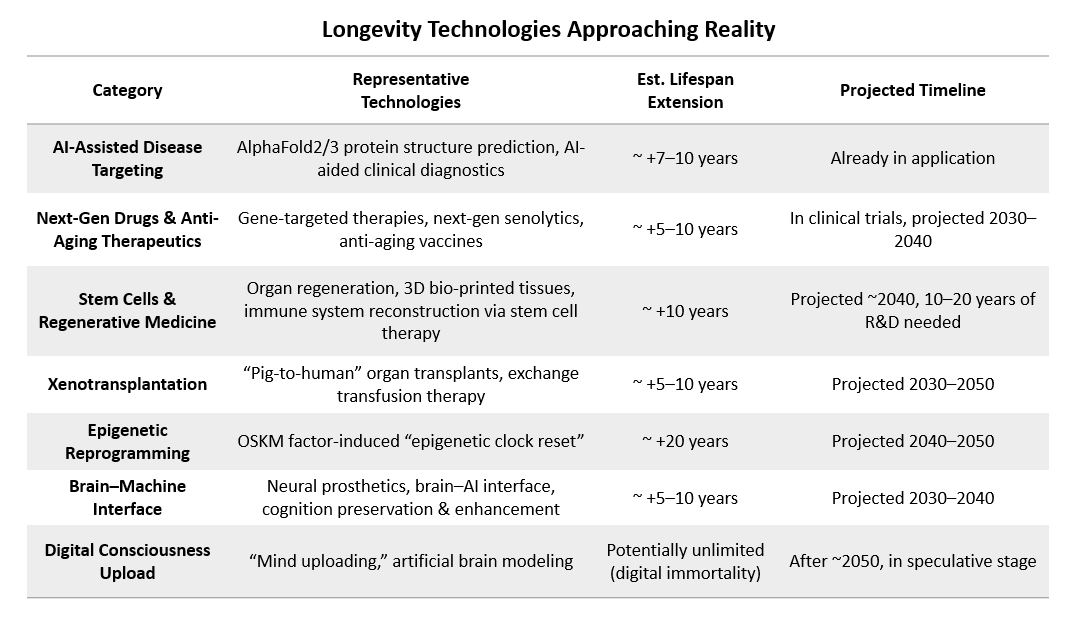
Here’s a glimpse at some of the near-future technologies with life-extending potential, with my biased, romantic, optimistic, and personal point of view.
▍Tipping Point 2: Civilization is changing faster than we are
This next century might be the most consequential 100 years in human history.
AI is reshaping every industry from the core. Fusion energy and quantum computing are on the brink. Space colonization, consciousness transfer, brain-machine interfaces — These are no longer fantasy. They are roadmaps.
We don’t know exactly when the shift will come, or if it will bring miracles or mayhem. But the shape of humanity will be different.
And I know one thing: I don’t want to miss it.
I don’t just want to observe history. I want to contribute. I want to be part of what comes next — whether from the sidelines or center stage — adding what little I can to nudge the future in a direction worth hoping for.
That’s our second super option.
3. Why Prime Lab?
Because I want to keep as much agency — over my body, my mind, and my future — as I possibly can.
To give myself a shot at those two super options. And to start, right now, building a life that’s worth extending.
This is how I see it:
Romantic Pragmatism.
If a goal feels too far, break it into steps. If a step seems doable, begin today.
Romance is believing the future can be beautiful. Pragmatism is choosing to walk toward it.
So let’s begin — together. In the coming essays from Prime Lab, we’ll explore the tools, choices, and frameworks for designing and living a Prime Life.
Let’s do this.
References10
[1]Fried, Linda P., Jing E.–L. Wong, and Victor Dzau. “A Global Roadmap to Seize the Opportunities of Healthy Longevity.” Nature Aging, vol. 2, no. 12, 2022, pp. 1080‑1083. [2]Parkhitko, Andrey A., Elizabeth Filine, and Marc Tatar. “Combinatorial Interventions in Aging.” Nature Aging, vol. 3, no. 10, 2023, pp. 1187‑1200.[3]Shaposhnikov, Mikhail V., et al. Molecular Mechanisms of Exceptional Lifespan Increase of Drosophila melanogaster after Combinations of Pro‑Longevity Interventions. Communications Biology, vol. 5, 2022, article 566. [4]Buettner, Dan, and Samantha M. Skemp. “Blue Zones: Lessons from the World’s Longest Lived.” American Journal of Lifestyle Medicine, vol. 10, no. 5, 2016, pp. 318‑321. [5]Poulain, Michel, et al. “Identification of a Geographic Area Characterized by Extreme Longevity in the Sardinia Island: The AKEA Study.” Experimental Gerontology, vol. 39, no. 9, Sept. 2004, pp. 1423‑1429. [6]Scott, Andrew J., Martin Ellison, and David A. Sinclair. “The Economic Value of Targeting Aging.” Nature Aging, vol. 1, no. 7, July 2021, pp. 616–623. [7]Fries, James F. “Aging, Natural Death, and the Compression of Morbidity.” The New England Journal of Medicine, vol. 303, no. 3, 17 July 1980, pp. 130–135. [8]Scott, Andrew J. “The Longevity Society.” The Lancet Healthy Longevity, vol. 2, no. 12, Dec. 2021, pp. e820–e827. Elsevier, doi:10.1016/S2666‑7568(21)00247‑6. [9]Andersen, Stacy L., et al. “Health Span Approximates Life Span among Many Supercentenarians: Compression of Morbidity at the Approximate Limit of Life Span.” The Journals of Gerontology: Series A, vol. 67, no. 4, 2012, pp. 395–405. [10]Arai, Yasumichi, et al. “Physical Independence and Mortality at the Extreme Limit of Life Span: Supercentenarians Study in Japan.” The Journals of Gerontology: Series A, vol. 69, no. 4, 2014, pp. 486–494. [11]de Grey, Aubrey D. N. J. “Escape Velocity: Why the Prospect of Extreme Human Life Extension Matters Now.” PLoS Biology, vol. 2, no. 6, 15 June 2004, e187.