Today, I’m beginning to unpack the full action framework of Prime Life — starting with the first module: Knowing Yourself.
As highlighted in the framework below —
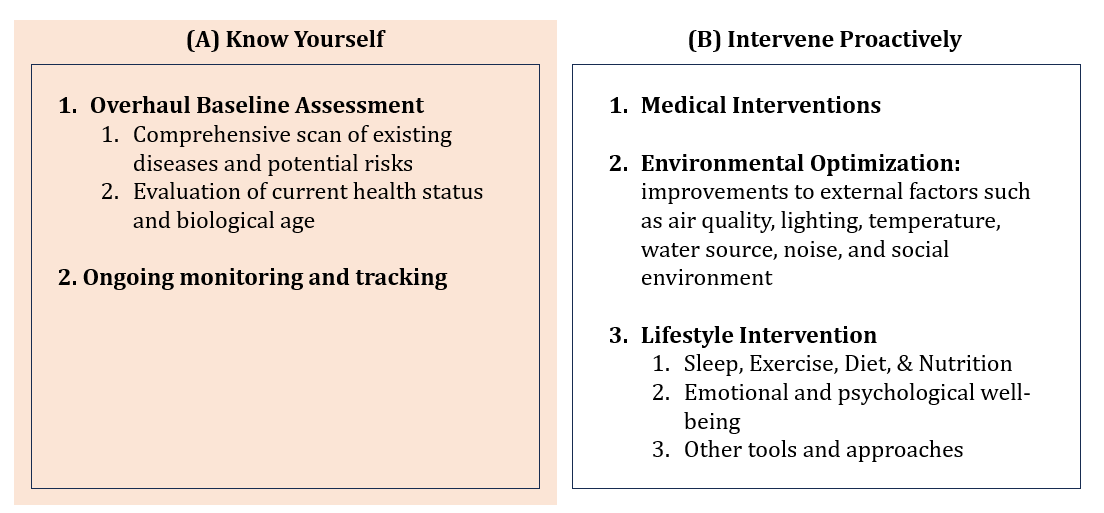
The Prime Life Action Plan
I want to start the “Know Yourself” section with something that might seem mundane, but turned out to be one of the most revealing actions I’ve taken: decoding the “time signatures” buried inside my annual health check-up reports.
Before diving into new diagnostic technologies or tests, I went back to something old — my own health records from the past decade.
From Fragments to Trends
For the past eight years, I’ve consistently undergone annual health checkups. Every year, the report came back with some version of “mostly normal,” and any outliers were usually brushed off by doctors with a casual: “You’re still young — this is likely just a temporary lifestyle fluctuation. It’ll normalize soon.”
But was that really true?
So I did something unusual. I aggregated all the data from those years — PDFs, JPGs, paper files — and compiled them into a master spreadsheet. That turned isolated snapshots into a living, breathing timeline.
It wasn’t easy. The data was messy: different labs, different formats, different naming conventions, and wildly inconsistent units (hello, mg/L vs. mmol/L). But once I stitched everything together, a new health narrative began to emerge.
A Subtle Metabolic Storm: What Trends Revealed
What I found was quietly alarming. Several of my metabolic markers — like total cholesterol, LDL-C, and uric acid — had been hovering at the high end of “normal” for years, and frequently exceeded it. My HbA1c, though still below the diabetic threshold of 6.5, had been creeping upward year by year.
This wasn’t the occasional spike due to a bad month. This was a slow, structural drift. A decade-long trend that had been hiding in plain sight. And the thing is — these metabolic abnormalities are not trivial. They’re deeply entangled with the risk of cardiovascular disease, type 2 diabetes, fatty liver, pancreatic issues, even neurodegenerative diseases and certain cancers.
What was especially counterintuitive: my BMI has always been in the 20–23 range. I’m naturally lean. But this showed me that metabolic risk has little to do with body type. You can look “fit” and still be carrying significant internal risk.
Genetic Confirmation: Risk Written in My DNA
The picture became clearer when I followed up with Whole Genome Sequencing (WGS) at an AI-driven genomics lab. Their analysis indicated I carry a significantly elevated polygenic risk for both hyperlipidemia and gout.
To be clear: I’m not talking about having a single-gene hereditary disorder. This is a polygenic landscape — multiple genes interacting to make me more susceptible to complex, chronic illnesses. It’s not destiny, but it’s a probability curve. Think of it like being told there’s a 60% chance of rain — it doesn’t guarantee a storm, but you’d be smart to carry an umbrella.
Even among those with the same gene variants, whether the disease actually develops depends heavily on lifestyle and environment. Some of us carry protective genes too. So our fate isn’t written in stone — but it’s definitely sketched in pencil.
In my case, this polygenic map gave clarity to a long-standing puzzle. It explained why even with a healthy diet and regular workouts in recent years, my metabolic profile remained stubbornly out of range. It wasn’t that my efforts had failed — it was that my baseline risk was higher to begin with.
Knowing this didn’t discourage me. It lit a fire under me.
Because now I understood: without active intervention, I wasn’t just drifting — I was on track to lose a decade or more from my healthy lifespan.
That’s not fate. That’s a signal. And I’ve chosen to treat it as such.
Once I identified the risks, taking action was surprisingly straightforward. Modern medicine knows how to deal with elevated lipids and chronic metabolic issues. There are well-tested medications, targeted dietary strategies, and highly effective lifestyle interventions.
In fact, this is a topic worth a dedicated piece — how we can intelligently manage and even reverse chronic metabolic dysfunction. Especially since cardiovascular and metabolic diseases together account for around half of all global deaths. But I’ll leave that for another day.
A Quick Summary
Reanalyzing your own health check-up data across time — rather than looking at it as isolated events — can reveal powerful, early clues about chronic disease risk and genetic predisposition. This same approach can also help track the evolution of things like benign cysts or nodules: are they stable, growing, or multiplying over time?
And for the clearest picture, it’s best to combine this trend analysis with other diagnostic layers: blood biomarkers (to track metabolic pathways), genetic testing (for risk), and imaging (to catch structural abnormalities). All of that, over time, gives you the multidimensional map you need to stay ahead.
Chronic disease doesn’t erupt overnight. It simmers. And the earlier you catch the boil, the easier it is to turn down the heat.
And One More Thing…
The more I spoke with endocrinologists and cardiologists, the more I realized something that should’ve been obvious: when it comes to managing chronic metabolic conditions, modern medicine is already incredibly capable. If we can detect the problem early, we have no shortage of tools — drugs, diagnostics, lifestyle interventions — to deal with it.
So why is cardiovascular disease still the world’s number one killer, responsible for nearly half of all deaths?
Maybe the problem isn’t the technology. Maybe the problem… is us.
It’s not ignorance. Most people know the risks. But many still choose not to test, not to treat, not to look too closely. Deep down, they’re making a silent wager — betting they’ll be fine, betting they’ll have time, betting they’ll be the exception.
But this is a bet against a process that moves slowly, silently, and almost irreversibly over decades. And history shows: when it comes to metabolic disease, the house always wins.
In health, true agency means acting before the alarm bells ring. It means doing something while everything still looks normal.
Looking back over my forty-plus years of life, I can see the moments when fear, laziness, or blind optimism delayed my action. Rationality arrived late — sometimes too late. I’ve learned this the hard way: indecision is also a decision. And it rarely serves you well.
To live a Prime Life, we need a certain mindset — one grounded in realism, not fantasy. Do the right things within your control, and do them early. Stack the odds in your favor. And for the parts we can’t control — our genes, fate, random chance — learn to let go with grace.
We may not yet be able to rewrite our DNA. But we can reshape the environment it expresses itself in. We can’t stop time. But we can slow the rate at which our body decays.
There’s a quiet, ancient strength in this attitude. The Stoics called it Amor Fati — love of fate. It means doing everything you can, and then making peace with what you can’t.
Whatever choices we make — may they be our choices. Not the default. Not the product of fear. Not something passively inherited from habit, inertia, or avoidance.
It’s not easy. But it’s worth it.

Painted by AI