What is the most intuitive marker of whether someone looks “young”? Probably not their resting heart rate or VO2 max, but their** skin**. When the skin looks luminous, with fewer spots and shallower lines, the brain automatically reads that as youth.
Taking care of your skin is pleasing both to yourself and to others. More than that, the “youthfulness” of skin can become a powerful psychological cue that gets internalized: a younger appearance often really does help pull physiology in a younger direction.
To preserve that youth, humanity has built a multi-trillion-dollar market: cosmetics, skincare, aesthetic medicine — the list goes on.
But in essence, it all comes down to just two paths:
One is to make you look younger (through covering, concealing, or immediate filling).
The other is to make the skin actually younger (by slowing the rate of aging).
After unpacking a large body of research in the longevity field, our current view is this: sun protection — the most basic, cheapest, and most frequently overlooked habit — is the single highest-ROI intervention in skin anti-aging.
Its benefit may well exceed the combined payoff of all the other expensive skincare methods you use.
So today, let’s talk about this unusually good bargain: why sun protection is the true king of skincare.
Sunburn Lasts a While. Photoaging Lasts a Lifetime.
When ordinary people think about sun protection, what they fear is usually sunburn — that hot, stinging pain, the peeling, the tanning. It is an acute, short-term stress response in the skin, like pulling an occasional all-nighter.
But from a Prime Life perspective, what concerns us more is the long-term accumulation of photoaging. Photoaging is the most visible way time carves itself into the human body 1,2.
Dermatologists broadly agree that among the visible signs of facial aging, roughly 70%–80% are attributable to long-term aging caused by light damage, while only a relatively small remaining portion belongs to intrinsic aging alone 3,4.
This kind of damage has a frightening “memory.” Every time you think, The sun isn’t that strong, I don’t need protection, and go bare-skinned, you leave a permanent imprint in the deeper layers of the skin. That “skin memory” is not just about broken collagen — it extends all the way into epigenetics. Research suggests that ultraviolet exposure can alter DNA methylation patterns, keeping certain aging-related genes chronically switched on. Even if you start protecting your skin later, those awakened aging programs may continue running in the background. This is one of the core patterns of aging in the human body: it accumulates over time, and in many cases it is difficult to reverse 1,5,6.
Ultraviolet Light: UVB Brings Sunburn, UVA Brings Photoaging
Although every part of the light spectrum can become harmful at excessive doses (for example, very intense blue light or infrared), in the natural environment, the main thing we need to defend against is still ultraviolet radiation.
The International Agency for Research on Cancer (IARC) has long classified ultraviolet radiation as a Group 1 carcinogen, the highest category. The ultraviolet radiation we truly need to contend with at the Earth’s surface is mainly UVA (long-wave ultraviolet) and UVB (medium-wave ultraviolet) 2,7. Wavelength determines penetration depth. UVC (short-wave ultraviolet) cannot penetrate the ozone layer and therefore rarely reaches the ground. UVB is mainly absorbed by the epidermis, while UVA penetrates deeper into the dermis, causing deeper forms of damage. This difference in penetration directly determines where and how these two forms of ultraviolet light injure the skin 2,8.
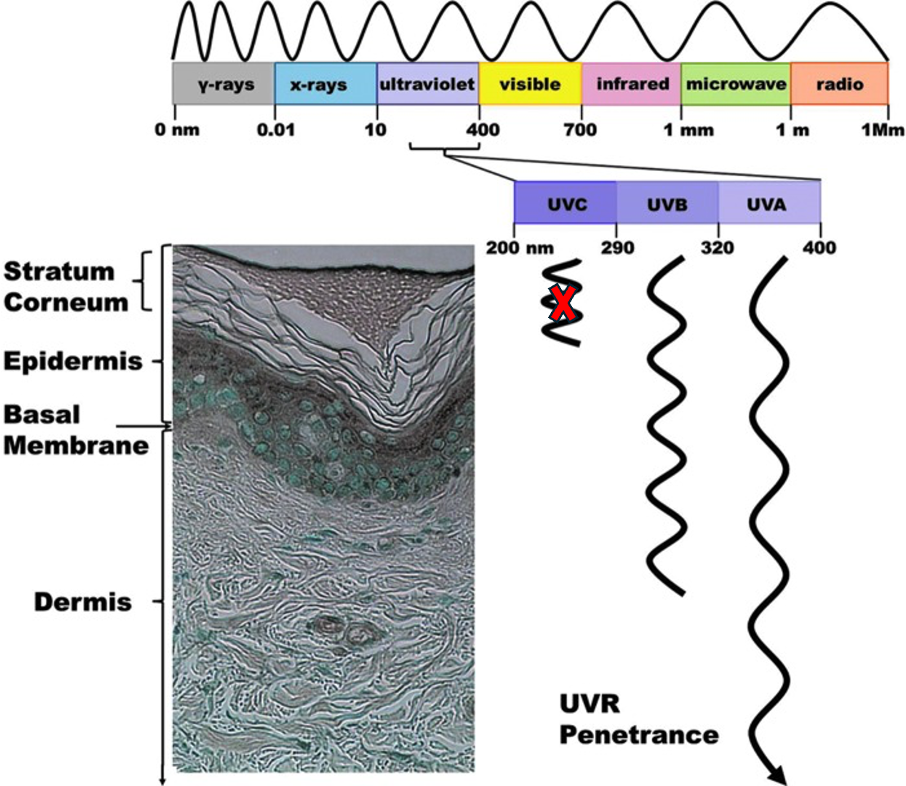
Stratum corneum:the outermost layer of the epidermis, made up of dead keratinocytes, and the skin’s main physical barrier to ultraviolet radiation.
Epidermis:the outer layer of the skin; a physical barrier.
Basal membrane:the boundary between the epidermis and the dermis.
Dermis:the layer beneath the epidermis, containing collagen and elastic fibers, and determining the skin’s strength and elasticity.
UVC (200–290 nm):the shortest wavelength and highest energy, but absorbed by the ozone layer and therefore unlikely to reach the ground.
UVB (290–320 nm):shallow penetration, acts mainly on the epidermis, and is the major driver of sunburn, DNA damage, and skin cancer.
UVA (320–400 nm):penetrates into the dermis and drives collagen loss.
Source: Figure 1,Antioxid Redox Signal.2014 Jun 20;20(18):2982–2996.
1. UVB: the explosive “king of sunburn”
UVB carries more energy, but it penetrates less deeply, so it mainly wreaks havoc on the surface layers of the skin. It is the primary cause of sunburn — redness, swelling, pain — and one of the main causes of skin cancer. It directly damages the structure of DNA in superficial skin cells. If the cell’s repair systems cannot keep up with that barrage, DNA mutations accumulate and cancer risk rises. When we talk about everyday sun protection, and when we see SPF on a sunscreen label, this is mainly what it is protecting against: UVB 2,9.
2. UVA: the invisible “aging assassin”
UVA is like a stealth assassin. It is the main force behind photoaging.
Its stealth and destructive power come from its extraordinary ability to penetrate:
- It penetrates cloud cover, so it is present year-round and all day long — even on rainy days and in cold winter weather.
- It penetrates office windows and car windshields, which means indoor life does not truly spare you.
- It reflects and scatters, so beaches, snow-covered mountains, and ski resorts can expose you to far stronger UVA than city centers, because reflective surfaces such as snow and seawater create a second wave of injury.
- Its damage is subtle: it does not immediately make you feel pain or redness. Instead, it penetrates deep into the dermis and generates large amounts of reactive oxygen species (ROS). These molecules activate enzymes that specialize in degrading collagen, cutting through the fibers that support the skin’s elasticity. The result is structural collapse: the scaffold weakens, the skin loosens, and wrinkles gradually emerge 1,10.
Most of us will at least make some effort to protect against UVB, because it is easier to feel — it burns, it heats, it stings. But UVA is easily and systematically ignored for years. That is why it matters to pay attention to the PA+++ rating on sunscreen: it specifically indicates the degree of protection against UVA 11,12.
There are also a few less intuitive facts worth knowing:
- A dramatic imbalance in proportion:Of the ultraviolet radiation that reaches the Earth’s surface,UVA is the main force, accounting for roughly90%–95%, and the total dose may be10 to 20 times greater than UVB(with the exact ratio varying by wavelength definition, solar angle, season, and weather; in some conditions it can be even higher) 2,13.
- The cloudy-day trap:Even on overcast days, ultraviolet intensity can still reach50% to 70%of that on a sunny day. Because clouds block more UVB than UVA, the relative share of UVA can actually become higher [14–16].
- The seasonal misconception:UVA fluctuates little across the year. Sun protection is not just for summer. Even in late autumn or winter, the atmosphere filters out very little UVA, and its damage to the skin never truly stops 17,18.
- The index blind spot:The UV index (UVI) shown in your weather app is weighted mainly towardUVB, because it is based on theerythema-weightedeffect of ultraviolet exposure. It does not assign much weight to UVA. So even when the index reads “moderate,” your skin may still be undergoing a substantial dose of aging-related exposure 19,20.
The Systemic Consequences of Photoaging
From a longevity perspective, light damage imposes a systemic aging burden on the body.
1. Cells turning “zombie-like”: SASP contamination
When skin cells suffer severe light damage, they do not necessarily die. Instead, they can enter a kind of “zombie state” known as cellular senescence. These cells stop dividing, but remain in the body and continue secreting inflammatory factors, contaminating the healthy cells around them and accelerating the aging of the tissue as a whole. This phenomenon is known as SASP (senescence-associated secretory phenotype), and it is one of the hallmark forms of aging. The skin is, in fact, one of the most visibly affected tissues for the accumulation of these senescent cells [21–23].
2. Long-term overload of DNA repair
Under repeated ultraviolet assault, cells are forced to repair DNA constantly. When that damage happens too frequently, the repair system becomes overwhelmed. This chronic repair burden is one of the major reasons cells ultimately become fully senescent — those so-called “zombie cells” [21–23].
3. Immune suppression
Ultraviolet radiation can also blind the skin’s “security patrol” — the Langerhans cells. These cells are responsible for immune surveillance in the skin. Once their function is suppressed, the skin not only ages faster, but also becomes less capable of identifying and clearing abnormal cells, which raises cancer risk [24–25].
4. The “sunscreen paradox”: vitamin D synthesis
Many people worry that if they avoid the sun, they will become calcium deficient. It is true that the synthesis of vitamin D, which is crucial for calcium absorption, requires UVB acting on the skin. That process cannot be fully separated from the DNA damage that UVB causes. If you rely on sun exposure alone to make enough vitamin D, the required UVB dose will very likely enter sunburn territory and meaningfully increase cancer risk 26,27.
In modern life, the better way to resolve this tradeoff is simple: obtaining vitamin D through supplementation (oral vitamin D3) is far more controllable and far safer than trying to get it through intentional overexposure to sunlight.
Protect collagen and DNA with sunscreen. Meet physiological needs with supplements. That is the more intelligent solution after proper risk management.
Sunscreen 101: A Three-Layer Defense System
Sun protection is one of the simplest and cheapest things you can do for your skin — and the payoff is enormous for both men and women.
Especially for many straight men, who probably are not going to spend much time researching skincare, getting sun protection right already captures most of the benefit. If you build good sun-protection habits, your visible state will very likely look younger than that of your peers.
It matters just as much for women. Many women already do a decent job protecting against UVB, and invest huge amounts of time and money into “repair” and “anti-aging.” But skin repair and anti-aging are, to a large extent, efforts to fight the cumulative erosion caused by UVA over the years. Rather than repairing the damage after the fact, it makes far more sense to reduce UVA injury at the source and prevent it before it happens.
So what does that actually look like in practice? Let me walk through it slowly.
When to protect: how to read UVI
The UVI (Ultraviolet Index) you often see in a weather app is a globally standardized public-health metric developed by the WHO together with other authoritative organizations. But as a public-health index, its calculation model is built mainly on erythema weighting — in other words, the risk of sunburn carries the greatest weight 19,20.
Put simply, the algorithm is heavily tilted toward UVB, because UVB is what makes people burn quickly and is the primary target in skin-cancer prevention.
But UVA, the main driver of photoaging, gets a relatively low weight in UVI because it does not immediately cause dramatic redness or pain.
For practical use, we can still rely on UVI as a baseline for environmental defense — but with a slight adjustment:
- WhenUVI > 3: the skin’s defensive burden rises sharply. Whether you are outdoors in direct sun, or indoors by a sunlit window (ordinary glass may block UVB, but can still allow more than 70% of UVA through), your sun-protection protocol should begin.
- WhenUVI is between 2 and 3: short outdoor exposure of 10–15 minutes may not require protection, but once the exposure gets longer, protection should still be turned on.
Take Shenzhen in March as an example (based on available March 2026 data): the UVI typically rises above 3 at around 9 a.m. and stays there until roughly 4 p.m. That is a period when outdoor exposure needs protection.
Between 8 to 9 a.m. and 3 to 4 p.m., the UVI can still stay above 2. If you are outdoors for extended periods during that window, it is also best to protect yourself.
Layer 1: Physical shielding
This is the most effective and most stable form of protection. It includes UPF 50+ sun-protective clothing, wide-brim hats, parasols, sunglasses, and sun-protective face coverings. The beauty of this “armor” is that it is stable: it does not wear off with time, and it does not stop working just because you sweat a little.
And for UVA protection, duration of coverage is crucial. That is very hard to solve with sunscreen alone. So it is worth adding a few good pieces of sun-protective clothing to your wardrobe for different situations. They may end up becoming some of the most frequently used items you own.
One small detail: an ordinary baseball cap is actually not good enough, because it does nothing for the sides of the face — which happen to be prime zones for pigmentation and deep wrinkles. A proper sun hat has a wider brim that shields the cheeks as well.
Layer 2: Sunscreen
For areas that clothing cannot cover, sunscreen is an essential patch. For everyday use, it is generally best to choose a product with at least SPF 30+ (for UVB) and PA+++ (for UVA). Especially if you will be outdoors for a long time, or exposed to strong sunlight, sunscreen is not optional.
But sunscreen — even if it blocks 90% to 98% of ultraviolet radiation — is time-limited. The protective film it forms on the skin is not especially durable. Sweat, skin oil, and even absentminded face-touching can all remove it. Especially outdoors, if you do not reapply in time, by the afternoon your skin is often essentially back to being “unprotected” [28–30].
Layer 3: Antioxidant counterbalance
No defensive layer blocks 100% of ultraviolet radiation. So what do we do with the small amount that still gets through? That is where antioxidants come in — as a kind of post-disaster cleanup team. Once UVA penetrates the skin, it generates large amounts of reactive oxygen species, which are the fuse for aging. **Supplementing vitamin C, vitamin E, or polyphenols — whether topically or orally **— can help neutralize these reactive species and reduce the oxidative damage they cause.
For example, many moisturizers on the market already contain vitamin E and vitamin C; and low-caffeine coffee and green tea are rich in polyphenols.
But one thing needs to be clear: antioxidants are only a patch. They can blunt the indirect damage caused by UVA, but they cannot do much to stop the direct DNA bombardment caused by UVB. So antioxidant counterbalancing only works as part of a complete system, alongside physical and chemical protection 31,32.
A Quick Summary
Skin aging is, in essence, a function of cumulative ultraviolet dose. We have unpacked the two main pathways by which ultraviolet radiation damages the skin: UVB mainly bombards DNA in the epidermis, bringing sunburn and mutation risk; UVA penetrates into the dermis, gradually weakening the skin’s structural support through oxidative stress and collagen degradation.
Sun protection delivers a very high return for both men and women. But it has to be done properly —
In practice, once UVI ≥ 3, sun protection should begin. Build a three-layer defense system of physical shielding, chemical protection, and antioxidant counterbalance.
Intervention recommendations are geared toward generally healthy individuals. If you have existing health conditions, always follow your doctor’s instructions.
References
[1]Rittié L, Fisher GJ. UV-light-induced signal cascades and skin aging. Ageing Res Rev. 2002 Sep;1(4):705–20.
[2]D’Orazio J, Jarrett S, Amaro-Ortiz A, Scott T. UV radiation and the skin. Int J Mol Sci. 2013 Jun 12;14(6):12222–48.
[3]Flament F, Bazin R, Laquieze S, Rubert V, Simonpietri E, Piot B. Effect of the sun on visible clinical signs of aging in Caucasian skin. Clin Cosmet Investig Dermatol. 2013;6:221–32.
[4]Amaro-Ortiz A, Yan B, D’Orazio JA. Ultraviolet radiation, aging and the skin: prevention of damage by topical cAMP manipulation. Molecules. 2014 May 15;19(5):6202–19
[5]de Oliveira NFP, de Souza BF, de Castro Coêlho M. UV Radiation and Its Relation to DNA Methylation in Epidermal Cells: A Review. Epigenomes. 2020 Sep 9;4(4):23.
[6]Barnes BM, Yaar M, Gilchrest BA. Epigenetics and ultraviolet radiation: Implications for skin photoageing and photocarcinogenesis. Exp Dermatol. 2025 Jan;34(1):e70015.
[7]El Ghissassi F, Baan R, Straif K, Grosse Y, Secretan B, Bouvard V, et al. A review of human carcinogens — part D: radiation. Lancet Oncol. 2009 Aug;10(8):751–2.
[8]Bernerd F, Vioux-Chagnoleau C, Asselineau D. The damaging effects of long UVA (UVA1) rays: a major challenge to preserve skin health and integrity. Int J Mol Sci. 2022 Aug 4;23(15):8243.
[9]Pelizzo M, Zattra E, Nicolosi P, Peserico A, Garoli D, Alaibac M. In vitro evaluation of sunscreens: an update for the clinicians. ISRN Dermatol. 2012;2012:352135.
[10]Fisher GJ, Wang ZQ, Datta SC, Varani J, Kang S, Voorhees JJ. Pathophysiology of premature skin aging induced by ultraviolet light. N Engl J Med. 1997 Nov 13;337(20):1419–28.
[11]Hedayat K, Ahmad Nasrollahi S, Firooz A, Rastegar H, Dadgarnejad M. Comparison of UVA Protection Factor Measurement Protocols. Clin Cosmet Investig Dermatol. 2020;13:351–358.
[12]Zou W, Ramanathan R, Urban S, Sinclair C, King K, Tinker R, Bansal V. Sunscreen testing: A critical perspective and future roadmap. TrAC Trends Anal Chem. 2022;157:116724
[13]Kollias N, Ruvolo E Jr, Sayre RM. The value of the ratio of UVA to UVB in sunlight. Photochem Photobiol. 2011 Nov-Dec;87(6):1474–5.[14]Calbó J, Pagès D, González JA. Empirical studies of cloud effects on UV radiation: A review. Rev Geophys. 2005;43(2):RG2002.
[15]Parisi AV, Downs NJ, Turner J. Evaluation of the cloudy sky solar UVA radiation exposures. J Photochem Photobiol B. 2014 Aug;138:141–5.
[16]Andersen PA, Buller DB, Walkosz BJ, Scott MD, Maloy JA, Cutter GR, Dignan MD. Environmental cues to ultraviolet radiation and personal sun protection in outdoor winter recreation. Arch Dermatol. 2010 Nov;146(11):1241–7.
[17]Grigalavicius M, Moan J, Dahlback A, Juzeniene A. Daily, seasonal, and latitudinal variations in solar ultraviolet A and B radiation in relation to vitamin D production and risk for skin cancer. Int J Dermatol. 2016 Jan;55(1):e23–8.
[18]Nishimura K, Tanioka M, Hara M, et al. Seasonal differences in the UVA/UVB ratio of natural sunlight influence the efficiency of the photoisomerization of 6–4 photoproducts into their Dewar valence isomers. Photochem Photobiol. 2021 Jul;97(4):842–849.
[19]World Health Organization, World Meteorological Organization, United Nations Environment Programme, International Commission on Non-Ionizing Radiation Protection. Global Solar UV Index: A Practical Guide. Geneva: World Health Organization; 2002.
[20]McKenzie RL, Smale D, Kotkamp M. Relationship between UVB and erythemally weighted radiation. Photochem Photobiol Sci. 2004;3(3):252–6.
[21]Tchkonia T, Zhu Y, van Deursen J, Campisi J, Kirkland JL. Cellular senescence and the senescent secretory phenotype. J Clin Invest. 2013 Mar;123(3):966–72.
[22]Fitsiou E, Pulido T, Campisi J, Alimirah F, Demaria M. Cellular Senescence and the Senescence-Associated Secretory Phenotype as Drivers of Skin Photoaging. J Invest Dermatol. 2021 Apr;141(4):1119–1126.
[23]Huang W, Hickson LJ, Eirin A, Kirkland JL, Lerman LO. Cellular senescence: the good, the bad and the unknown. Nat Rev Nephrol. 2022 Oct;18(10):611–627.
[24]Ullrich SE, Byrne SN. The immunologic revolution: photoimmunology. J Invest Dermatol. 2012 Mar;132(3 Pt 2):896–905.
[25]Seité S, Zucchi H, Moyal D, Tison S, Compan D, Christiaens F, Gueniche A, Fourtanier A. Alterations in human epidermal Langerhans cells by ultraviolet radiation: quantitative and morphological study. Br J Dermatol. 2003 Feb;148(2):291–9.
[26]Webb AR, Alghamdi R, Kift R, Rhodes LE. 100 YEARS OF VITAMIN D: Dose-response for change in 25-hydroxyvitamin D after UV exposure: outcome of a systematic review. Endocr Connect. 2021 Oct;10(10):R248-R266.
[27]Young AR, Narbutt J, Harrison GI, Lawrence KP, Bell M, Kimlin MG, et al. A revised action spectrum for vitamin D synthesis by suberythemal UV radiation exposure in humans in vivo. Proc Natl Acad Sci U S A. 2021 Oct 19;118(42):e2015867118.
[28]Guan LL, Lim HW, Mohammad TF. Sunscreens and Photoaging: A Review of Current Literature. Am J Clin Dermatol. 2021 Dec;22(6):819–828.
[29]American Academy of Dermatology Association. How to select a sunscreen [Internet]. Rosemont (IL): AAD; 2026 [cited 2026 Mar 17].
[30]American Academy of Dermatology Association. How to apply sunscreen [Internet]. Rosemont (IL): AAD; 2026 [cited 2026 Mar 17].
[31]Chen L, Hu JY, Wang SQ. The role of antioxidants in photoprotection: a critical review. J Am Acad Dermatol. 2012 Nov;67(5):1013–24.
[32]Murray JC, Burch JA, Streilein RD, Iannacchione MA, Hall RP, Pinnell SR. A topical antioxidant solution containing vitamins C and E stabilized by ferulic acid provides protection for human skin against damage caused by ultraviolet irradiation. J Am Acad Dermatol. 2008 Sep;59(3):418–25.