Strictly speaking, artificial sweeteners are neither carbohydrates nor part of the three main macronutrients. But if you’re trying to reduce “free sugars” without sacrificing the joy that sweetness brings, then it deserves a dedicated discussion alongside resistant starches and dietary fibers.
At Prime Lab, we care not only about “knowing health principles” but also about applying science to our daily choices.
I am an example myself: when I wore a CGM (Continuous Glucose Monitor), I saw firsthand how a can of classic coke sent my blood sugar soaring, and from that moment on, I parted ways with it. But as my research into artificial sweeteners deepened, I found myself occasionally enjoying a bottle of Diet Coke.
1. What Are Artificial Sweeteners: Sweet Stand-ins with “Innocent Until Proven Guilty”
How do we eliminate sugar’s metabolic burden without losing the pleasure of sweetness?
Scientists began their search for “sweet stand-ins” — molecules found in nature or synthesized in labs that:
- Taste sweet but contain almost no calories
- Offer texture without spiking blood sugar
- Trick our taste buds without triggering insulin
These sweet mimics are artificial sweeteners. Some are naturally occurring in fruits and herbs, while others are entirely man-made.
The current scientific consensus on artificial sweeteners is as follows:
- They cause very little blood sugar response, and their short-term benefits for blood sugar control are clear.
- They are safe within recommended intake limits, with no definitive long-term harm observed.
- There is insufficient long-term randomized controlled trial (RCT) data to prove their effectiveness in weight management or chronic disease prevention — but lack of evidence doesn’t mean inefficacy; it simply hasn’t been proven yet.
- As a tool for sugar withdrawal, artificial sweeteners can help reduce our dependence on high-sugar, high-sweet foods and gradually cultivate a low-sugar diet.
Research continues. If you can’t fully give up “free sugars” for now, artificial sweeteners remain a scientifically sound, practical, and effective alternative.
2. The Current State of Research on Health Risks of Artificial Sweeteners
You may have heard — artificial sweeteners could lead to cancer, cardiovascular diseases, type 2 diabetes, and even mood disorders.
It sounds frightening, but most of these “warnings” come from correlation studies rather than causation validation. For instance:
- Some studies link erythritol to cardiovascular risks, but the human body can also produce erythritol (especially under high-sugar diets). It may simply be an “accompanying product” of metabolic issues rather than the “culprit.”
- People who regularly drink sugar-free beverages may already be part of a high-risk, high-sugar group, which may make them more likely to show up with chronic disease risks.
Another concern is that the zero-calorie sweetness might fool the brain, disrupting appetite and energy balance. Animal studies show that long-term consumption of certain artificial sweeteners could affect the gut-brain axis, leptin/hunger signaling, and even induce neuroinflammation. However, these effects have yet to be confirmed in large human studies.
On the flip side, human research has not shown significant long-term effects of artificial sweeteners on weight management or chronic disease prevention. Based on this, the WHO 2023 guidelines offer conditional advice: They do not recommend non-sugar sweeteners (NSS) as a method for controlling weight or reducing chronic disease risks, primarily due to insufficient long-term evidence, not because they are outright harmful.
The conclusion is simple: Short-term benefits are clear, but the long-term impact is uncertain.
So how do we deal with this uncertainty?
At Prime Lab, our approach is:
- Be cautious, but don’t panic
- Give up on perfection, but aim for higher probabilities
- Don’t be intimidated by “what-ifs,” but also avoid blind compliance
Currently, our view on artificial sweeteners is:
- Effective for blood sugar control
- Safe at regular dosages
- Prioritize natural molecules over synthetic ones
- Exercise more caution with children, pregnant women, and special populations.
3. Three Main Types of Artificial Sweeteners: Which One Is The Best?
We categorize artificial sweeteners in the market into three types based on their source and mechanism:
A: Sugar Alcohols (Polyols) — “Sweet and Substantial”
Examples: Erythritol, Xylitol, Sorbitol, Maltitol
Sweetness: 0.6–1x that of sucrose
Calories: 0.2–2.6 kcal/g
Sugar alcohols are molecules naturally found in the environment, some of which the human body can also produce (e.g., erythritol). They are characterized by having both sweetness and bulk similar to sucrose. In baking and chocolate, they provide sweetness while helping “structure.”
Erythritol is the most popular:
- A natural molecule, also synthesized by the human body
- Does not spike blood sugar, has zero calories, and is not metabolized, with 90% being excreted unchanged
- Fairly well-tolerated by the gut, heat-stable
- Though some studies suggest a link between erythritol levels and CVD risks, causality has yet to be established
- Widely regarded as safe in moderate amounts.
In contrast:
- Xylitol has a slight blood sugar increase and some calories, but it helps prevent cavities[2–5].
- Maltitol/Sorbitol have a more noticeable blood sugar impact, conflicting with the primary goal of artificial sweeteners; they can also cause diarrhea in large amounts6,7.
Note that sugar alcohols are short-chain carbohydrates that are poorly absorbed in the small intestine and fermented by bacteria in the colon. Excessive consumption can cause gas, bloating, stomach cramps, and diarrhea. For those with IBS (Irritable Bowel Syndrome), sugar alcohols are a type of FODMAP to avoid. Pay attention if your gut is sensitive.
FODMAP refers to a group of fermentable short-chain carbohydrates that, through high osmotic pressure and rapid fermentation, increase gases and liquids in the gut, triggering IBS symptoms. FODMAP stands for: F (Fermentable), O (Oligosaccharides), D (Disaccharides), M (Monosaccharides, such as excessive fructose), and P (Polyols, which include sugar alcohols).28
B: Artificial Sweeteners — “Techy, but Not Entirely Trustworthy”
Examples: Aspartame, Sucralose, Acesulfame-K, Saccharin
Sweetness: 200–600x that of sucrose
Calories: ≈0
Their greatest advantage is their immense sweetness and low cost, making them widely used. Sugar-free sodas, such as those replacing classic coke, often contain three major artificial sweeteners: aspartame, sucralose, and acesulfame-K.
However, this is the most controversial class of artificial sweeteners because they are not natural, but rather synthetic molecules created by humans. Our “biological history” with them spans just a few decades, much shorter than the millennia we’ve spent interacting with natural molecules. While no major issues have surfaced in the short term, we can’t be sure there won’t be long-term, cumulative effects that will become apparent only later.
Hence, it’s understandable and necessary to stay vigilant and keep researching artificial sweeteners.
Notable examples include:
- Aspartame: The only sweetener classified by the IARC as a Group 2B carcinogen (“possibly carcinogenic to humans”). It is one of the few sweeteners that is fully metabolized in the body — hydrolyzed in the gut into phenylalanine, aspartic acid, and methanol. Although safe at typical dietary levels, caution is advised for sensitive individuals, such as pregnant women or those with phenylketonuria (PKU).
- Sucralose: Largely unmetabolized and excreted through feces or urine. However, prolonged heating above 120°C may lead to the formation of potentially toxic chlorinated byproducts (e.g., dioxin precursors), making it unsuitable for baking or high-temperature frying. Animal studies suggest that long-term intake may disrupt gut microbiota and trigger intestinal inflammation.
- Acesulfame-K: Not metabolized and excreted entirely through urine. Some animal studies indicate potential impacts on the gut microbiome. [8–10]
- Saccharin: One of the earliest artificial sweeteners, once banned but later reinstated. It is barely metabolized by the body. High doses have been associated with bladder cancer in animal studies, though this has not been confirmed in humans. Long-term safety remains a topic of concern.
While this class hasn’t shown definitive harmful effects yet, it is advisable to exercise caution and not consider these as the top choice for artificial sweeteners.
C: Natural Sweeteners — “The Healthy Artificial Sweeteners”
Examples: Stevia Glycosides, Mogrosides, Allulose
Sweetness: 0.7–600x that of sucrose
Calories: ≈0
These artificial sweeteners are mostly plant-derived, metabolism-friendly, and carry little health risk, with most being classified as GRAS (Generally Recognized as Safe) by the FDA[11–12].
GRAS stands for “Generally Recognized As Safe,” which is a safety certification system used by the U.S. FDA for certain food additives. In practice, GRAS is considered somewhat stricter than the FDA’s approval process. For example, artificial sweeteners like aspartame, sucralose, and acesulfame-K are legally approved food additives in both the U.S. and China, but they have not been granted GRAS status, while most natural sweeteners and sugar alcohols meet GRAS standards.
Stevia Glycosides: Derived from the South American stevia plant, stevia glycosides are natural, safe, and metabolically friendly. They are about 200–300 times sweeter than sucrose. Stevia is not absorbed in the small intestine; instead, it is broken down by gut microbiota in the colon and then metabolized in the liver before being excreted. Its glycemic index (GI) is 0. Multiple human studies have shown that it may improve insulin sensitivity, help regulate blood pressure, and has minimal impact on the gut microbiome. It can carry a bitter aftertaste, so high-purity forms like Reb-A are recommended to reduce bitterness. [13–15]
Mogrosides: Extracted from the Chinese native fruit Siraitia grosvenorii, mogrosides is approximately 250–400 times sweeter than sucrose. Like stevia, it is not absorbed in the small intestine and is fermented by gut bacteria in the colon before being excreted. It has a GI of 0 and does not trigger an insulin response. Preliminary animal and in vitro studies suggest anti-inflammatory benefits and potential support for blood sugar and lipid regulation. Mogrosides tends to have a distinctive herbal taste, and personal preference can vary. [16–18]
Allulose: Allulose offers a taste closest to sucrose. It is a rare monosaccharide that is minimally metabolized by the body. Most of it is absorbed in the small intestine and excreted unchanged in the urine. It is about 70% as sweet as sucrose and provides a small amount of calories (0.2–0.4 kcal/g), but with a GI close to zero. Studies show it can improve glucose and lipid metabolism, with virtually no known side effects. [19–22]
4. Choosing the “Perfect Artificial Sweetener”
Based on the above, you might already have an instinctive sense of which artificial sweetener is the best. But in keeping with the Prime Lab style, let’s make it more structured:
We’ll score each substitute across 12 dimensions:
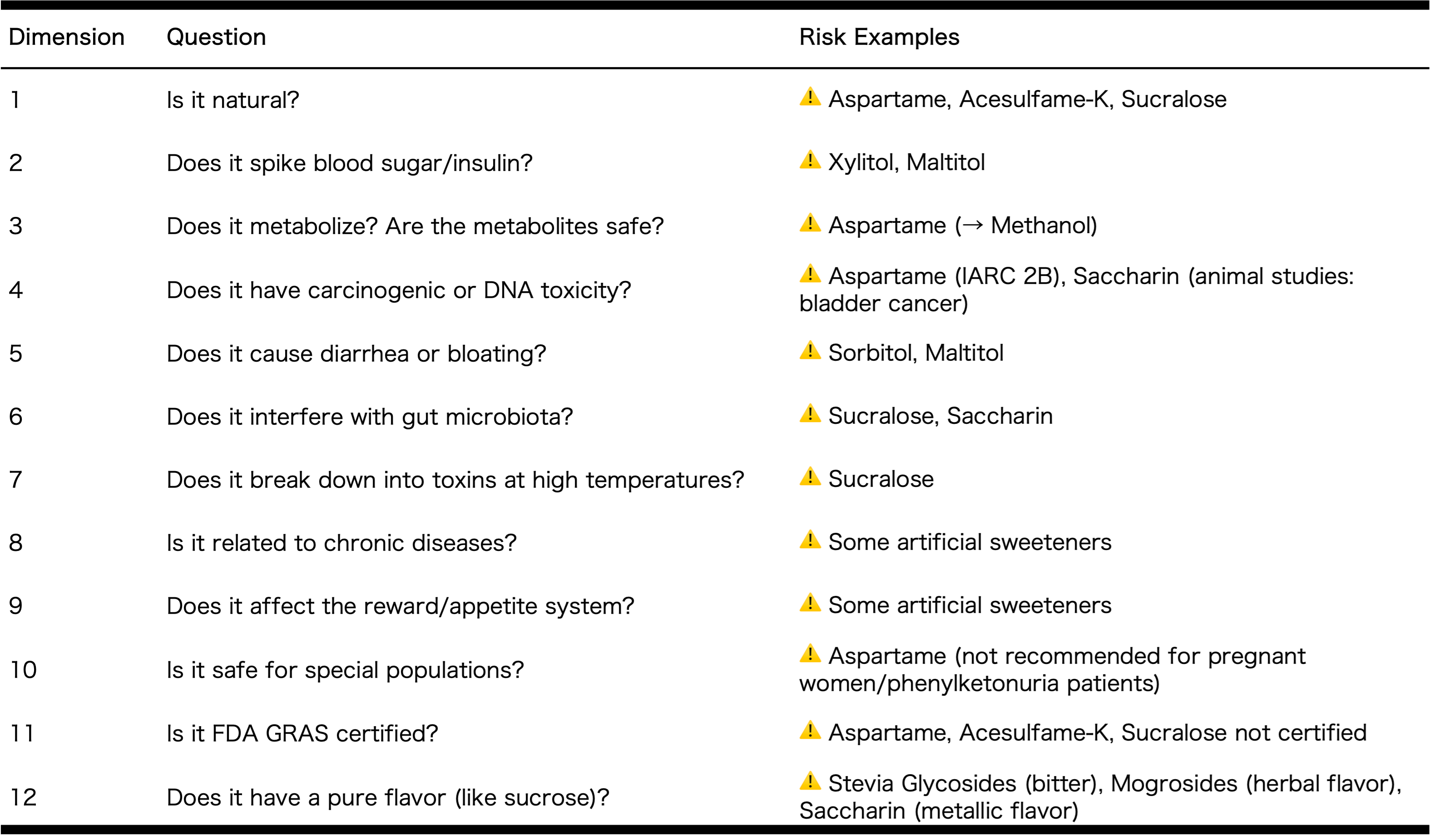
The conclusion is clear:
- The most risky substitutes are the major artificial sweeteners, which should be avoided where possible.
- Natural artificial sweeteners (including sugar alcohols) are generally much better.
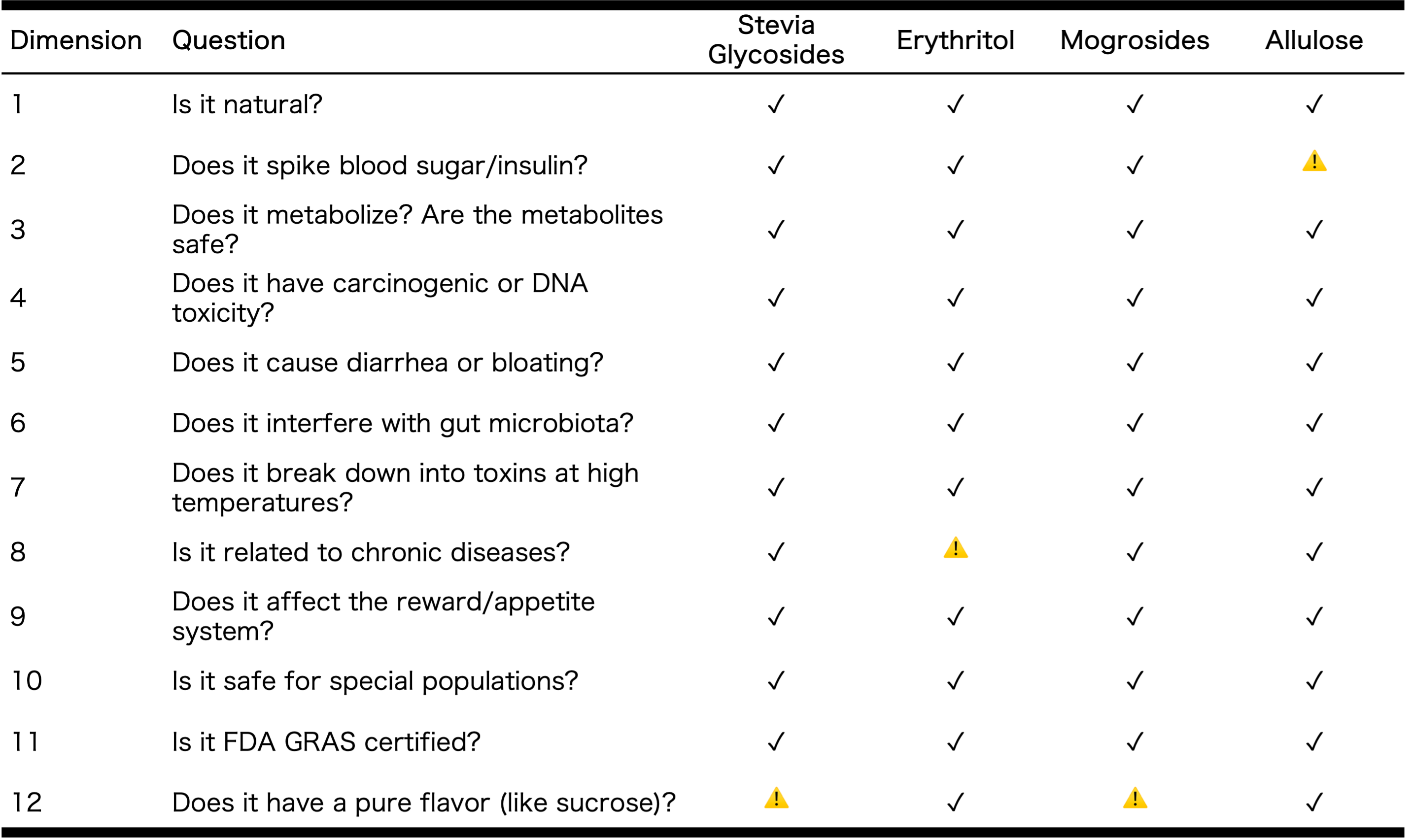
The top contenders are Stevia Glycosides, Allulose, Erythritol, and Mogrosides.
These are essentially all perfect choices, with reasonable explanations for the small caveats:
- Stevia Glycosides: Choose high-purity versions (like Reb-A) to avoid bitterness; manufacturers already take this into account for us.
- Erythritol: Though some studies have suggested a link between erythritol levels and CVD risks, this may be related to endogenous erythritol produced by high-sugar diets, rather than the erythritol consumed.
- Mogrosides: Some may find its herbal taste peculiar, but that’s a personal preference, not a safety issue.
- Allulose: Shows almost zero glycemic response, GI close to zero, and is safe for use. Recent animal studies even suggest it may improve insulin sensitivity, delay fatty liver development, and reduce obesity risk.23,24
One More Thing: How Do We Make Decisions?
Artificial sweeteners serve as a fitting “litmus test” to evaluate Prime Lab’s practical philosophy.
It places us in a typical scenario: when faced with a long-standing, controversial issue with no clear conclusion, how should we judge? Should we be cautious and wait for all the evidence to be in? Or should we be bold and take action now? How do we balance research and practice, risk and reward?
This is precisely the question Prime Life’s second article sought to answer — the three principles of practice for personal growth:
- Focused on the present: It’s about investing in long-term health span, yes — but also improving energy, strength, and mood right now.
- Probabilistic thinking: There’s no magic pill, no guaranteed outcome — but there are thousands of micro-decisions that can steadily shift the odds in our favor.
- Science-backed and safety-first: I stay grounded in well-researched principles, avoid hype and shortcuts, and rely on evidence-based interventions whenever possible.
These three principles are reflected in the question of whether or not to consume artificial sweeteners.
01 | Focus on the Present: You Must Make a Decision Today
We can choose to consume artificial sweeteners, or we can choose NOT to, but we cannot choose not to decide. Our goal is never to achieve “perfect health” but to make the best possible decision for today, amidst uncertainty.
Completely cutting out sugar is, of course, the more ideal solution. However, it could lead to significant psychological resistance and drastic lifestyle changes, which could bring unnecessary internal conflict and health risks. In this case, choosing a type of artificial sweetener that is relatively safe in the short term (but still requires long-term observation) to replace the clearly harmful free sugars is a reasonable decision with positive benefits.
Being kind to your body today is also a way of accumulating long-term health dividends for your future self. (Of course, choosing artificial sweeteners is to truly replace free sugars, not just to add sweeteners to an already high-sugar diet.)
02 | Probabilistic Thinking: Finding the “Higher Probability” Path in Imperfection
We don’t expect artificial sweeteners to be “flawless.” On the contrary, we fully accept that they may be controversial, have knowledge gaps, and may even be proven to have issues in the future.
But the issue is: we don’t have a time machine.
Human history in medicine has seen some shocking mistakes. For example, radium and heroin were once considered wonder drugs. But this does not prevent us from making decisions today based on the best available evidence. We cannot let the fear of the unknown stop us from taking action.
What we can do is to understand the boundaries of current research, and within uncertainty, anchor ourselves to a “relatively better solution.” Regarding artificial sweeteners, we avoid the highly controversial synthetic options and prioritize natural sweeteners with clearer metabolic pathways and higher safety.
This is probabilistic thinking in action: not waiting for a definitive future, but betting on a more reasonable present amidst uncertainty.
03 | Scientific Safety: The Boundaries of Science Are the Boundaries of Our Actions
Longevity, by nature, is a field with “incomplete consensus.” Many therapies have barely emerged from animal labs, and some enthusiasts immediately start self-experimentation. While I understand this exploratory spirit, Prime Lab chooses another path: we may be a “half-step behind” in practice, but we prefer to stay grounded.
We carefully examine the source of each study: Is it a cell experiment? A mouse study? Or a double-blind, large-sample human clinical trial? Does it apply to patients or healthy individuals? Is it short-term, or has there been long-term follow-up?
You must know that intervention studies on healthy populations are extremely rare, and aging-related research requires time. We must admit: we are in a field with insufficient evidence and a long road ahead. The more so, we must respect the rigor of science and the complexity of the human body.
In the case of artificial sweeteners, we have observed signs of neurotoxicity in some synthetic sweeteners in animal studies . While these are far from sufficient to predict human-level health damage, we will adjust the trust score of these sweeteners according to these scientific findings, placing them in more conservative recommendations.
In Summary: This is Prime Lab’s practical philosophy:
- Focus on the Present: Let’s make a clear decision today.
- Probabilistic Thinking: Let’s improve the odds of success amidst imperfection.
- Scientific Safety: Let’s avoid misjudgments, internal conflict, and unnecessary risks.
We calmly accept the results of our decisions.
We will revisit these principles again and again, just as we are doing with the discussion of artificial sweeteners today.
Intervention recommendations are geared toward generally healthy individuals. If you have existing health conditions, always follow your doctor’s instructions.
References28
[1]AI Research
[2]U.S. Food and Drug Administration. “21 CFR § 101.9 — Nutrition Labeling of Food.” Electronic Code of Federal Regulations, 2025.
[3]Nayak, P. A., et al. “The Effect of Xylitol on Dental Caries and Oral Flora.” Clinics, vol. 69, no. 10, 2014, pp. 1–7.
[4]U.S. Food and Drug Administration. “21 CFR § 101.80 — Health Claims: Sugar Alcohols and Dental Caries.” Electronic ode of Federal Regulations, 2025.
[5]Atkinson, Fiona S., et al. “International Tables of Glycemic Index and Glycemic Load Values 2021: A Systematic Review.” The American Journal of Clinical Nutrition, vol. 114, no. 5, 2021, pp. 1625–32.
[6]Interactive Nutrition Facts Label: Sugar Alcohols.” FDA, Oct. 2021.
[7]Regulation (EU) No 1169/2011, Annex III. Official Journal of the European Union, 2011; consolidated versions cite: “Foods containing more than 10% added polyols: ‘excessive consumption may produce laxative effects’.”
[8]Magnuson, Bernadene A., et al. “Biological Fate of Low-Calorie Sweeteners.” Nutrition Reviews, vol. 74, no. 11, 2016, pp. 670–89.
[9]Bian, Xuezhi, et al. “The Artificial Sweetener Acesulfame Potassium Affects the Gut Microbiome and Body Weight Gain in CD-1 Mice.” PLOS ONE, vol. 12, no. 6, 2017, e0178426.
[10]European Food Safety Authority (EFSA). “Re-evaluation of Acesulfame K (E 950) as a Food Additive.” EFSA Journal, 2025.
[11]U.S. Food and Drug Administration. “Generally Recognized as Safe (GRAS).” 17 Oct. 2023.
[12]U.S. Food and Drug Administration. “High-Intensity Sweeteners.” Updated 2024.
[13]Hsieh, Ming-Hsiung et al. “Efficacy and tolerability of oral stevioside in patients with mild essential hypertension: a two-year, randomized, placebo-controlled study.” Clinical therapeutics vol. 25,11 (2003): 2797–808.
[14]Anton, Stephen D., et al. “Effects of Stevia, Aspartame, and Sucrose on Food Intake, Satiety, and Postprandial Glucose and Insulin Levels.” Appetite, vol. 55, no. 1, 2010, pp. 37–43.
[15]Chan, P., et al. “A Double-Blind Placebo-Controlled Study of the Effectiveness and Tolerability of Oral Stevioside in Human Hypertension.” British Journal of Clinical Pharmacology, vol. 50, no. 3, 2000, pp. 215–20.
[16]FDA GRAS Notice No. GRN 301. “Siraitia grosvenorii (Luo Han Guo) Fruit Extract.” FDA GRAS Inventory, 2009–2010.
[17]FDA GRAS Notice No. GRN 784. “Siraitia grosvenorii Fruit Juice Concentrate.” FDA, 20 Nov. 2018.
[18]Tey SL, Salleh NB, Henry J, Forde CG. Effects of aspartame-, monk fruit-, stevia- and sucrose-sweetened beverages on postprandial glucose, insulin and energy intake. International Journal of Obesity (2005). 2017 Mar;41(3):450–457.
[19]U.S. Food and Drug Administration. “Guidance for Industry: The Declaration of Allulose and Calories from Allulose on Nutrition and Supplement Facts Labels.” 16 Oct. 2020.
[20]Franchi, Federica, et al. “Effects of D-Allulose on Glucose Tolerance and Insulin Resistance in Humans.” BMJ Open Diabetes Research & Care, vol. 9, no. 1, 2021, e001939.
[21]U.S. FDA. “The Calorie Content of D-Allulose.” FDA Guidance/Updates, 2019.
[22]Noronha, Joao C., et al. “The Effect of Small Doses of Fructose and Allulose on Postprandial Blood Glucose Regulation in Type 2 Diabetes.” Diabetes, Obesity and Metabolism, vol. 20, 2018, pp. 2361–2365.
[23]Bae, Heekyong R., et al. “D-Allulose Ameliorates Dysregulated Macrophage Function and Mitochondrial NADH Homeostasis, Mitigating Obesity-Induced Insulin Resistance.” Nutrients, vol. 15, no. 19, 2023, 4218.
[24]Lee, Dayoun, et al. “D-Allulose Ameliorates Metabolic Dysfunction in C57BL/KsJ-db/db Mice.” Nutrients, vol. 12, no. 7, 2020, 2113.
[25]European Food Safety Authority (EFSA). “Scientific Opinion on the Re-evaluation of Aspartame (E951) as a Food Additive.” EFSA Journal, vol. 11, no. 12, 2013, 3496.
[26]Ibi, Daisuke, et al. “Effect of Ace-K (Acesulfame Potassium) on Brain Function under Dietary Restriction in Mice.” Physiology & Behavior, vol. 188, 2018, pp. 291–97.
[27]Jones, Sara K., et al. “Transgenerational Transmission of Aspartame-Induced Anxiety.” Proceedings of the National Academy of Sciences, vol. 119, no. 45, 2022, e2213120119.
[28]“What are FODMAPs?” Cleveland Clinic, 2022.