It’s been a month already — ten entries published. I’m grateful for all your interest, support, and thoughtful feedbacks.
From defining the meaning of Health Span and Prime Life, to laying out Prime Life Action Framework, then moving into baseline testing, cancer screening, trendline analysis, the “Five Horsemen of Death”, and finally health assessments and biological age — we’ve completed Phase One: Knowing Ourselves.
Like climbers at the base of a mountain, we’ve surveyed the terrain, packed our gear, and filled our water bottles. We’re finally ready to set off toward the next stretch — longer, more complex, and far more demanding.
This next chapter is called: Proactive Intervention.

Painted by AI
But before diving into the what, I’d like to talk about the how.
Because the world of “intervention” is a maze — dense, messy, noisy. Information is everywhere, and often contradictory. Methods are endless, trends come and go, and it’s hard to tell what’s valid and what’s just hype.
Every day, platforms feed us new ways to reverse aging. Right next to that, new headlines declare something else is carcinogenic. The noise is deafening.
The truth? Most of what’s out there is fragmented, inconsistent, or premature. There’s no coherent system that’s widely validated yet — just pieces of something still in the making.
If we charge in unprepared, it may feel exciting at first — but what lies ahead is often just confusion and disappointment.
That’s why I wanted to write this entry — a kind of “basecamp briefing” before we start the climb.
To share: Where we’re headed. How we’ll move. And how we’ll move together.
How We’ll Talk About Interventions
1. From question → to mechanism → to action. As always.
I’ll continue the same approach: begin with a real-world question, trace it through the underlying mechanisms, and arrive at concrete, actionable insights.
Because I believe this: Most of our decisions aren’t “wrong” because we’re lazy or incapable. They’re “wrong” because our mental models are incomplete. We’re often doing the best we can based on what we think is true.
So when someone fails to sleep better, eat healthier, or exercise regularly — it’s not a matter of “knowing but not doing.” More often, it’s “never truly understood.”
So for each intervention, we’ll move through this loop: A specific question → Core mechanisms → Key insights → Practical strategies
Over the next few months, we’ll build up a robust intervention system — step by step.
2. One topic at a time, layered with structure.
The intervention landscape is enormous. We need a map. And structure.
In the Prime Life framework, we split interventions into three main categories:
- Medical interventions
- Environmental optimization (light, air, temperature, water, sound, social context, etc.)
- Lifestyle intervention
And within lifestyle, we break it down further:
- Sleep, exercise, diet, nutrition
- Emotional and pscyhological well-being
- Other cutting-edge tools and emerging approaches
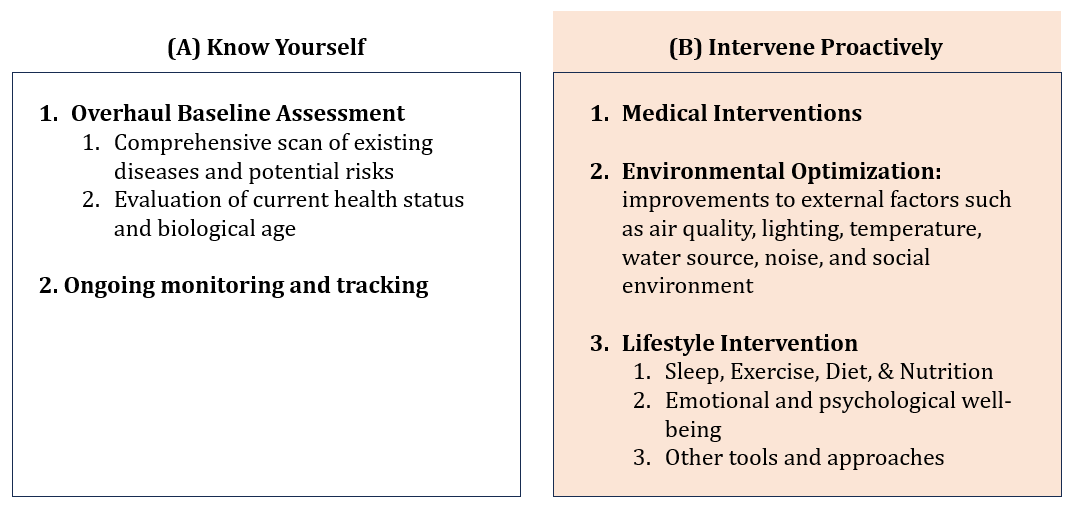
Prime Life Action Framework
We’ll begin with lifestyle as the core, while weaving in other types of interventions where relevant — one module at a time.
That said, Prime Life isn’t defined by a single structure. We might also explore interventions by looking at the 14 hallmarks of aging1, or through the so called “longevity staircase”2, from avoiding deficiencis, to stimulating hormesis, to reducing growth stimulation, to reversing the aging process.
Eventually, this may look less like a single staircase and more like a network: a central spine, branching nodes, cross-links of understanding.
Within this larger map, we’ll occasionally drop in “micro-structures” — useful side quests.
And now and then, we’ll publish synthesis pieces to connect the dots and refine the big picture.
One note: as mentioned earlier, the dynamic feedback loop of “Knowing Yourself → Intervening Proactively → Knowing Yourself Better → Repeat” is itself a foundation structure of proactive intervention.
Though Overhaul Baseline Assessment is shared as a standalone module, I’ll weave “knowing yourself” throughout our future discussion of interventions. For example, CGM (continuous glucose monitoring) will be discussed directly in the chapters on diet and nutrition — where it actually shows up in life.
Each topic will be standalone, but also additive. This isn’t a theoretical exercise. It’s a lived, evolving record of experimentation, error, iteration, and insight.
3. Not encyclopedic. Just deeply essential.
This is not a textbook. Prime Lab exists to help you build a mental framework — something memorable, doable, and relevant in real life.
We’ll use the 80/20 principle to identify the few key levers that move the needle most.
For example, in talking about lipids, I won’t walk you through the entire lipoprotein family tree. Instead, I’ll focus on the relationship between lipids and healthspan, and spotlight the 1–2 most critical metrics. Then we’ll talk strategy: What actually works? What’s the risk/reward? What can you start with?
Same with exercise. Instead of listing every type of training, we’ll focus on how to match movement to your body, lifestyle, and risk profile — and how to build a plan you’ll actually follow.
Biology is complex. Life is more so. But even in complexity, there’s always hierarchy. And that’s what we’ll try to uncover — together.
On “Feeling” Entries, and Why I Write Them
I also plan to write one emotionally grounded entry each month — a looser piece about my internal state, my highs and lows, the days I nail it, and the days I crash.
These won’t be polished reports. But they’re intentional — and important.
Here’s why:
1. To remind myself that I’m a real-life practitioner.
Yes, I have expert friends — doctors, researchers, scientists. But still, I’m writing it from real life experiences.
My time, energy, and resources are limited — just like yours. I navigate work, family, self-care, obligations — just like you. And it’s precisely within these constraints that Prime Life becomes meaningful.
In the real world, practice isn’t linear. Sleep breaks down. Diets derail. Some days I feel burned out by health itself. But because I’ve felt this, I know what it takes to cross the gap between “knowing” and “doing.” And I’m constantly finding new ways to bridge it.
This is what I can uniquely offer: A superuser perspective — from someone walking the same ground, solving the same puzzles, inching forward in real time.
I’m not here to be a perfect example. I’m here to present an authentic, evolving, replicable journey.
Prime Lab isn’t a pedestal. It’s a campfire we gather around. Part structure, part science, part soul. All in service of one thing: sustainable, meaningful action.
And sometimes, to keep that going, you need to pause and reflect. To vent. To recalibrate your role — as a practitioner, not a performer.
2. Because emotional and mental fitness are part of the system
Mental health isn’t just something we treat at the end. It’s something we need in order to begin.
It’s both the object of intervention — and the agent of it.
If your mood collapses, you won’t even want to eat, let alone optimize. So rather than tuck “emotional regulation” into the final chapter, I’ll weave it in from the start — through these monthly “feeling entries.”
For instance, we’ll talk about:
- Feedback loops like: “The more I want to sleep, the harder it is. And the harder it is, the more anxious I get.”
- Agency breakdowns like: “I know I should work out. But when I feel low, I just… can’t.”
- Classic addiction spirals like: “I know I shouldn’t scroll at 1 a.m., but guilt makes me crave it even more.”
Emotional well-being isn’t a thing to “solve later.” It’s a state to inhabit now — dynamic, contradictory, and constantly shifting.
For me, writing about it is part of staying inside that state. Part mindfulness. Part resistance. Part repair.
3. To keep Prime Lab honest — and me with it.
When I first started Prime Lab, the goal was simple: To move from passive drift to active design. To live my life, not just react to it.
But soon, the project grew. It became a thing. A platform. A task list.
I had to update weekly. I had to get better and better. I had to earn trust. I had to “have impact.”
What began as a space of freedom became another source of pressure. Another system of expectations. Another perfection trap.
But I noticed. I saw the shift happening.
That’s why these entries matter. They help me return to the beginning.
To remind myself — and anyone following along — Prime Lab didn’t start because I was already better. It started because I wanted to become better. And I wanted to take you with me.
This is my anchor. My way of staying honest. So I don’t drift too far from my original why. So the “me” you read here doesn’t deviate from the “me” living it.
That said —
The “realness” I share here will always be selective.
This isn’t a dumping ground. It’s not my private diary. I won’t overshare just to be raw. What I share will be considered, useful, and grounded.
Because boundaries are part of the work, too.
And One More Thing…
We don’t become better and then begin. We begin, and slowly become better.
Adulthood is walking into the wild — with no map, no trail, and mud underfoot.

Painted by AI
Some days you’re tired. Some days you break. Some days even one more step feels impossible.
And then — you look up.
You see someone else. Also walking. Also stumbling. Also covered in dust.
But still moving.
And you say to yourself, “Alright. Maybe I’ll keep going, too.”
That’s who I hope to be. The one you see. Still walking.
Not perfect. Not all-knowing. But honest, real, and relentlessly alive.
Prime Life is not always a radiant state. It’s the decision to keep moving — bravely, consciously — even when life is messy.
So in the next stage, we won’t just talk interventions. We’ll talk about how to stay oriented in the noise — and how to keep showing up, even in the real.
References2
[1]Kroemer G, Maier AB, et al. From geroscience to precision geromedicine: Understanding and managing aging.Cell. 2025;188(8):2043–2062.
[2]Verburgh, Kris. The Longevity Code: Secrets to Living Well for Longer from the Front Lines of Science. Translated by Tina Vonhof, The Experiment, 2018.