94. A 7-Day Low-Plastic Diet Reduced Plastic Pollutant Excretion by Nearly 60% — Measured by Urinary BPA

Painted by AI
In the previous article, we talked about the harms of microplastic particles themselves. The evidence level is moderate, and the mechanisms are still being studied. But what we should pay even closer attention to are the chemicals that “hitchhike” on microplastics. The scientific evidence for this layer of harm is actually stronger.
And more importantly — you can reduce them this week.
The Plastic Threat: Two Layers of Harm, Different Priorities
Think of plastic as a truck carrying chemicals.
The particles themselves are the vehicle. They can enter your bloodstream, liver, and even brain. That is the first layer of harm.
But the cargo on the truck — the chemicals added to make plastics softer, harder, flame-resistant, or water-resistant 1,23 — can cause clearer and more established damage to the body. They have a collective name: PACs, or plastic-associated chemicals.
The maturity of evidence for these two layers is very different. The particle effect currently relies mainly on prospective clinical association studies and in vitro research; the long-term human causal chain is not yet fully closed. But for the chemical layer, the epidemiological data, human intervention trials, and dose-response relationships are already on the table 24,25.
If we want to spend our limited attention where it matters most, we should focus on the chemicals. And the good news is: most of these compounds have short half-lives. In just a few days, you can significantly lower their concentration in your body.
The “Hitchhiking” Molecules in Plastic
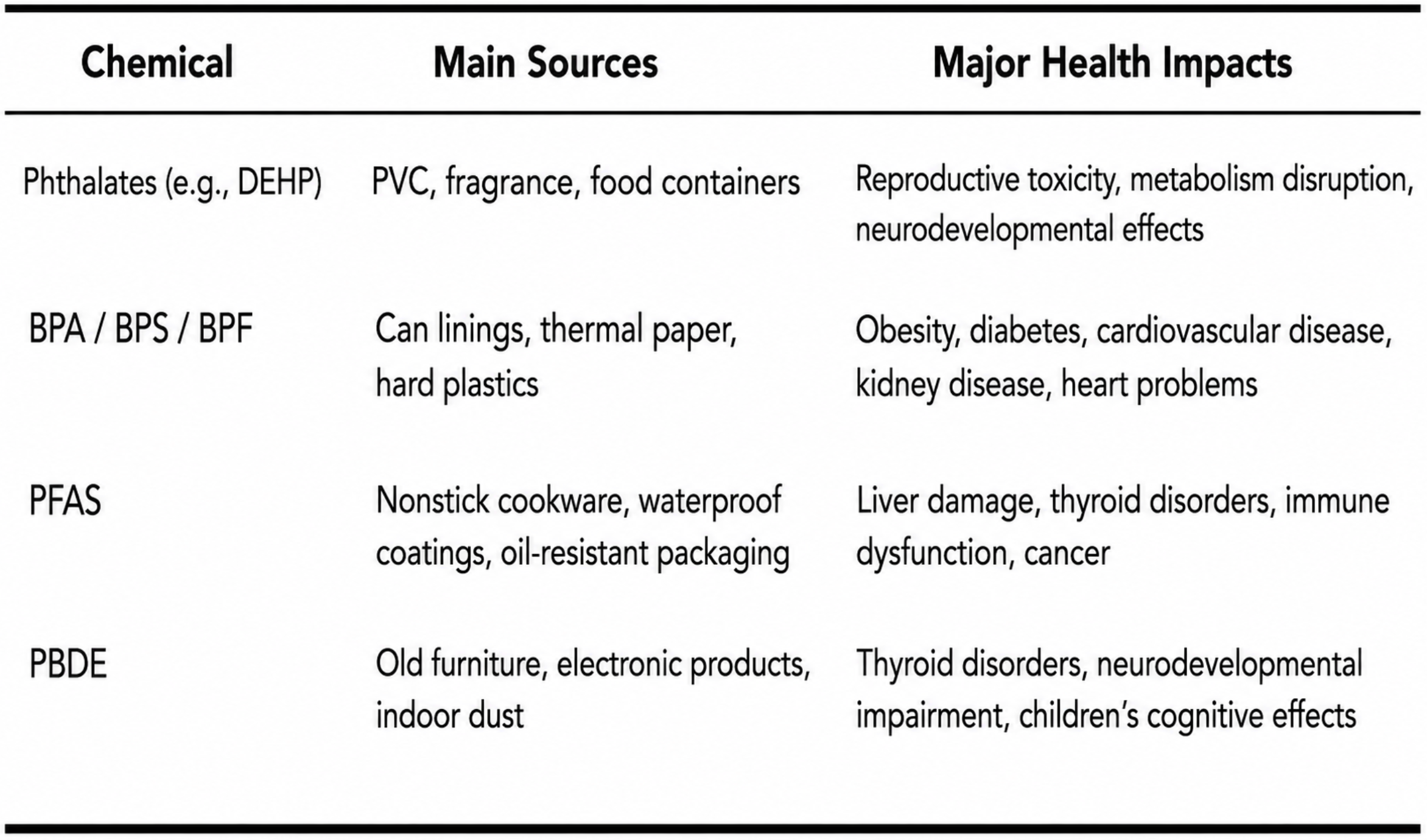
Plastic manufacturing, use, and packaging involve many PACs, including phthalates, bisphenols, PFAS, flame retardants, and more.
Phthalates are plasticizers that make PVC soft. They include a broad family of chemicals, such as DEHP, DBP, and DEP, and can be found in flooring, perfume, shampoo, and takeout food containers. Some phthalates are anti-androgenic compounds and can interfere with the male reproductive system 2, metabolism, and neurodevelopment.
A 2022 study published in Environmental Pollution, based on U.S. NHANES data, estimated that phthalate exposure was associated with 91,000 to 107,000 premature deaths per year among Americans aged 55–64 3. A 2025 global burden model published in eBioMedicine estimated that in 2018, among adults aged 55–64 worldwide, about 356,000 cardiovascular deaths were associated with DEHP exposure, accounting for roughly 13.5% of cardiovascular deaths in that age group 26.
And age 55–64 should have been the core stage of healthspan.
Bisphenols include BPA and its “stand-ins,” BPS and BPF. They make plastics hard and transparent, and can be found in some rigid clear plastic water bottles and the inner linings of cans 4. BPA has weak estrogenic activity 5, and BPA exposure is associated with obesity, type 2 diabetes, and cardiovascular disease 6.
In 2023, the European Food Safety Authority did something that shook the field: it lowered the tolerable daily intake of BPA by 20,000-fold 7.
A crucial reminder: products labeled “BPA-free” are not automatically safe. The substitutes BPS and BPF can have similarly strong endocrine-disrupting activity 8,27.
PFAS are known as “forever chemicals.” Some PFAS compounds have human half-lives as long as 2 to 8 years 9 — once they get in, they are hard to get out 28. Sources include nonstick coatings such as Teflon and other fluorinated coatings, waterproof jackets, and some grease-resistant food packaging papers, including pizza boxes, popcorn bags, and burger wrappers 10. PFAS exposure has been linked to abnormal blood lipids, thyroid dysfunction, immune suppression, kidney cancer, and testicular cancer 11,29,30.
In 2024, the U.S. EPA set limits for PFAS in drinking water — mainly PFOA and PFOS — at 4 ppt 12. That is roughly equivalent to one drop of water diluted into five Olympic swimming pools. A limit that strict tells you something: regulators now treat PFAS as a top-tier threat.
PBDE flame retardants hide in old furniture and old electronics. They mainly enter the body through household dust and can disrupt thyroid function 13. Exposure during pregnancy or childhood is associated with lower neurodevelopmental markers and may reduce children’s IQ 14,31.
When Plastic Becomes Most Dangerous: Heat, Oil, and Time
Plastic does not release chemicals at the same rate all the time. Release depends heavily on environmental conditions.
There are three key triggers: heat, oil, and time.
High temperature significantly accelerates the migration of plasticizers and bisphenols 15. Microwaving leftovers in plastic containers is one of the worst habits. It is not just because of heat. The oil in the food can also “wash out” fat-soluble plasticizers from the packaging 16. That is why hot takeout soup, pizza boxes, and French fry bags are high-exposure scenarios 32.
Long contact time, combined with UV aging and mechanical wear — such as repeatedly reused plastic bottles or scratched nonstick pans — can also increase chemical release.
The Good News: You Can See the Numbers Drop This Week
This is rare in health interventions: make a change today, and within one week you can detect meaningful changes in your body.
A 2026 study published in Nature Medicine, called PERTH, ran a clean and direct experiment: participants followed a 7-day low-plastic diet. The results were striking: urinary BPA fell by 59.7%, MBzP, a phthalate metabolite, fell by 53.5%, and DBP, another phthalate, fell by 37.5%.
In one week 18.
The reverse experiment is even more alarming. A 2011 study published in JAMA asked participants to eat one serving of canned soup every day for five consecutive days. Urinary BPA concentration surged by 1221% 19. The cost of several days of canned soup was a more than tenfold flood of endocrine disruptors into the body.
There is also the HERMOSA study in adolescents: girls replaced their usual skincare and cosmetic products, removing fragrance-containing products with phthalates. In just 3 days, urinary MEP, a phthalate metabolite, dropped by 27% 20.
These data tell us something important: BPA and most phthalates have short half-lives, ranging from hours to days 21. Your current body burden mainly reflects exposure over the past few days. So the right strategy is not some vague “detox.” Your body is already detoxing. The real strategy is to reduce continuous input. Turn off the tap, and the pool drains on its own.
PFAS is the exception. Its half-life is measured in years. So for PFAS, we need a much longer time horizon: the benefits of reducing exposure today may take years to fully show up. The earlier you start, the better.
Reducing intake of plastic-associated chemicals is one of the few health interventions where you can lower exposure quickly and accumulate benefits over time. Start using glass containers for food this week, and your urine biomarkers can already start changing next week.
Summary
Plastic has two layers of harm. The second layer — the attached and released chemicals, including phthalates, bisphenols, PFAS, and PBDEs — is the one with clearer mechanisms and stronger evidence.
Remember the three trigger scenarios: heat, oil, and long contact time.
“BPA-free” does not mean safe. The substitutes BPS and BPF can have similarly strong endocrine-disrupting activity. Reduce contact with all hard plastics and canned foods.
BPA and phthalates have short half-lives. Once you reduce exposure, body levels can drop significantly within a week.
PFAS is the exception. It can remain in the body for years. That is why the earlier you reduce exposure, the better — especially from nonstick cookware and grease-resistant food packaging.
In the next article, we will turn these principles into a concrete action list ranked by ROI, so you know exactly which step is most worth changing first.
Intervention recommendations are geared toward generally healthy individuals. If you have existing health conditions, always follow your doctor’s instructions.
References
[1]Hahladakis JN, Velis CA, Weber R, Iacovidou E, Purnell P. An overview of chemical additives present in plastics: Migration, release, fate and environmental impact during their use, disposal and recycling. J Hazard Mater. 2018 Feb;344:179–199.
[2]Swan SH, Main KM, Liu F, Stewart SL, Kruse RL, Calafat AM, Mao CS, et al.; Study for Future Families Research Team. Decrease in anogenital distance among male infants with prenatal phthalate exposure. Environ Health Perspect. 2005 Aug;113(8):1056–1061.
[3]Trasande L, Liu B, Bao W. Phthalates and attributable mortality: a population-based longitudinal cohort study and cost analysis. Environ Pollut. 2022 Jan 1;292(Pt A):118021.
[4]Geens T, Aerts D, Berthot C, Bourguignon JP, Goeyens L, Lecomte P, Maghuin-Rogister G, Pironnet AM, Pussemier L, Scippo ML, Van Loco J, Covaci A. A review of dietary and non-dietary exposure to bisphenol-A. Food Chem Toxicol. 2012 Oct;50(10):3725–3740.
[5]Krishnan AV, Stathis P, Permuth SF, Tokes L, Feldman D. Bisphenol-A: an estrogenic substance is released from polycarbonate flasks during autoclaving. Endocrinology. 1993 Jun;132(6):2279–2286.
[6]Lang IA, Galloway TS, Scarlett A, Henley WE, Depledge M, Wallace RB, Melzer D. Association of urinary bisphenol A concentration with medical disorders and laboratory abnormalities in adults. JAMA. 2008 Sep;300(11):1303–1310.
[7]EFSA Panel on Food Contact Materials, Enzymes and Processing Aids (CEP); Lambré C, Barat Baviera JM, Bolognesi C, Chesson A, Cocconcelli PS, Crebelli R, et al. Re-evaluation of the risks to public health related to the presence of bisphenol A (BPA) in foodstuffs. EFSA J. 2023 Apr 19;21(4):e06857.
[8]Rochester JR, Bolden AL. Bisphenol S and F: A Systematic Review and Comparison of the Hormonal Activity of Bisphenol A Substitutes. Environ Health Perspect. 2015 Jul;123(7):643–650.
[9]Olsen GW, Burris JM, Ehresman DJ, Froehlich JW, Seacat AM, Butenhoff JL, Zobel LR. Half-life of serum elimination of perfluorooctanesulfonate, perfluorohexanesulfonate, and perfluorooctanoate in retired fluorochemical production workers. Environ Health Perspect. 2007 Sep;115(9):1298–1305.
[10]Glüge J, Scheringer M, Cousins IT, DeWitt JC, Goldenman G, Herzke D, Lohmann R, Ng CA, Trier X, Wang Z. An overview of the uses of per- and polyfluoroalkyl substances (PFAS). Environ Sci Process Impacts. 2020 Dec;22(12):2345–2373.
[11]Fenton SE, Ducatman A, Boobis A, DeWitt JC, Lau C, Ng C, Smith JS, Roberts SM. Per- and Polyfluoroalkyl Substance Toxicity and Human Health Review: Current State of Knowledge and Strategies for Informing Future Research. Environ Toxicol Chem. 2021 Mar;40(3):606–630.
[12]U.S. Environmental Protection Agency. PFAS National Primary Drinking Water Regulation. Fed Regist. 2024 Apr 26;89(82):32532–32757.
[13]Chevrier J, Harley KG, Bradman A, Gharbi M, Sjödin A, Eskenazi B. Polybrominated diphenyl ether (PBDE) flame retardants and thyroid hormone during pregnancy. Environ Health Perspect. 2010 Oct;118(10):1444–1449.
[14]Herbstman JB, Sjödin A, Kurzon M, Lederman SA, Jones RS, Rauh V, et al. Prenatal exposure to PBDEs and neurodevelopment. Environ Health Perspect. 2010 May;118(5):712–719.
[15]Le HH, Carlson EM, Chua JP, Belcher SM. Bisphenol A is released from polycarbonate drinking bottles and mimics the neurotoxic actions of estrogen in developing cerebellar neurons. Toxicol Lett. 2008 Jan;176(2):149–156.
[16]Fasano E, Bono-Blay F, Cirillo T, Montuori P, Lacorte S. Migration of phthalates, alkylphenols, bisphenol A and di(2-ethylhexyl)adipate from food packaging. Food Control. 2012 Sep;27(1):132–138.
[17]Noonan GO, Ackerman LK, Begley TH. Concentration of bisphenol A in highly consumed canned foods on the U.S. market. J Agric Food Chem. 2011 Jul;59(13):7178–7185.
[18]Harray AJ, Lucas AD, Herrmann SE, Vlaskovsky PS, Elagali A, Seewoo BJ, et al.; PERTH Trial Consortium. Low-plastic diet and urinary levels of plastic-associated phthalates and bisphenols: the randomized controlled PERTH Trial. Nat Med. 2026 Apr 21.
[19]Carwile JL, Ye X, Zhou X, Calafat AM, Michels KB. Canned soup consumption and urinary bisphenol A: a randomized crossover trial. JAMA. 2011 Nov;306(20):2218–2220.
[20]Harley KG, Kogut K, Madrigal DS, Cardenas M, Vera IA, Meza-Alfaro G, She J, Gavin Q, Zahedi R, Bradman A, Eskenazi B, Parra KL. Reducing Phthalate, Paraben, and Phenol Exposure from Personal Care Products in Adolescent Girls: Findings from the HERMOSA Intervention Study. Environ Health Perspect. 2016 Oct;124(10):1600–1607.
[21]Völkel W, Colnot T, Csanady GA, Filser JG, Dekant W. Metabolism and kinetics of bisphenol A in humans at low doses following oral administration. Chem Res Toxicol. 2002 Oct;15(10):1281–1287.
[22]Gore AC, Chappell VA, Fenton SE, Flaws JA, Nadal A, Prins GS, Toppari J, Zoeller RT. EDC-2: The Endocrine Society’s Second Scientific Statement on Endocrine-Disrupting Chemicals. Endocr Rev. 2015 Dec;36(6):E1-E150.
[23]Symeonides C, Aromataris E, Mulders Y, Dizon J, Stern C, Barker TH, et al. An umbrella review of meta-analyses evaluating associations between human health and exposure to major classes of plastic-associated chemicals. Ann Glob Health. 2024 Aug 19;90(1):52.
[24]Marfella R, Prattichizzo F, Sardu C, Fulgenzi G, Graciotti L, Spadoni T, et al. Microplastics and nanoplastics in atheromas and cardiovascular events. N Engl J Med. 2024 Mar;390(10):900–910.
[25]Nihart AJ, Garcia MA, El Hayek E, Liu R, Olewine M, Kingston JD, et al. Bioaccumulation of microplastics in decedent human brains. Nat Med. 2025 Feb 3.
[26]Hyman S, Acevedo J, Giannarelli C, et al. Phthalate exposure from plastics and cardiovascular disease: global estimates of attributable mortality and years life lost. eBioMedicine. 2025;116:105730.
[27]Yang CZ, Yaniger SI, Jordan VC, Klein DJ, Bittner GD. Most plastic products release estrogenic chemicals: a potential health problem that can be solved. Environ Health Perspect. 2011 Jul;119(7):989–996.
[28]Li Y, Fletcher T, Mucs D, Scott K, Lindh CH, Tallving P, Jakobsson K. Half-lives of PFOS, PFHxS and PFOA after end of exposure to contaminated drinking water. Occup Environ Med. 2018 Jan;75(1):46–51.
[29]National Academies of Sciences, Engineering, and Medicine. Guidance on PFAS exposure, testing, and clinical follow-up. Washington (DC): National Academies Press; 2022.
[30]Li Y, Fletcher T, Mucs D, Scott K, Lindh CH, Tallving P, Jakobsson K. Half-lives of PFOS, PFHxS and PFOA after end of exposure to contaminated drinking water. Occup Environ Med. 2018 Jan;75(1):46–51.
[31]Lam J, Lanphear BP, Bellinger D, Axelrad DA, McPartland J, Sutton P, Davidson L, Daniels N, Sen S, Woodruff TJ. Developmental PBDE exposure and IQ/ADHD in childhood: a systematic review and meta-analysis. Environ Health Perspect. 2017 Aug 18;125(8):086001.
[32]Lerch M, Fengler R, Mbog G, Nguyen KH, Granby K, Beldì G, et al. What do we know about the migration of PFAS from paper based food contact materials? Food Chem. 2023 Apr 15;403:134411.