We’ve spent several articles breaking down Zone 2, HIIT, and resistance training — building a robust, mitochondria-friendly, metabolism-enhancing framework for exercise.
But what if we asked a simpler, more direct question:
👉 “If I could only do one kind of exercise for longevity, which should I choose?”
The answer may surprise you.
It’s not running. Not cycling. Not swimming.
It’s racket sports — like tennis, badminton, table tennis, squash.
This isn’t the opinion of some fitness influencer — it’s backed by compelling scientific data.
Tennis: The Longevity Champion
A large-scale study published in the British Journal of Sports Medicine tracked over 80,000 adults in England and Scotland for nearly 9 years. It found that:
🧬 People who regularly played racket sports had a 46% lower risk of all-cause mortality (HR=0.53) 1.
An even more striking study came from the Copenhagen City Heart Study, which followed participants for 25 years 2. It reported the following life expectancy gains:
🏆 Tennis: +9.7 years 🏸 Badminton: +6.2 years 🏃 Running: +3.2 years 🚴 Cycling: +3.7 years 🏊 Swimming: +3.4 years
Yes, you read that right — tennis offered the highest longevity benefit among all sports studied.
And this wasn’t a fluke. These results have shown up more than once.
Now, to be clear, both studies were observational cohort studies. They adjusted for multiple variables but couldn’t fully eliminate potential confounding factors like socioeconomic status, lifestyle, or personality traits. So racket sports may not be the best for everyone, but they’re clearly among the best.
Personally, I dabbled in tennis over a decade ago. I wasn’t new to it. But it wasn’t easy to sustain: court access was tricky, finding a partner even harder, and without proper gear or warm-up, injuries came fast. Eventually, life got in the way and the racket gathered dust.
Which left me wondering: Why is it tennis, of all things, that delivers the greatest longevity benefit?
1. My Return to the Racket
My first proper game of tennis was back in 2008. The coach said I had “natural feel,” probably because of my table tennis background when I was younger. For a while, I was hooked — but then came work, travel, and long gaps. The racket sat idle in the closet.
I tried to pick it back up a few times, but tennis isn’t something you can just casually pick up without a similarly skilled partner. Each time, the plan fizzled out.
Then came last year’s Olympics — my family and I were glued to the screen, cheering on athletes. That excitement carried us to a live match: Alcaraz vs. Sinner, an electrifying showdown.
From watching to playing was a natural next step. I stepped back onto the court. The satisfying “pop” of the racket meeting the ball, the rhythm of movement, the mindfulness of being in play — it all came flooding back.
To love a sport is a gift.
And to love a sport that happens to extend your life? That’s a divine bonus.
This time, I’m not letting it slip away.
Today, I want to unpack the hidden superpowers of racket sports — using tennis as our lens.
2. From a Metabolic Lens: Tennis = Dynamic Zone 2 + HIIT
Physiologically, a tennis session looks something like this:
- During rallies (5–15 seconds): Sprints, lunges, explosive stops — heart rate spikes to 90–100% HRmax (Zone 4–5)
- Between rallies (20–30 seconds): Picking up balls, prepping serves — heart rate dips to Zone 2–3
- Changeover breaks (90 seconds): Heart rate drops toward Zone 1, nervous system shifts into recovery
What this means is:
🎾 Average heart rate stays in Zone 2 💥 Peak heart rate frequently touches Zone 4–5
It’s the ideal hybrid of interval and steady-state training.
Rough estimates (varies by individual) for an hour of recreational tennis:
- ~30–40 minutes of Zone 2 aerobic effort
- ~15–20 minutes of Zone 4–5 bursts
In short: 🎯 One tennis session = One HIIT + One Zone 2 workout.
Even casual players might hit higher average intensities than pros, especially due to shorter recovery. But this balance can be modulated — for instance, rallying with a coach or hitting drills instead of competitive play. Either way, the metabolic benefits hold up.
3. Muscle × Bone × Anti-Fall: The Structural Shields of Aging
Tennis isn’t just a cardio sport — it’s full-body functional strength training.
Especially rich in:
- Quick starts & explosive stops
- Asymmetric loading, unilateral movements
- Landing, jumping, twisting, sudden direction shifts
These movements create powerful eccentric loads — where muscles lengthen while contracting. This is the most potent stimulus for bone formation.
Such impact strengthens bones in critical areas: hips, knees, shins, forearms. These are the very regions most vulnerable to falls and fractures as we age 3,4.
And when combined with:
- Balance training
- Reflex development
- Neuromuscular coordination
…it becomes an elite-level fall prevention exercise.
Tennis trains the muscular, skeletal, and neural systems — reducing the long-term risk of injury, disability, or immobility 5,6.
4. Physical × Cognitive × Social: The Three Axes of Prime Life
Tennis isn’t just exercise for the body. It’s training for the brain and fuel for the heart.
🧠 From a neuroscience perspective:
Tennis is an “open skill sport” — you operate in a constantly changing environment. You must observe → decide → act in real time.
Open skill sports = dynamic context, unpredictable outcomes, moment-to-moment adjustments. Examples: tennis, badminton, table tennis, squash, soccer, basketball, volleyball, rugby, boxing.
Closed skill sports = stable environments, pre-programmed, repetitive. Examples: running, swimming, cycling, rowing, weightlifting [7–10].
In tennis, you’re constantly:
- Tracking ball speed, spin, trajectory
- Reading opponent’s position and anticipating their shot
- Adjusting footwork, angles, swing force
This activates:
- Prefrontal cortex (executive function) 11
- Parietal lobe (spatial awareness) 12
- Cerebellum (motor coordination) 13
One study showed: badminton improves attention and executive function more than equivalent running 14.
🎾 Then there’s the social dimension:
The camaraderie of doubles, the high-fives, the laughter after each point —
All this stimulates the oxytocin and dopamine systems. It also fosters enduring social support networks.
And social connection, as many studies show, is an independent predictor of longevity 15.
So one tennis match can:
- Activate your cardiovascular system (metabolic)
- Strengthen your brain (cognitive)
- Uplift your mood and connection (social)
This is the resonance of all three longevity axes — in one joyful game.
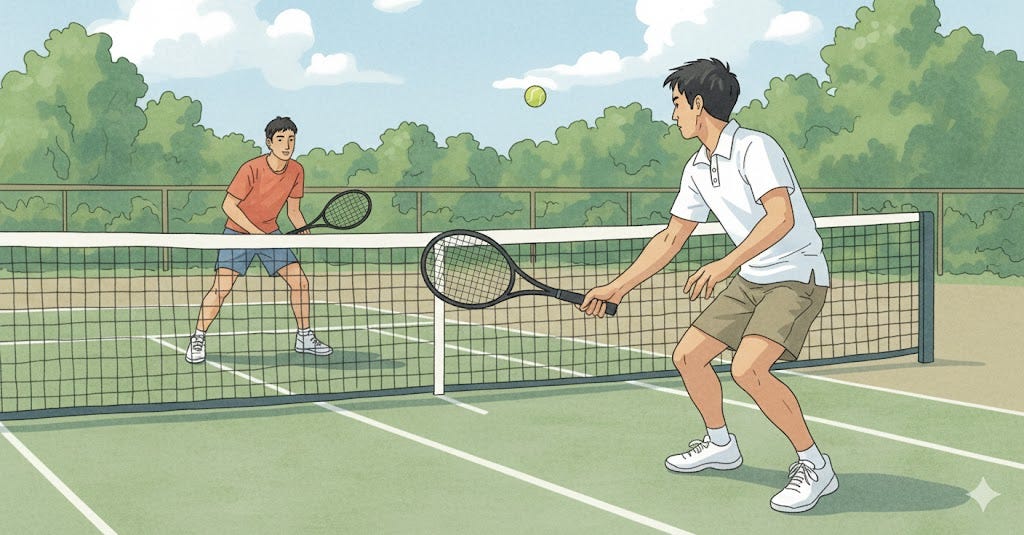
Painted by AI
5. Why You Shouldn’t Play Tennis Every Day
As addictive as it is, tennis isn’t something you should overdo.
Many people report post-game insomnia or next-day hyperactivity. That’s not “feeling great” — that’s your sympathetic nervous system still in overdrive [16–18].
Your body is stuck in fight-or-flight mode.
HRV (Heart Rate Variability) dips, cortisol levels stay high — your system hasn’t begun recovery. In fact, it’s still under stress.
A healthy recovery curve looks like this:
- 0–6 hours post-game: HRV drops
- ~24 hours later: returns to baseline
- 48 hours without recovery: you’re not ready, and further play = overtraining
🧘♀️ The mark of a resilient nervous system is the ability to rise and fall.
Weekly rhythm suggestion for racket sports:
- 1–2 sessions per week is ideal
- Max 3 sessions if you’re passionate (each = HIIT + Zone 2)
- Avoid games within 2–4 hours before bed
- Rehydrate, replenish electrolytes, ice down, sleep early — don’t follow up with a late-night party
6. Injuries Happen — Here’s Your Prevention Guide
Tennis brings high loads and asymmetric movements. Without prep, injuries are common — especially in these zones:
🎯 Rotator cuff & tennis elbow· Cause: unilateral force, overuse, poor form · Fix: strengthen scapular stabilizers + forearm extensors, balance forehand/backhand
🎯 Knees & calf tendons· Cause: hard surface impact, frequent stops, no warm-up · Fix: glute bridges, calf raises, hip abductions; shoes with lateral support
🎯 Lower back & core· Cause: forceful twisting under fatigue, stiff spine · Fix: anti-rotation core drills, thoracic mobility work
If you play long-term, resistance training is non-negotiable. Skipping it means risking injury — and injury disrupts your rhythm and sends you back into sedentary habits.
A Great Match Is a Glimpse of Prime Life
Why do we move our bodies?
To sharpen our minds. To build strength. To connect with others.
And racket sports? They do all three.
They make your lungs stronger, bones denser, blood sugar steadier. They make your mind sharper, reactions quicker, risk of dementia lower. They bring people into your life, elevate your mood, draw you out into the world.
This isn’t just exercise — it’s how life should feel.
And really, that’s the lens I hope you bring to everything I share.
These practices aren’t just tools to live longer — they’re how we live better right now.
So if you’re already playing, keep going. If you once loved it, maybe it’s time to return. And if you’ve never tried, why not start today?
🎾 Racket in hand. Time on your side.
Intervention recommendations are geared toward generally healthy individuals. If you have existing health conditions, always follow your doctor’s instructions.
References
[1]Associations of Specific Types of Sports and Exercise With All-Cause and Cardiovascular-Disease Mortality: A Cohort Study of 80 306 British Adults.Oja P, Kelly P, Pedisic Z, et al.British Journal of Sports Medicine. 2017;51(10):812–817.
[2]Various Leisure-Time Physical Activities Associated With Widely Divergent Life Expectancies: The Copenhagen City Heart Study.Schnohr P, O’Keefe JH, Holtermann A, et al.Mayo Clinic Proceedings. 2018;93(12):1775–1785.
[3]Eccentric Muscle Action Increases Site-Specific Osteogenic Response.Hawkins SA, Schroeder ET, Wiswell RA, et al.Medicine and Science in Sports and Exercise. 1999;31(9):1287–92.
[4]Osteocyte-Mediated Mechanical Response Controls Osteoblast Differentiation and Function.Buck HV, Stains JP.Frontiers in Physiology. 2024;15:1364694.
[5]Effects of Immersive Virtual Reality-Based Tennis Training on Balance in Older Adults.Yue T, Yan X, Lv Y, et al.Gerontology. 2025;:1–19.
[6]Postural Balance in Young Tennis Players of Varied Competition Levels.Srihi S, Jouira G, Ben Waer F, et al.Perceptual and Motor Skills. 2022;129(5):1599–1613.
[7]Cognitive Function of Older Adults Engaging in Physical Activity. Ingold M, Tulliani N, Chan CCH, Liu KPY.BMC Geriatrics. 2020;20(1):229.
[8]Cognitive Benefits of Open-Skill Sports in Childhood: Evidence From the ABCD Study.Shih CH, Broadnax M, Eckner J, Veliz P, Varangis E.Medicine and Science in Sports and Exercise. 2025;57(6):1182–1188.
[9]Effects of Open Versus Closed Skill Exercise on Cognitive Function: A Systematic Review.Gu Q, Zou L, Loprinzi PD, Quan M, Huang T.Frontiers in Psychology. 2019;10:1707.
[10]Open vs. Closed Skill Sports and the Modulation of Inhibitory Control.Wang CH, Chang CC, Liang YM, et al.PloS One. 2013;8(2):e55773.
[11]Lesion Mapping of Cognitive Control and Value-Based Decision Making in the Prefrontal Cortex.Gläscher J, Adolphs R, Damasio H, et al.Proceedings of the National Academy of Sciences of the United States of America. 2012;109(36):14681–6.
[12]Where Is the “Where” in the Brain? A Meta-Analysis of Neuroimaging Studies on Spatial Cognition.Cona G, Scarpazza C.Human Brain Mapping. 2019;40(6):1867–1886.
[13]The Cerebellar Nuclei and Dexterous Limb Movments.Thanawalla AR, Chen AI, Azim E.Neuroscience. 2020;450:168–183.
[14]Takahashi, Shinji, and Philip M. Grove. “Comparison of the Effects of Running and Badminton on Executive Function: A Within-Subjects Design.” PLOS ONE, vol. 14, no. 9, 2019, e0216842.
[15]Holt-Lunstad, Julianne, Timothy B. Smith, and J. Bradley Layton. “Social Relationships and Mortality Risk: A Meta-Analytic Review.” PLOS Medicine, vol. 7, no. 7, 2010, e1000316.
[16]Leota, J., Presby, D.M., Le, F. et al. Dose-response relationship between evening exercise and sleep. Nat Commun 16, 3297 (2025).
[17]Korkutata, A., Korkutata, M. & Lazarus, M. The impact of exercise on sleep and sleep disorders. npj Biol Timing Sleep 2, 5 (2025).
[18]Stanley J, Peake JM, Buchheit M. Cardiac parasympathetic reactivation following exercise: implications for training prescription. Sports Med. 2013 Dec;43(12):1259–77.