In the last article, The Paradox of Protein, I laid out a paradox: while protein brings growth and repair, the overactivation of growth signals may, paradoxically, accelerate aging.
And yet, muscle — the very foundation of vitality and one of the most powerful defenses against aging — depends on high-quality protein and periodic stimulation to grow and stay strong.
This presents a tension.
How can we get the benefits of growth signals only when we need them — and avoid the cost when we don’t?
The answer lies in precision. We want to trigger muscle protein synthesis (MPS) with just the right dose and timing — maximizing efficiency, minimizing waste, and protecting our long-term metabolic health.
At the end of my last piece, I offered a path:
Path 1: “Only stimulate muscle growth when necessary, with targeted high-quality protein. Keep your baseline growth signal low during regular meals.”
In this article, I want to break down exactly how this works — both the science and the strategy.
I. The Four Pillars of Muscle Protein Synthesis
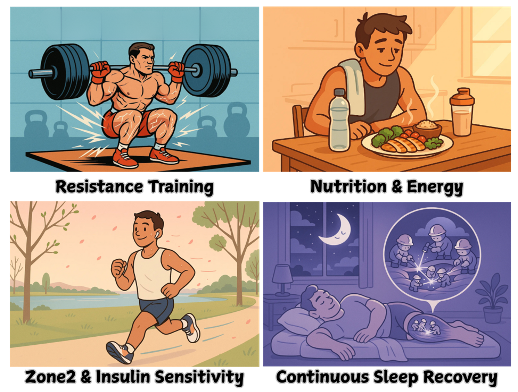
Muscle Protein Synthesis (MPS) is the process that turns dietary protein into muscle. To get the most out of it, you need to align four key drivers:
1. Mechanical Tension: Resistance Training
Nothing stimulates MPS more directly than high-intensity resistance training. Think 6–8 reps per set, 3–4 sets per muscle group, each workout lasting at least 30–40 minutes.
Why? Because strong mechanical tension causes microdamage to muscle fibers, which sends a clear signal to the body: “We need to grow.”
Even high-intensity interval training (HIIT), while not classic resistance training, can generate enough tension to activate MPS when done right.
On the other hand, conventional cardio and Zone 2 aerobic workouts, while great for cardiovascular health and insulin sensitivity, do little to directly trigger MPS. The tension simply isn’t high enough. In fact, under extreme calorie deficits, long aerobic sessions can accelerate muscle breakdown1,2.
In short:
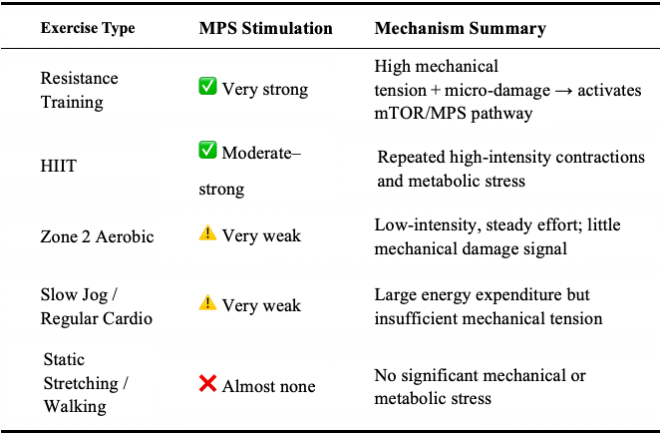
One key detail: After a solid resistance workout, the targeted muscles stay primed for MPS for 48–72 hours. That’s why training each muscle group once every 3–4 days is usually enough3.
2. Fuel & Amino Acids: The Nutritional Switch
The mTOR pathway — the biochemical switch that initiates MPS — can be flipped in three main ways:
- Leucine: This essential amino acid is the ignition key. Roughly 2.5g of leucine (about 25–30g of high-quality protein) is enough to turn the switch on4.
- Cellular Energy: Low energy activates AMPK, which inhibits mTOR. A small carb intake can suppress AMPK, helping mTOR activate5.
- Resistance Training: Heavy lifting can independently trigger mTOR, even if protein intake isn’t perfect — especially in younger individuals with robust metabolic responses.
A few critical clarifications:
- mTOR activation is a short pulse — about 2–3 hours. But the MPS window can stay open for 2–3 days6.
- Leucine has a threshold effect. More isn’t better — once you cross the activation point, the excess gets wasted.
- If you eat protein without training, the metabolic burden rises without meaningful muscle synthesis. Over time, this may even accelerate aging.
Leucine needs also vary by age and condition. Older adults or those who train less intensely may need more leucine — 3 to 3.5g — to get the same effect7. Synergistic support from other essential amino acids, and even gut absorption capacity, also matters.
Bottom line? Don’t flip the mTOR switch randomly. Time it carefully — ideally 2–3 times a day, paired with training or repair windows.
Otherwise, you’re just paying a biological tax: (1) More protein wasted (2) Growth factors upregulated — with no actual growth.
3. Insulin Sensitivity: The Silent Multiplier
Insulin helps shuttle amino acids into muscle and suppresses muscle breakdown (MPB).
That’s why insulin sensitivity matters — especially as we age.
Zone 2 cardio, HIIT, and steady-state aerobic exercise may not activate MPS directly, but they amplify the system by improving hormonal and metabolic conditions over the long term8,9.
4. Deep Sleep: Growth Happens in the Dark
Growth Hormone (GH) release during deep sleep — especially in the first half of the night — also fuels muscle repair, mostly via IGF-1 (Insulin-like Growth Factor 1) signaling.
This is a separate pathway from mTOR, but it’s complementary:
- mTOR: Pulse-driven, relies on nutrients and training
- GH/IGF-1: Smoother, slower, and supports recovery and regeneration during sleep
Hence, quality sleep isn’t just rest — it’s muscle medicine10.
A simple trick: On training nights, have 10–15g of casein protein (like 1–2 Greek yogurts) before bed. Its slow release supports amino acid supply through the night.
Yes, the lactose in yogurt may slightly raise blood glucose — but its insulin response is mild and well worth the muscle-building upside.
As they say: “Muscles don’t grow when you train — they grow when you rest.”
In short —
Train hard to stimulate; Leucine triggers synthesis; Insulin prevents breakdown; Sleep fuels recovery.
Put all four together, and growth happens.
II. The MPS Game Plan
Here is a detailed breakdown of Path 1 strategy from last entry:
- Resistance training every 2–3 days: Keep MPS windows open regularly
- Post-workout within 1–2 hours: 25g whey protein + small carb (e.g., half a banana)
- Daily protein spread across 3 meals: 1.2–1.5g/kg body weight (e.g., 90–105g for 70kg)
- On training nights: 10–15g casein protein before bed (Greek yogurt works great)
There are more advanced methods under study — for example, combining 5:2 intermittent fasting with strategic resistance training (“Weekend Fasting, Weekday Lifting” model). This could balance longevity signals with growth signals — but the execution must be precise and tailored. We’ll explore this in future articles.
III. Metabolic States That Steal Your Muscle
If MPS is your “income,” then MPB (muscle protein breakdown) is your “spending.”
Here’s the problem: MPB never really stops. It’s always nibbling at your gains.
Even at rest and with adequate nutrition, protein undergoes continuous turnover, with a small portion oxidized for energy — typically less than 5% of total energy expenditure (around 2–5%). Under high-protein, low-carb diets at rest, this can rise to 5–10%. In states of stress such as fasting, very low carbohydrate intake, or prolonged endurance exercise, protein may contribute 10–15% of energy — and in extreme cases, up to 20%15,16.
Without enough anabolic signaling, you’re slowly losing muscle — often without noticing.
Here are common traps that accelerate MPB:
- Chronic Inflammation / High Stress → Cortisol spikes promote breakdown, suppress mTOR11
- Poor Sleep → Reduced GH, elevated cortisol12
- Long-term fasting or energy deficit → AMPK up, mTOR down; amino acids burned for energy5
- Sedentary lifestyle → No tension, no MPS; bed rest for 1–2 weeks leads to significant muscle loss13
- Insulin resistance → Less ability to suppress breakdown, muscle loss risk rises14
You can self-check with these 4 questions:
- Did I train today (resistance or HIIT)?
- Did I eat enough high-quality protein (≥1.2–1.5g/kg, well distributed)?
- Is my metabolic state healthy (low stress, good sleep, low sugar)?
- Am I in a calorie deficit (16:8 or 5:2 fasting)?
If 2 or more are negative, it’s time for a muscle-saving intervention: Prioritize protein, reduce stress, add light carbs, do a mini workout.
Here’s a common trap: You eat 100g of protein but stay sedentary all day.
What happens?
- 10–20g goes to basic repair
- The rest gets burned for energy or excreted — burdening liver and kidneys
- Limited mechanical stimulus = weak MPS
- Leucine threshold is met, but wasted
Net result: You thought you were building muscle, but you were just burning expensive fuel.
Glossary
- MPS (Muscle Protein Synthesis): Turning amino acids into new muscle
- MPB (Muscle Protein Breakdown): Breaking down existing muscle
- mTOR: Master regulator of growth, triggered by leucine, energy, and tension
- IGF-1: Growth hormone-induced anabolic signal
- RM (Repetition Maximum): How many reps you can perform at a given weight
- Zone 2 Training: Moderate-intensity aerobic training (60–70% HR max)
- AMPK: Energy sensor that inhibits mTOR when energy is low
- HIIT: Alternating bursts of intense exercise with recovery
- Leucine: The amino acid that flips the mTOR switch
- DIAAS: Protein quality score based on digestible essential amino acids
Intervention recommendations are geared toward generally healthy individuals. If you have existing health conditions, always follow your doctor’s instructions.
References16
[1]Hawley, John A., et al. “Exercise Metabolism and the Molecular Regulation of Skeletal Muscle Adaptation.” Cell Metabolism, vol. 25, no. 2, 2017, pp. 285‑305.
[2]Pillon, Nicolas J., et al. “Transcriptomic Profiling of Skeletal‑Muscle Adaptations to Exercise and Inactivity.” Nature Communications, vol. 11, 2020, Article 470.
[3]Phillips, Stuart M., et al. “Aerobic plus Resistance Exercise in Obese Older Adults Improves Muscle Protein Synthesis.” Cell Metabolism, vol. 29, no. 6, 2019, pp. 1336‑1349.
[4]Wolfson, Rachel L., et al. “Sestrin2 Is a Leucine Sensor for the mTORC1 Pathway.” Science, vol. 351, 2016, pp. 43‑48.
[5]Herzig, Sebastian, and Reuben J. Shaw. “AMPK and TOR: Yin and Yang of Cellular Nutrient Sensing.” Cell Metabolism, vol. 31, 2020, pp. 472‑492.
[6]Wolfson, Rachel L., et al. “Sestrin2 Is a Leucine Sensor for the mTORC1 Pathway.” Science, vol. 351, 2016, pp. 43‑48.
[7]Katsanos, Christos S., et al. “A High Proportion of Leucine Is Required for Optimal Stimulation of Muscle Protein Synthesis in the Elderly.” American Journal of Physiology — Endocrinology & Metabolism, vol. 291, 2006, pp. E381‑E387.
[8]Wolfe, Robert R., et al. “Insulin Regulation of Proteostasis and Clinical Implications.” Cell Metabolism, vol. 27, 2018, pp. 1‑15.
[9]Egan, Brendan, and John A. Hawley. “Exercise Metabolism and Insulin Sensitivity: A Cellular Perspective.” Cell Metabolism, vol. 30, 2019, pp. 539‑556.
[10]Kern, Wolfgang, et al. “Growth Hormone Release and Slow‑Wave Sleep.” Nature Reviews Endocrinology, vol. 18, 2022, pp. 707‑720.
[11]Delivanis, Dimitrios A., et al. “Impact of Hypercortisolism on Skeletal‑Muscle Mass.” Nature Reviews Endocrinology, vol. 24, 2023, pp. 209‑216.
[12]Ikonen, Toby, et al. “Sleep Restriction Impairs Anabolic Signalling in Human Skeletal Muscle.” Nature Communications, vol. 15, 2024, Article 3892.[13]Li, Xiang, et al. “Reduced ATP Turnover during Disuse Accelerates Muscle Loss.” Nature Communications, vol. 15, 2024, Article 55565
[13]Li, Xiang, et al. “Reduced ATP Turnover during Disuse Accelerates Muscle Loss.” Nature Communications, vol. 15, 2024, Article 55565
[14]Zierath, Juleen R., and Anna Krook. “Insulin Resistance: Mechanisms and Consequences.” Nature Reviews Molecular Cell Biology, vol. 22, 2021, pp. 1‑16.
[15]Kazeminasab, Fatemeh et al. “Effects of intermittent fasting combined with physical exercise on cardiometabolic outcomes: systematic review and meta-analysis of clinical studies.” Nutrition reviews vol. 82,12 (2024): 1726–1740.
[16]Mian Li, et al. “Effect of 5:2 Regimens: Energy-Restricted Diet or Low-Volume High-Intensity Interval Training Combined With Resistance Exercise on Glycemic Control and Cardiometabolic Health in Adults With Overweight/Obesity and Type 2 Diabetes: A Three-Arm Randomized Controlled Trial.” Diabetes Care 20 May 2024; 47 (6): 1074–1083.